
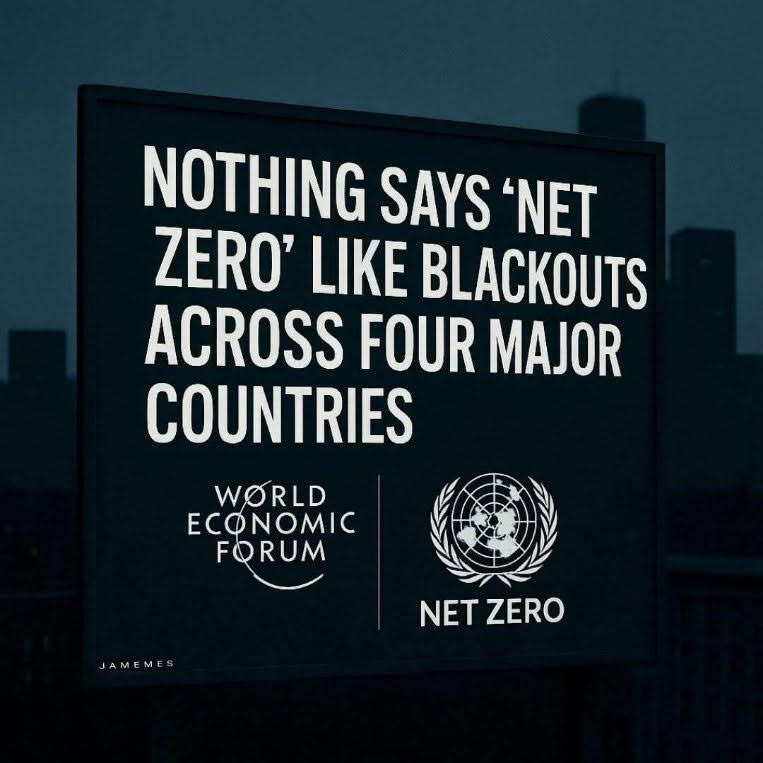
The mother of all blackouts struck the Iberian Peninsula last week – and the lived-reality of the so-called wind and solar transition hit home. For a few days immediately preceding the inevitable calamity, the wind and sun cult were in raptures – Spain claimed to be running on nothing but sunshine and breezes. Then it all turned to mud. With millions powerless across Spain and Portugal, the ideologues were left ranting as they struggled with the limits of electrical engineering, physics and reality.
Which brings us to this week’s roundup.
We start with probably the clearest articulation of what went wrong from The Australian’s Chris Uhlmann.
Spain’s blackout is a flashing warning light for our renewable energy system
The Australian
Chris Uhlmann
1 May 2025
The blackout on the Iberian Peninsula on Monday should keep every Australian energy minister awake at night. In just five seconds, an electricity grid supplying nearly 60 million people collapsed.
Spain in 2025, like South Australia in 2016, is a flashing warning light for the electricity system we’re building around weather-dependent generation.
Rising power bills are already signalling the cost of this transition. Blackouts are the proof of its fragility.
To understand why, keep one iron law in mind: in an electricity system, supply must match demand every second of every day. The moment that balance slips, the system begins to fail.
Electricity flows through the grid at a constant frequency, which is 50 hertz in Australia and Spain. Think of it as a rhythm; the steady beat of a metronome. Every generator and every appliance must stay in time. If a few fall out of sync, the system usually recovers. But if too many do, it’s like a drummer losing tempo in a tightly conducted orchestra. The harmony collapses – and so does the system.
Electricity systems were built around machines that spin big wheels – coal, nuclear, hydro, gas – whose speed sets the frequency of the grid. It is an engineering marvel with a century of experience behind it. These are called synchronous generators. The big wheels inside them, spinning at 3000 revolutions per minute, don’t just produce power. They also help stabilise the system. They keep the rhythm steady and absorb shocks when something goes wrong.
Wind and solar work differently. They generate only when the sun shines or the wind blows, regardless of when power is actually needed. That means supply often peaks when demand doesn’t and can vanish when demand surges. And because they don’t spin large wheels, they can’t directly support the grid’s frequency. Their electricity has to be converted, through inverters, to stay in time with the grid.
But when trouble hits, these inverter-based generators can’t offer the same stabilising force. They can’t ride through shocks.
So what happened in Spain?
At 12.33pm on Monday, local time, Spain’s electricity system was running smoothly. According to Eduardo Prieto, director of services at Red Electrica, the national grid operator, about 18,000 megawatts were coming from solar, 3500MW from wind and 3000MW from nuclear.
Roughly two-thirds of supply came from wind and solar, with just one-third coming from traditional spinning machines.
Then came a sudden loss of generation in the southwest, home to massive solar farms. The system absorbed the first hit. But just 1.5 seconds later, a second drop occurred. Demand surged onto the interconnector with France, which tripped from overload. Spain and Portugal were suddenly cut off from the rest of Europe. The peninsula became an electrical island. Without enough internal synchronous generation, frequency collapsed. Automated protection systems tried to isolate the fault, but the disturbance was too great. Two countries went dark.
In Prieto’s words, it was a sequence of events “incompatible with the survival of an electrical system”.
The grid had died.
Time will tell the full story. But the tale to date eerily echoes a warning made in a 2021 engineering paper by University of Queensland researchers Nicholas Maurer, Stephen Wilson and Archie Chapman. They found that when power systems rely heavily on inverter-based generators such as wind and solar – especially above 70 per cent of total supply – the grid becomes dangerously vulnerable to sudden disturbances. Their simulations, using Australia’s National Electricity Market as a model, showed the system could survive a single failure. But if a second shock followed too quickly, there wasn’t enough time to recover, and the system would collapse.
Sound familiar?
The researchers also tested whether rapid-response tools such as batteries providing “fast-frequency response” could fill the gap left by the loss of big turbines. Their answer was no. Synchronous machines have mass and momentum. They act like shock absorbers. Digital fixes can react quickly, but they only buy milliseconds. They don’t stop a system falling over.
We’ve seen this before – on September 28, 2016 – when South Australia suffered a statewide blackout. As Matthew Warren later wrote for the Australian Energy Council: “The more material issue was the insufficient levels of inertia in the system to slow down frequency changes and enable load shedding … In other words, the SA grid was configured in a way which made it more fragile.”
SA was the canary in the coalmine. Spain is the mine. And Australia is digging a very large hole for itself. The federal government wants 82 per cent of electricity to be generated by weather-dependent sources by 2030. And the more we have, the more fragile the grid will become.
These aren’t teething problems. They are structural flaws in a grid built around high levels of wind and solar without enough synchronous back-up. Coal is closing. Nuclear is banned. We have limited hydro, and gas has been demonised by people who have no idea the grid won’t work without it. A group of six-year-olds with crayons would struggle to design a dumber set of policies.
But it’s worse than that because the costs and risks of this transition are being wilfully ignored, or actively withheld, from the Australian people.
The Albanese government has stopped promising lower power bills because that pledge hasn’t held anywhere wind and solar have been rolled out at scale. In Germany, California, Spain and the UK, the pattern is the same. Because wind and solar can’t match demand, they need a complex and costly life support system the old grid didn’t need. Batteries, gas back-up, pumped hydro and other firming sources cost billions to turn part-time generation into full-time electricity. Add the transmission lines and distribution upgrades to stitch it all together. No one in government knows the final price tag. But know this: you will pay it.
There is no nuclear-powered France to save us. Our interconnectors lead only to other fragile regions. The only true back-up to renewables is 100 per cent firm generation. And don’t believe what federal and state governments say – watch what they do. In NSW and Victoria, deals are being done to keep coal-fired power plants running because politicians know the next closure will result in wholesale prices spiking and grid reliability plummeting.
Spain’s blackout is all the more alarming because, unlike Australia, it still has a solid base of reliable power. About 20 per cent of its electricity comes from nuclear and up to 15 per cent from hydro, depending on rainfall. These sources provide steady, inertia-rich generation that helps stabilise the grid during shocks. We are building a more fragile version of the Spanish system: more solar, more wind, less firming, and no link to a stronger grid.
The purpose of an electricity system is to deliver affordable, reliable power. Politics retooled it to cut emissions. We are engineering failure and calling it progress.
The Australian
The Anonymous Engineer digs a little deeper in this piece, with a focus on the inherent weakness in a system designed around intermittent wind and solar.
Spain and Portugal’s Blackout Reveals the Achilles’ Heel of Electricity Grids Dominated by Wind and Solar
Daily Skeptic
Anonymous Engineer
29 April 2025
James Taylor presents the scorecard on wind and solar, which earn zero points in a head-to-head with gas.
Affordable, Reliable, Clean Scorecard: Natural Gas Is Tops, Wind and Solar Are the Worst
Real Clear Wire
James Taylor
22 April 2025
Jim Lovgren provides a fitting note of Thanksgiving to the US President for killing off a string of threatened economic and environmental disasters and thereby saving America’s Atlantic coast for future generations.
Thank You, Thank You, Thank You, President Trump
Fishery Nation
Jim Lovgren
18 April 2025
Eric Worrall concludes that solar panels are no match for hail, hurricanes, tornadoes and sunset.
Green Delusion: Solar Panels are a “One Off” Investment
Watts Up With That?
Eric Worrall
27 April 2025
Stay tuned, STT will be back next week with more.

 STOP THESE THINGS
Hey, let’s replace our traditional generation with these cheap solar panels and wind turbines.
Okay, but what about the reliability the grid provided?
No problem. We’ll just add a bunch of batteries.
Okay, but won’t that cost more?
Don’t worry, it’ll be okay.
I guess, but what about frequency maintenance?
No problem, we’ll just add a bunch of synthetic inertia.
More cost? What about the distance between generation and demand?
No problem. We’ll just expand the transmission capacity of the grid by 400%.
Hmmm. Wouldn’t it have been better to just keep the thing that works without all these patches? Plus, how in the world could you ever claim it would be cheaper, when it needs all these after market accessories just to work worse than what we already had?
It’s not that simple in Iberia. If you want to know the truth use a translator and read this:
https://www.paginaum.pt/2025/05/01/portugal-continua-a-exportar-grandes-quantidades-de-electricidade-apesar-das-garantias-da-ren
https://www.paginaum.pt/2025/04/29/horas-antes-do-apagao-portugal-andou-a-vender-ao-desbarato-electricidade-a-espanha
https://www.paginaum.pt/2025/04/28/excessiva-dependencia-energetica-de-espanha-causou-blackout-em-portugal
https://www.paginaum.pt/2025/05/03/cupula-da-administracao-da-ren-recebeu-23-milhoes-de-euros-por-ano-desde-2020
https://www.paginaum.pt/2025/05/01/ren-desinveste-na-rede-electrica-portuguesa-e-prefere-apostar-no-chile
We’ve read the articles, none of which address the real engineering issue. The authors discuss power imports and exports, and make an assertion about lack of investment. Complaining about mismanagement of the former is like shuffling deck chairs on the Titanic. Pointless, because once you reach a point where wind and solar dominate the system will fail. As to the latter, we imagine the complaint is insufficient investment in even more solar panels and wind turbines, the very source of the disaster. If the point was spending more on batteries, again, utterly pointless, as any competent engineer will soon tell you. Good luck in dark.
The point is CORRUPTION. Governments are corrupt. Politicians are corrupt and all is a matter of money. Windmills and solar panels are in Portugal the causes of wildfires. Consequences? None whatsoever for sharks. Windmils and solar panels are a complete nightmare for consumers and the environment.
Agreed