
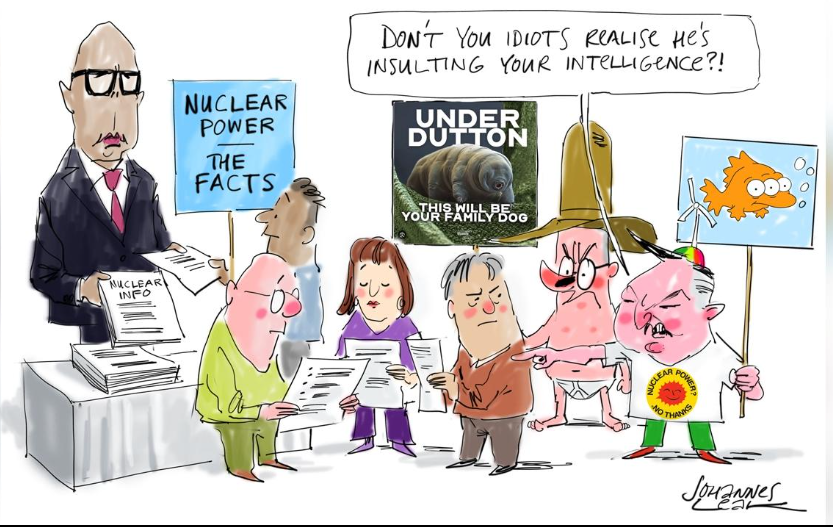
The anti-carbon dioxide squad comes undone the moment they start ranting against nuclear power generation. The only stand-alone power generation system that does not generate CO2 during the process, that delivers power 24 x 365 – irrespective of the weather or time-of-day – with no need for batteries and no need for back up.
The propaganda squad that runs interference for rent-seeking, crony capitalist cashing in on the grand wind and solar scam knows full well that nuclear power is the greatest, single threat faced by their paymasters. Hence the hysteria that follows the mere mention of nuclear power.
In Australia, where nuclear power generation was banned in 1998, the wind and sun cult are in a state of apoplexy, with the Liberal/National Coalition (currently in opposition) setting up a pro-nuclear power generation policy as a headline issue for the coming Federal election.
In a country now suffering the world’s highest power prices and looking forward to load-shedding and mass blackouts this summer, whenever the sun sets and/or calm weather sets in, it’s the smartest policy move that the Coalition has made for decades.
The predictably outraged response from the Green/Labor Alliance demonstrates a level of ignorance that goes beyond mere delusion, as Nick Cater details in the first piece below.
In the second, the team from Jo Nova point out America’s big power users have woken up to the reality that if they want mountains of power around-the-clock, then wind and solar have no hope of delivering it.
Net zero 2050 is an impossible target without clean nuclear
The Australian
Nick Cater
30 September 2024
In October 2006, Anthony Albanese was questioned at a press conference in Canberra about nuclear power. “The idea that we can put action on climate change on hold for 20 years while groups of nuclear reactors are built is simply absurd,” the then shadow minister for the environment said.
With the benefit of 18 years of hindsight, Labor’s politicisation of nuclear power in the final term of the Howard government looks foolish. If our 26th prime minister had taken the nuclear path instead of throwing subsidies at wind and solar, he would look like a visionary nation-building prime minister. Instead, he looks like Kevin Rudd, and Australia has one of the dirtiest electricity grids in the developed world.
The realisation that net zero 2050 is impossible to achieve with renewable energy sources alone has triggered a seismic shift in nuclear sentiment in the past 12 months among policymakers and corporations. The nuclear reawakening has been stimulated by the arrival of energy-gobbling artificial intelligence and the growth of data storage.
Four years ago, Microsoft announced the company would be carbon-negative by the end of the decade, meaning it would remove more carbon from the atmosphere than it emits. Last year, Microsoft announced the company’s carbon emissions had risen to 29 per cent above the 2020 baseline, primarily from constructing data centres and hardware components such as semiconductors, servers and racks.
Microsoft responded by shifting its goal from 100 per cent renewable electricity to “carbon-free electricity”, including nuclear energy. Ten days ago, Microsoft announced a contract to purchase energy from the Unit 1 reactor at Three Mile Island, which is about to be reopened by Constellation Energy.
Three Mile Island’s iconic status in anti-nuclear folklore does not bother Microsoft. Microsoft executive Todd Noe told a conference this month that while intermittent renewable power sources should remain in the mix, “there have to be other sources of firm power … that’s it, in a nutshell … At the end of the day, you have to have electrons coming into the data centre”.
The reopening of Three Mile Island is further evidence of the step change in the momentum towards nuclear energy that began at the COP28 meeting in Dubai last year when 25 countries pledged to work towards tripling global nuclear power capacity by 2050. Last week, a group of 14 financial institutions gathered in New York to declare their support for nuclear investment.
James Schaefer, senior managing director of Guggenheim Securities, said investment in nuclear reactors was “essential given the huge demand coming down the line for data centres and AI technologies”.
President Joe Biden’s climate change adviser, John Podesta, threw the weight of the US federal government behind the move. The US Department of Energy has identified 128 coal-power plants that could house nuclear reactors and 54 sites at atomic power stations that could house up to 94 small modular or large-scale reactors.
The Australian Electricity Market Operator noted the increase in demand for electricity for data centres and processing in last month in its annual Statement of Opportunities report. “The expansion of data centres – specifically with the rise of larger hyperscale facilities – has the potential to be a catalyst for substantial increases in electricity consumption for NSW and Victoria in particular,” it says.
It estimates that data centres will soak up 5 per cent of electricity for heavy industrial use by 2034-35. The figure is little more than a guesstimate and a low one given the rising demand that has already been reported in countries such as the US and Ireland.
Forecasting future electricity consumption is more than an academic exercise since the government’s plans for building more generation and transmission are predicated on AEMO’s forecast that electricity from the grid will rise from 174TWh to 313TWh by 2050. AEMO forecasts that this will require a six-fold increase in grid-scale wind and solar and a 16-fold increase in battery capacity. These targets are challenging, to put it mildly. Yet if electricity demand rises, the problems of scaling up renewable energy and transmission capacity will be insurmountable.
The imperative to generate power that is not just clean, reliable and affordable but also scalable appears not to have been given a moment’s thought by the boffins at AEMO. Yet the implications of the nuclear renaissance abroad are clear for Australia, which, as things stand, will miss out on the potential benefits of a fast-developing technology.
Research into new uses for nuclear technology is accelerating. A gas-graphite reactor under construction at a Dow plant in Texas, for example, is designed to produce steam that can be used to process chemicals and phosphates without producing methane. China uses steam from an AP-1000 nuclear reactor to heat a town, formerly heated with steam from burning coal.
Researchers are also working on nuclear-produced hydrogen that would be cleaner than hydrogen made by splitting methane molecules and could be used as a storage medium.
Meanwhile, the life of existing reactors is extended to up to 80 years, potentially 100. This means a nuclear reactor built in Australia in the 2030s would produce reliable power well into the next century.
It is little wonder that Energy Minister Chris Bowen appears to have exhausted the stockpile of logical arguments against nuclear power. Earlier this year, he conceded in a Radio National interview that safety was no longer a concern. His arguments on cost are not cutting through, given the disconnect between his claim that renewable energy is cheap and rising electricity bills.
His arguments have grown steadily less substantial as he thrashes around like punch-drunk boxer.
In an opinion article in The Land last week, he claimed nuclear power plants would compete with farmers for water licences. Recently, he claimed additional transmission lines would be required from Port Augusta to Adelaide because the existing lines were being used for renewable energy.
Last week in the Australian Financial Review, he argued that the delay in building nuclear reactors would lead to a gas shortfall. This looks like a government that has lost the argument and control of its own destiny.
Bowen is right about one thing: nuclear does take a long time to build, which is all the more reason we need to get cracking.
The Australian
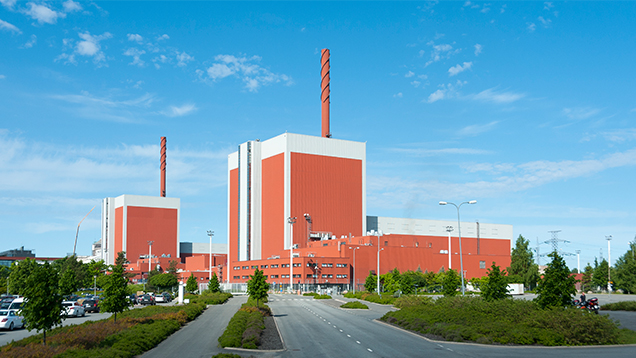
First hint of energy squeeze and Big Tech drops the wind and solar purity, and launches into nuclear power
Jo Nova Blog
Jo Nova
2 October 2024
All those sustainable dreams, gone pfft
Google, Oracle, Microsoft were all raving fans of renewable energy, but all of them have given up trying to reach “net zero” with wind and solar power. In the rush to feed the baby AI gargoyle, instead of lining the streets with wind turbines and battery packs, they’re all suddenly buying, building and talking about nuclear power. For some reason, when running $100 billion dollar data centres, no one seems to want to use random electricity and turn them on and off when the wind stops. Probably because without electricity AI is a dumb rock.
In a sense, AI is a form of energy. The guy with the biggest gigawatts has a head start, and the guy with unreliable generators isn’t in the race.
It’s all turned on a dime. It was only in May that Microsoft was making the “biggest ever renewable energy agreement” in order to power AI and be carbon neutral. Ten minutes later and it’s resurrecting the old Three Mile Island nuclear plant. Lucky Americans don’t blow up their old power plants.
Oracle is building the world’s largest datacentre and wants to power it with three small modular reactors. Amazon Web Services has bought a data centre next to a nuclear plant, and is running job ads for a nuclear engineer. Recently, Alphabet CEO Sundar Pichai, spoke about small modular reactors. The chief of Open AI also happens to chair the boards of two nuclear start-ups.
The AI Boom Is Raising Hopes of a Nuclear Comeback
The AI boom has left technology companies scrambling for low-carbon sources of energy to power their data centers. The International Energy Agency estimates that electricity demand from AI, data centers, and crypto could more than double by 2026. Even its lowball estimates say that the added demand will be equivalent to all the electricity used in Sweden or—in the high-usage case—Germany.
Australia uses ten times as much electricity as Microsoft, but is still fantasizing about reaching 82% renewable by 2030 with no nuclear power “because it will cost too much and take too long”. Microsoft uses 24 TWh of energy a year and employs 220,000 people, and knows it needs a nuclear plant to be competitive (and reach, albeit frivolous weather changing ideals). Australia uses 274 TWh of electricity, and employs 14 million people but is going to aim for frivolous climate witchery anyway, and do it the double-hard way.
Who needs to be competitive, right?
Pierre Gosselin discusses how Germany risks being left behind because it has switched off all its nuclear plants. At least it has some power lines to France. Australia has no nukes, not much hydro, no mountains to spare, is the driest inhabited continent on Earth, and it has no powerlines to anywhere. We are the crash test dummy. Soon most big companies will have more reliable power than we do.
Jo Nova Blog

 STOP THESE THINGS
Climate realists are not worried about warming and CO2 because both promote the growth of crops and green the planet. We tend to reach for our revolvers when we see references to “clean energy” which tacitly endorse the foundational lie that plant food is a pollutant that drives the Climate Change Industrial Complex.
There are two ways to promote nuclear energy in conversation with Greens without using the clean power gambit.
That might not convert them to nuclear power but it will tell them something they need to know.
And how many people did you tell about the Nemwatch widget this week, persuading them to have a look at the wind supply at sunrise and sunset