
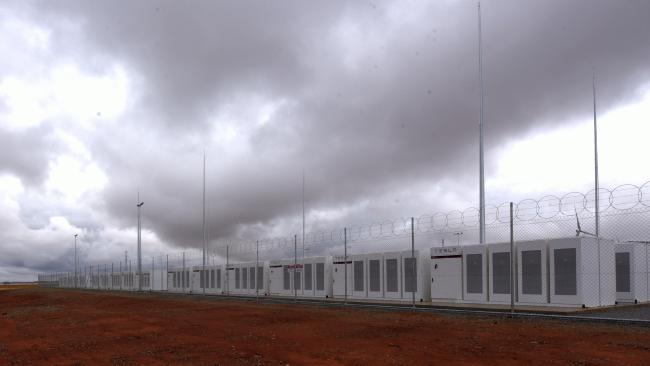
Cornered with wind and solar’s hopeless intermittency, the cult cries “storage”, as some kind of crushing hex against the energy realists ready to tackle their delusional thinking.
The ideologue never lets the facts get in the way of radical, self-destructive policies, especially when it comes to energy.
The application of simple arithmetic is enough to kill off the notion that enormous banks of lithium-ion batteries can overcome the chaotic (and only occasional) production and wind and solar deliver us to our glorious wind and sun powered utopian future.
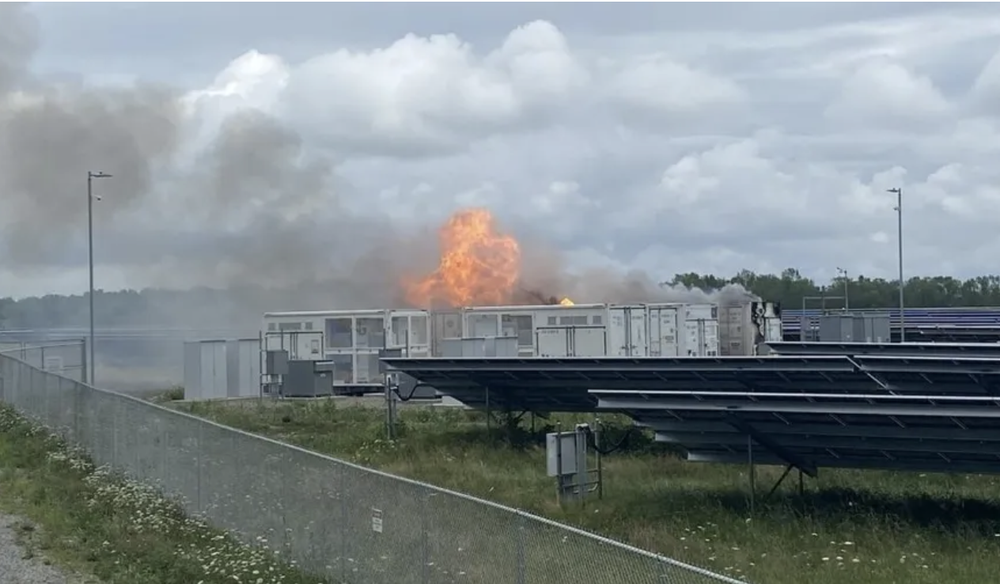
Countless $billions have already been thrown at giant batteries around the world, and – when they’re not bursting into impossible-to-extinguish toxic fireballs – their total contribution to the World’s energy supply remains positively risible – little better than a rounding error.
It’s a point picked up by Joshua Antonini in his response to a Wall Street Journal reader wedded to the idea that mega-batteries will fix it all, in a jiffy.
Better batteries won’t save the energy grid
Mackinac Centre Blog
Joshua Antonini
28 August 2024
A reader took the time to send a respectful response to the recent Wall Street Journal op-ed in which Jason Hayes and I discussed our new report on the threat to grid reliability in seven Great Lakes states.
This reader wrote:
You raise some interesting points. One clear solution is more storage. Renewable sources such as wind and solar often produce peak power at the wrong time of the day. Storage choices will expand over the next five to ten years and the cost will decline.
Another part of the mix should be small scale nuclear which is much safer and more sophisticated than the old nuclear plants of Three Mile Island or Fukushima days. Bill Gates’ Terrapower plant in Wyoming, which is on the site of an old coal-fired generation plant and employs some of the same workers, is an interesting model.
I saw a report that gas at the wellhead in parts of Texas has been reported to be selling for negative prices as oil producers are paying to have it piped away. This does argue for keeping some natural gas-fired power stations if the gas can be moved to them economically.
These are reasonable points to bring up, and we appreciate the thoughtful feedback. So here are some additional thoughts:
When it comes to utility-scale battery storage, unfortunately, doing so at scale encounters prohibitively high prices due in no small part to the inefficiency of the batteries and the relative scarcity of the minerals needed for the batteries. While it is true that the market works to improve prices and options, the fundamental issues of utility-scale storage remain: They store far too little at far too high a cost.
Energy analysis group Doomberg finds that battery storage is improving, but at a pace far below what we need:
According to projections from industrial research firm Wood Mackenzie, the US is set to add 191.6 gigawatt hours (GWh) of battery backup systems across residential, non-residential, and grid-scale installations between 2022 and 2026. This sounds impressive until you realize the US produced 4,116,000 GWh of electricity on the grid in 2021 alone. By our math, the Wood Mackenzie projection amounts to a grand total of 24 minutes of total backup capacity added to the system over the quoted five-year period. (Emphases in original.)
In addition, these batteries use critical minerals whose reliable extraction is increasingly costly and difficult. A report from the International Energy Agency (an organization very clear in its support of net zero) admits that “mineral demand for use in EVs and battery storage is a major force [of mineral demand increases], growing at least thirty times to 2040”
“A utility-scale storage system sufficient for [a] 100-MW wind farm would entail using at least 10,000 tons of Tesla-class batteries,” according to a report from the Manhattan Institute. In another report, the Manhattan Institute notes, “Barely two hours of national electricity demand can be stored in all utility-scale batteries plus all batteries in one million electric cars in America.” (Emphasis in original.)
Weather conditions in 2023 reduced wind generation to less than 1% of its capacity on June 6th that year, a representative from Southwest Power Pool, the electric grid operator for the Great Plains region, told a U.S. House Subcommittee. The wind turbines in that grid are rated to generate up to 32,000 megawatts of electricity but produced only 110 megawatts – that is, wind production fell to about one-third of 1% of its capacity. (He talks about this at a little after the 35-minute mark on the video.) German utilities have experienced this frequently in their leap to wind and solar, calling it “dunkelflaute.”
When this happens, to my knowledge, no battery system in existence has ever provided enough electricity to meet demand throughout the night. Despite all that we’ve built, battery backup lasts a matter of minutes, not the entire night. The battery backup lasts just long enough for natural gas plants to turn on and meet the supply that weather-dependent generation didn’t meet.
Battery storage is improving over time, but it would require a quantum leap to become genuinely viable in meeting current demand, let alone the demand of a growing economy.
On the point of nuclear energy, we are most certainly in agreement. Small modular reactors are promising developments, but traditional fission plants often get a far worse reputation than is fair.
“There were no acute radiation injuries or deaths among the workers or the public due to exposure to radiation resulting from the incident,” wrote the World Health Organization in its Fukushima report. Had the Fukushima plant’s backup generators not been built in at-risk, low-lying areas (which some scientists at the time opposed), there would never have even been a meltdown.
Nuclear plants have been providing France with a majority of its power for decades — cleanly, reliably, cheaply, and with no disasters to speak of. The country is the world’s largest net exporter of electricity.
On natural gas, as well, we agree. No serious plans for America’s energy future can exclude natural gas. It can ramp up quickly to meet surprise demand, it is energy-dense, it emits less carbon, and it is widely available at low prices. Natural gas is harder to transport than coal and vulnerable to supply chain issues, but policy changes can ameliorate these problems. The cost-benefit analysis shows natural gas to be a cornerstone of a reliable energy portfolio.
Even major innovations in batter technology would do little to mitigate the change to unreliable energy sources. The push to wind and solar is a shift from cheap, reliable, and energy-dense forms of power generation to subsidized, weather-dependent, less efficient forms of generation.
Wind and solar do not work as advertised by politicians, bureaucrats, and activists. The replacement of traditional thermal generation with less-dense, less-reliable energy is driven not by market demand or technological reality but by orders from capitol buildings around the country.
We get effectively nothing from this transition. The supply chains for wind and solar are dominated by China and other unfriendly nations. If the United States were able to achieve 100% renewable electricity generation and ban fossil fuels entirely, that would, using the IPCC’s own MAGICC modeling, lower global average temperatures by nine-tenths of one tenth of one degree Celsius in 2100. The cost-benefit analysis shows we would end up crippling our grid for nothing.
I hope that you find this information helpful and convincing. Jason Hayes and I discuss the topic further in the report mentioned in the Wall Street Journal op-ed. Thank you for your response as well as for your time and attention.
Mackinac Centre Blog
 STOP THESE THINGS
“One of the saddest lessons of history is this: If we’ve been bamboozled long enough, we tend to reject any evidence of the bamboozle. We’re no longer interested in finding out the truth. The bamboozle has captured us. It’s simply too painful to acknowledge, even to ourselves, that we’ve been taken. Once you give a charlatan power over you, you almost never get it back.”
― Carl Sagan
No injuries, illnesses, or deaths from Three Mile Island.
Storage requirements are not overnight; more like forty days and forty nights. http://vandyke.mynetgear.com/Worse.html
Batteries to provide firm power in USA alone would require more copper, nickel, and cobalt than are known to exist.
Details in my book “Where Will We Get Our Energy?” A comprehensive end-to-end life-cycle system-engineering analysis of the entire energy landscape. Everything quantified. No vague handwaving. 350 bibliographic citations so you can verify that I didn’t just make up stuff.
Faith Based Grid: “The wind is always blowing somewhere.”
Fantasy Based Grid: “Batteries* will compensate for the inherent unreliable natures of wind and solar generation.”
Or substitute any number of other grid fantasies such as micro grid or macro grid management, “efficiency”, transmission build-out, etc.
I have just spoken with the neighbour of a BESS. She said it and the colocated substation have gone quiet in the last couple of months and wondered if it’s doing much, if anything? Perhaps STT could have a look at this some time? They are close to a crematorium and cemetery (and the System Operator HQ) but I don’t think that’s got anything to do with it (Lisnabreeny Road, Belfast).