

The wind and solar ‘industries’ profit from two tier environmental regulation. Where a gas or coal project gets knocked out of the park over a speckled banjo frog or a sea snake, the deliberate slaughter of rare and iconic creatures to make way for wind turbines or solar panels rarely raises an eyebrow with those pushing the grand wind and solar transition. Hypocrisy doesn’t really cover it. It’s way worse than that.
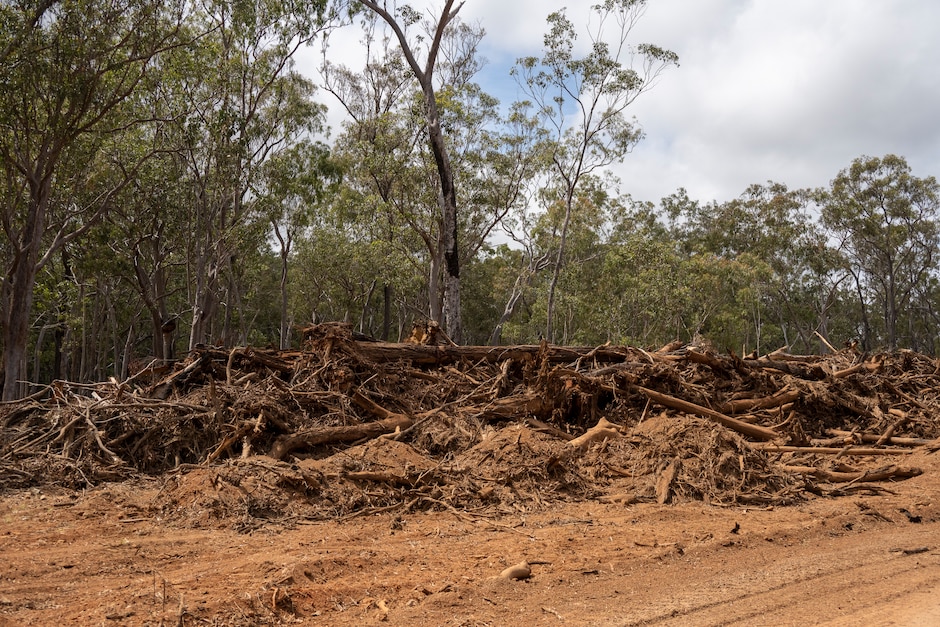
Across Australia’s Great Dividing Range – which runs like a spine down the east coast of the country, from Far North Queensland, across NSW and into Victoria – bulldozers, chainsaws and woodchippers are making short work of once pristine natural environments. Environments that, up to now, have been safe refuge for fluffy icons like the koala and a whole range of rare and endangered creatures.
In Australia, the largely foreign owned wind industry treats the koala as yet another expendable critter – just like whales, dolphins, eagles, hawks, bats and more.
Smashing up eucalypts with bulldozers as they clear a path for hundreds of these things across hills and mountain ranges, not only leaves koalas homeless, plenty get killed or maimed in the process.
Those that don’t die instantly are simply being clubbed to death by those in charge of building Australia’s wind-powered future, and are doing so with the full support of Australia’s Federal Government.
Its Labor Minister for ‘Destroying the Environment to Help Her Mates Profiting from the Wind and Solar Scam’, Tanya Plibersek has taken the cult’s hypocrisy to unprecedented levels, by ‘green’ lighting another environmental outrage, as Nick Cater details below.
Conservation groups fall silent as renewable chimera wreaks havoc
The Australian
Nick Cater
22 September 2024
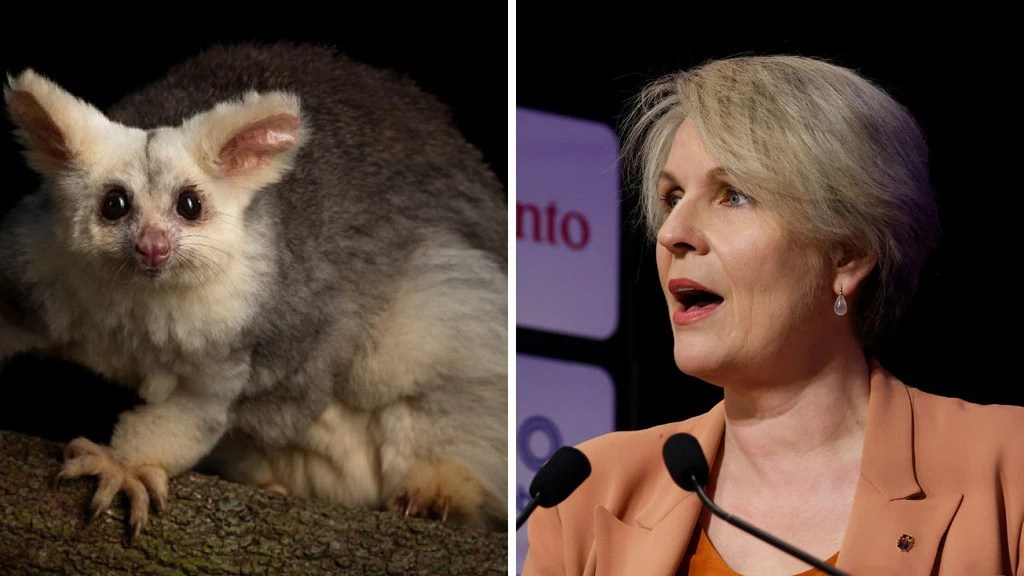
The greater glider is in pole position to win the Marsupial of the Year contest. Australia’s largest gliding possum has pushed the much-fancied koala into second place in the latest rankings. Fittingly, the winner of the battle, between creatures struggling for survival, will be announced next week on Channel 10’s The Project, a show that has been hovering on the brink of extinction for some time.
The Australian Conservation Foundation has been drumming up support for the panda-eyed eucalypt munchers with their teddy bear ears. “If smooth gliding, extra fluffy fur and smelly conversations are your thing, vote for the greater glider!” it urges on its website. It claims the greater glider population has halved in the past two decades because of bushfires and logging.
This makes it odd, to say the least, that the ACF is not raising a stink about Lotus Creek, where 310 hectares of old-growth forest are about to be bulldozed to make room for wind turbines. The Lotus Creek Wind Farm is 100 per cent funded by the Queensland government and is supported by the commonwealth. The environmental cost of the project in the Connors Range, adjacent to the Glencoe State Forest, is well documented.
Researchers counted 138 greater gliders during their environmental assessment. The old-growth trees provide hollow dens for the creatures to rest during the day. The area offers a rich habitat for koalas and squatter pigeons and is a refuge for the powerful owl and white-throated needletail, all classified as vulnerable.
An ecological assessment report listing five Matters of National Environmental Significance, under the Environment Protection and Biodiversity Conservation Act, was placed on Tanya Plibersek’s desk shortly after she became Environment Minister in 2022.
It gave Plibersek strong grounds to block the project as her Coalition predecessor, Sussan Ley, had done. Yet Plibersek overturned Ley’s decision and sanctioned the destruction of remnant bushland on the Great Dividing Range that was virtually untouched by farming.
The ACF has not raised an eyebrow about the Lotus Creek atrocity. Neither has it lodged an objection to Twiggy Forrest’s Upper Burdekin wind turbine development that received Plibersek’s rubber stamp in June. Ditto French giant Neoen’s plans for Mount Hopeful 65km west of Gladstone, approved by Plibersek in April, and the Boulder Creek Wind Farm she approved in June 2022, in which the Queensland state government has a 50 per cent stake.
Wind turbine developments also threaten to destroy greater glider and koala habitat at Mt Fox north of Ingham, Moah Creek and Boulder Creek to the west of Rockhampton. The Queensland government has approved all three, and Plibersek’s signature is regarded as little more than a formality.
The gulf between Plibersek’s actions and words is wide enough to be viewed from outer space. On Friday, Plibersek announced the government would co-host the Global Nature Positive Summit next month in Gadigal Country, or Sydney, as it was once known. “Australia can be a global leader in protecting and restoring nature and stopping biodiversity loss,” she said.
Yet our nature-positive Environment Minister has sanctioned the destruction of at least 1260ha of greater glider habit in old-growth forests in Queensland, while supine environmental bodies such as the ACF, Greenpeace and the Wilderness Society urge the government to roll out renewables faster.
The three activist organisations, with a combined income of more than $58m at their disposal last year, are staunch advocates of renewable energy and are strongly opposed to nuclear. None has been prepared to question the cumulative environmental damage of land-hungry wind, solar and pumped hydro schemes. They have shown little compassion for scores of rural communities with uglification forced upon them by pious city-based bureaucrats drawing lines on maps.
A decree by the European Union to ban imports of beef contaminated by deforestation has gifted the laptop activists another chance to beat up on regional Australia. The ACF is running a slippery campaign of moral equivalence to portray tightly regulated rotational clearance of woody growth on well-managed Australian farms with illegal tree-felling by cattle ranchers in the Amazon Basin. The activists want to change the definition of “old growth” to anything older than 15 years. If beef farmers become collateral damage in the EU’s virtue-signalling campaign, so be it. To them, anything that hastens the glorious vegan revolution must be good.
The Save Our Big Backyard campaign raises the green left to a new level of unsteady, barefaced hypocrisy. There is ample evidence to show that the biggest threat to the sanctity of our native vegetation and wildlife comes from wind and solar farmers, not the cattle industry. Vast hectares of land that have survived more than 200 years of settlement farming are being sacrificed for the sake of the planet.
Future generations will look back at these people with disdain. They will gaze at scarred hillsides where dynamite was used to build access roads and clear the ground for vast concrete pads as big as a football field to erect giant wind turbines that will have long since been removed.
They will wonder how on Earth an affluent, sophisticated, environmentally conscious nation could sanction such things. Future anthropologists will write textbooks about the religious fervour that led early-21st-century humans to believe they could harvest energy directly from the wind and sun. They will be puzzled as to why they didn’t adopt nuclear technology, just as cultural historians of Mesoamerica are curious why the Aztecs never invented the wheel.
There are signs we may be reaching peak madness, as opposition to cowboy renewable energy developers grows in regional and rural Australia, and people in the city begin to latch on. The backlash is particularly noticeable in Queensland, where the Labor government appears to have given up hope of retaining any seat north of Sandgate. Anger at the rampant spread of solar, wind and transmission development proposals has galvanised communities into action. Anti-renewable billboards funded by small donations have begun to appear along the Bruce Highway south of Gympie.
Premier Steven Miles took to Instagram last week, posting an unflattering video of himself endorsing the bilby as his nomination for Marsupial of the Year. The recovery in numbers of the burrowing big-eared critter makes it one of conservation’s success stories. Miles, on the other hand, is heading the way of the dodo.
The Australian
 STOP THESE THINGS
“We know that they are lying. They know that they are lying. They even know that we know that they are lying. But they’re still lying.”
— Aleksander Solzhenitsyn
“What we said yesterday was for the benefit of the party. What we say today is for the benefit of the party.”
— Vladimir Ilyich Lenin
My brother did some etymological research on the word “vegan.” He discovered it’s an ancient Choctaw (native American) word for “crappy hunter.”
310 hectares of old growth forest is 1.2 square miles. The projects at Chevelon Canyon in Arizona south of I-40 and old Route 66 is in vast open spaces mostly devoid of trees and covering over 100 square miles. West of the canyon has many turbines erected. East is mostly still in planning but is approved. There are Apache and Navajo Indian Tribal lands nearby and abutting. Tribes approve and the Navajo have vast holdings of mineral rights and now predominantly ships it’s coal to China. The state closed the coal power plant there that provided many solid jobs and worked not occasionally as wind and solar does in handicapped fashion, it worked 24/7 efficiently and robustly supplying energy. The project is ruining the visual tranquility of the region.
https://www.onlineconverter.com/area
https://stopchevelonbuttewind.com/
To compound the problem Regional Australia, from Cape York to Southern Tasmania to Streaky Bay SA, are being covered in a spray of:
1. Hundreds of millions of tightly packed, electrified solar panels, with highly inflammable Battery Energy Storage Systems (BESS’s) and electrical equipment.
2. Along with thousands of electrified wind turbines on 280m towers (out of the reach of firefighters). The wind turbines on 280m towers are being placed on inaccessible mountain ranges, where they will be subject to numerous lightning strikes.
3. As well as hundreds of electrified BESS’s across rural, city and domestic situations.
4. Joined together by thousands of kilometers of H V Transmission Lines. (Which have been the cause of major bushfires in the past).
ALL THESE RENEWABLE ITEMS ARE HIGHLY ELECTRIFIED AND AT RISK OF IGNITION IF THERE IS A FAULT. ALL HAVE THE POTENTIAL TO BECOME INCENDIARY DEVICES. IN SUMMER THIS POTENTIAL WILL TURN REGIONAL AUSTRALIA INTO A HIGHLY INCENDIARY AREA PARTICULARLY ON TOTAL FIRE BAN DAYS., THAT IS LIKELY TO HAVE HUGE BUSH FIRES BREAK OUT REGULARLY AND AT RANDOM.
THESE BUSHFIRES WILL CAUSE SERIOUS DISRUPTION TO THE ELECTRICITY GRID. AND ON A HUMAN LEVEL SERIOUSLY ENDANGER EVERY RESIDENT LIVING IN THE AREA, WILL DISCOURAGE TOURISTS AND PEOPLE FROM TRAVELING TO AND THROUGH THE AREA
THIS IS WHY THE TRANSITION TO UNRELIABLES’ MUST BE STOPPED NOW.