
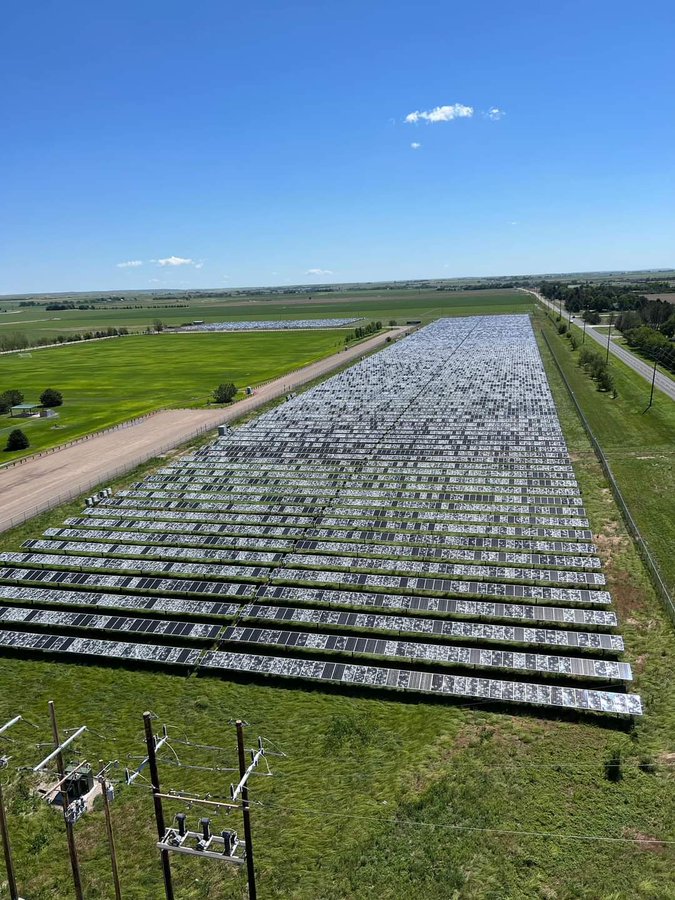
Solar panels deliver power for around 6 hours a day, struggle during wet/cloudy weather and a decent hailstorm or hurricane wipes them out completely.
Anyone recommending solar power as a solution to our growing need for electrical energy needs their head read.
Certain parts of the world suffer regular, violent hailstorms, where hailstones outsize golf balls and sometimes match the, even larger, cricket ball.
That a little ice from the heavens can destroy millions of dollars’ worth of solar panels in a matter of minutes ought to be a matter of serious concern for those in charge of a power grid, where solar increasingly dominates for a few hours either side of midday.
There is, of course, a solution: new-age nuclear. As this Sky News interview with Dr Adi Paterson makes plain.
The ‘next big hailstorm’ will destroy solar panels and the ‘lights will go out’
Sky News Australia
Adi Paterson
23 June 2024
Former ANSTO Chief Executive Dr Adi Paterson says the next “big hailstorm” will result in Australia losing “500 megawatts” of power.
Opposition Leader Peter Dutton announced the Coalition’s nuclear policy last week, including the seven proposed sites for the nuclear reactors.
“My fear for the Sydney basin is what I call the big hailstorm,” Dr Paterson said.
“When the big hailstorm comes, and a big hailstorm will come in the next 20 years, we will lose 500 megawatts of power in the Sydney Basin which is keeping the lights on.
“That is AEMO’s plan.
“This hail will smash the panels on our roofs, and the lights will go out.”
Transcript
Rowan Dean: A former CEO of ANSTO, Dr. Adi Paterson, great to have you here, Adi. You did a cracker of an interview on the ABC during the week. You ran Lucas Heights for a while. You’re a world renowned nuclear expert. The ABC was a fantastic interview because you completely blew them out of the water. They didn’t know where to look or what to do, and we’re desperate to get you off and it’s quite difficult to now find that particular interview on the ABC site. What a surprise. Now let’s get stuck into it. Why should Australia, in your opinion, be a nuclear power?
Dr Adi Paterson: I think we can’t afford not to be a nuclear power. I think the big challenge we are now facing, which is depressing to me, is that we are in a massive thought bubble about how we can get electrons from solar panels and wind turbines, both of which I worked on in the 1990s and the early 2000s, and came to the conclusion that they would not work. Everybody thinks that solar panels are new.
The first solar panel revolution happened 20 years ago and it failed. But my fear for the Sydney Basin is what I call the big hailstorm. What we don’t know, that is already we’re facing solar panel risk. If we get a mega hailstorm across the Sydney Basin, we will lose a power, literally a power plant. We used to build big plants out in the bush. Our power plant now given to us by AEMO is the rooftops of Sydney.
When the big hailstorm comes and a big hailstorm will come in the next 20 years, we will lose 500 megawatts of power in the Sydney Basin, which is keeping the lights on, and that is AEMO’s plan because these hail will smash the panels on our roofs and the lights will go out. That’s the plan. Build bigger solar panels out in the bush where they also have hailstorms. I don’t think anybody’s done the risk management or the control or the thought about what this will mean for us.
The same for wind turbines. Wind turbines might last for about 20 years. The big wind turbines are now seven megawatts. That is a massive machine. In the Sydney Basin, they work 37% of the time, summarising two days out of every five. Everybody says to me, “Adi, but the wind’s always blowing somewhere.” No, it’s not. It’s highly correlated across Eastern Australia.
Now, if somebody said to you, “I’m going to give you a car, it’s really wonderful. It’s completely green, but you can only use it two days out of five.” What would you say? “Probably not.” I’m going to give you a really wonderful solar car, but you work in an emergency room at a hospital or you run the sewage plants or you have to get to the airport to bring the aircraft after dark. I’m afraid you can’t use this car if it’s not charged up after dark.
We are building a world where solar panels, wind turbines, which are flaky resources, Germany has already failed and is deindustrializing. I think it’s possible that BMW will move out of Germany in the next five years because Munich now is a little bubble of failed plans, which is the AEMO plan.
My own view is that AEMO should be completely restructured. It should be brought back into the real world, not Animal Farm. Animal Farm where frankly, I think Animal Farm is a little bit kind to the AEMO paradigm at the moment. Really what I’m saying with humour is that I’m deeply worried. I think the Australia that we love is on the edge of a cliff. I think that we have got a thought bubble in an Animal Farm in Canberra and AEMO, and I think we are in big trouble.
Rita Panahi: And we’re not looking at the overseas experience. We’re not looking at Germany, for example, and we keep hearing this mantra from the renewables, not just the renewable sector, but also most of our politicians, that nuclear is the most expensive form of energy, and then we had that CSIRO GenCost report come out saying the same thing. Nuclear is going to be far more expensive than renewables. What’s your response to that?
Dr Adi Paterson: The GenCost report looks at one reactor, which is being built in Finland. It’s a gigawatt scale. That’s a thousand megawatts. I’m not proposing that we build, and I haven’t proposed that we build gigawatt scale reactors in Australia for the last two years, but people are not listening. I think we should be building reactors at the scale of a large wind turbine.
There are reactors being built in the world today that are five megawatt reactors. I’ve just told you that a big wind turbine is seven megawatts. Now what are you going to choose? A five megawatt reactor or a seven megawatt wind turbine. One that’s going to be on all the time that connected into the grid that you’ve already got. It’s very close to an existing power source. It’s got a safety case, which is the container on the pad.
You don’t need a 10 kilometre safety zone. These are already licenced. In Idaho, they’re building one of these things. Bill Gates is building a molten salt reactor in Wyoming. These are actual real projects that are being built now.
The great thing about them is that we already have a supply chain in Australia because these reactors are smaller than the OPAL reactor, which has a 20 megawatt core. We’ve already approved that in Australia, so I think we’ve got to move away from the gigawatts and fear and move to the megawatts and-
Rowan Dean: And you’ve called the GenCost report a con. GenCon.
Dr Adi Paterson: I call it GenCon report. It’s worse than that. It is actually a form of fascism. It is put together by an economist with a master’s degree and a person who is a proponent of wave power. It’s not the CSIRO report. It’s 10 spreadsheets which are sold to the Australian public as if it’s mandated by somebody who can spell nuclear. It has not a single ounce of credibility. I believe that we could have a new report.
In fact, I was talking to one of my colleagues that we’re going to start a little start up to do this, to take out the GenCon narrative and to create reports for a municipality level, for each municipality, of what nuclear could do for you with these smaller plants that I’m talking about. Some of these plants could literally be in our backyard within five to seven years. That’s the build time. It’s about the same duration as a wind turbine project, a big wind turbine project takes. We just have to change the paradigm. We lift the ban, we take the power away from the central government and we give it back to state governments.
Rowan Dean: James?
James Morrow: Adi, just quickly, the UAE, they’ve got lots of sun as we do, but they’ve introduced nuclear. What’s happened to the price of electricity since they’ve gone nuclear?
Dr Adi Paterson: Well, first of all, it’s become much better quality so you can keep your industry going. And the other great thing about it is that they’ve really solved the problem of all the gas and other plants they were using. Now, they built big ones because they had a big problem, but the people in other communities are building small ones, so the UAE actually built big plants, first one, seven years, second one, five years. It’s just wrong to suggest that it takes too long and costs too much. What costs too much is not being strategic. Nuclear is complicated, but hey, we can deal with complexity. We are Australia.
Rowan Dean: And you reckon the cost will come down with nuclear energy in this country?
Dr Adi Paterson: I’m absolutely certain because I’m an expert on the grid, not just nuclear. The cost of defence, you pay more for the cost of defence of the plant, but the cost in the home goes down to one third. We know this from Finland, their big expensive nuclear plant, when they switched it on, the price of electricity to Finnish consumers went to 30%.
Rowan Dean: Fantastic. It’s been done. Brilliant. Adi Patterson, thanks so much for talking to us, a fount of knowledge there on nuclear energy and there’s so much more we could talk about there. Thanks so much for coming on Outsiders…
Sky News

 STOP THESE THINGS
Get back the inferior sunshine power generation board as soon as possible! They have led to many wildfires!
The climate emergency cult last winter in America had sent out a letter to many in the US telling us how to in an emergency insulate our open windows in winter better than using even triple glass panes. The fix they say is exhaling natural carbon dioxide on the window opening to form a blanket there. They say exhaled breath of CO2 forms an insulating blanket same as in nature as caused by human activity. I tried it but it did not form a blanket that I could see and it remained very cold in the room and as the wind blew snow piled up on the bed. I tried installing that carbon blanket insulation a second time as their instructions stated it still did not work.
I am still after 10 months waiting patiently for a reply from the climate committee cult members a “trusted authority” which received about 2 trillion dollars in funding last year, very slow to respond oddly. If anyone has any data on why this happened please forward it. I heard one explanation that carbon does not form blankets at .04% current longstanding carbon particle count within moving air compared to 10,000% more with water vapor at times and 78% of air being nitrogen. That can’t be true, climate cult officials have repeatedly fact checked every claim using “trusted sources”. They know .04% of what’s in the air forms blankets of insulation with unicorns holding it together.
I did put my single pane window of solid non movable material instead of air in the window opening that next day and it fixed the problem but when I mailed the authorities they replied that their “trusted sources” forwarded me to other “trusted sources” who stated I was incorrect and they banned me from posting the misinformation.
Someone once told me the only cause of climate change is water in 3 forms, liquid, vapor, ice. That seems to make sense. Heat from sun and cold from “space” causes convection. No power anywhere greater than that can cause climate to do anything but change. No way around this. It was so long ago that I recall this being said but I’m not even sure it wasn’t just a dream. I can’t be sure this is true.
So we are left relying on only trust “trusted sources” who trust their sources who trust their sources who make up stuff.
The reactor being built in Kemmerer, Wyoming, by Bill Gates’s company Terrapower, is not a “molten salt reactor” in the sense of the Molten Salt Test Reactor that operated in Tennessee for 541 days hours during the four year project. In the Tennessee reactor, the fuel was uranium fluoride and the reactor operated at a temperature that melted the salt — intentionally, not by accident.
The reactor being built in Wyoming is a system called Natrium, consisting of a HE/Hitachi PRISM reactor coupled to a molten-salt thermal store that can provide up to 500 MWe for up to five hours (“natrium” is the Latin word for “salt”). The reactor has metallic fuel and liquid sodium coolant. It’s an up-scaled version of Experimental Breeder Reactor II, a 20 MWe reactor that operated flawlessly from 1963 until 1993, when the Cliton Administration terminated the research program, destroyed the reactor that Nobel Physics Laureate Hans Bethe had described as “the best research reactor ever built,” and filled the reactor cavity with concrete to make sure a new one couldn’t be built there. In 1986 it was proven to an invited international audience to be “walk-away safe.” Look for the article by David Baurac on http://vandyke.mynetgear.com/Nuclear.html. If you want an in-depth description of EBR-II, read Plentiful Energy: The IFR Story by Charles E. Till and Yoon Il Chang. Dr. Chang has generously given permission to link a PDF from the same page, or you can buy it on paper from Amazon.
DOUBLE STANDARDS
Adi reminds us that a hailstorm could take out 600 MW of power in the Sydney, and Anton Lang found that lulls in the wind can rapidly take out 500MW of capacity which is equivalent to a generator in a coal station.
https://www.flickerpower.com/index.php/search/categories/wind-power/21-6-short-term-fluctuations-in-the-supply-of-wind-power
When there is a breakdown in a coal station it is a scandal but nobody complains about the lull in the wind.
DO WE NEED NUCLEAR?
Certainly nuclear power should be legal but coal was preferred in the past on the ground of cost and the same applies today. Another black mark for nuclear compared with coal: it does not provide CO2 to green the planet.