
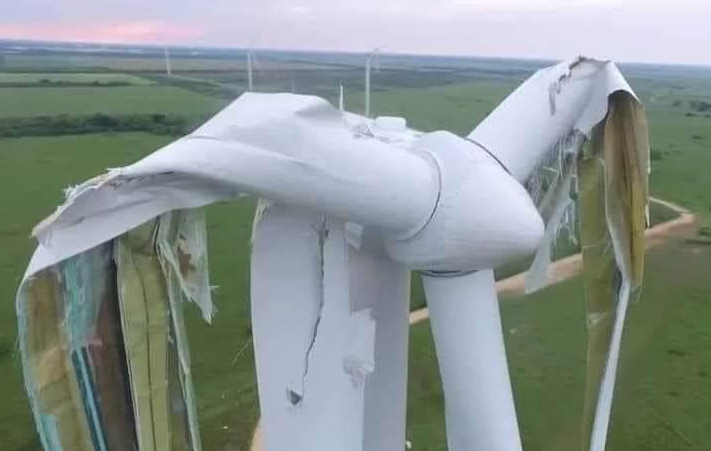
Claiming wind and solar betters nuclear power for price and reliability is like turning up to a machine-gun fight with a butter knife. The delusional and courageous are getting slaughtered at every turn. After all, this is an existential fight for the carpet bagging, crony capitalists – who have done so very well out of the grand wind and solar scam that it hurts to see it all disappear, crushed by the very mention of ever-reliable, always-on safe, and affordable nuclear power.
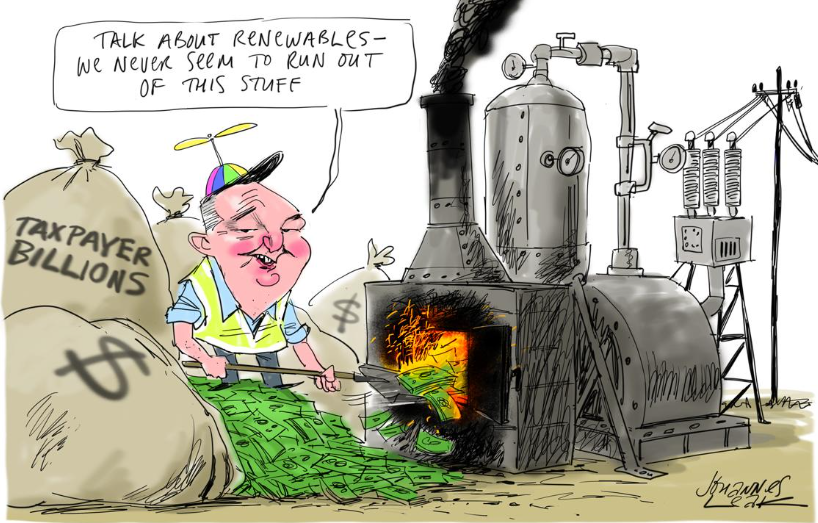
There seems to be a ratio between their desperate fear and the stupidity of their flailing arguments. Mocking nuclear power, the safest power generation source of all, with cartoon memes says it all, really.
As The Australian’s economics Editor, Judith Sloan explains below the line policy to obtain reliable and affordable energy is way too serious to leave in the hands of petulant children.
It’s no joke – our nation needs a serious discussion about energy
The Australian
Judith Sloan
25 June 2024
Once upon a time, Andrew Leigh was a professor of economics at the Australian National University. He holds a doctorate from Harvard. These days, he is an assistant minister for bibs and bobs in the federal Labor government.
To fill in his day, he is wont to put out “witty” posts on social media, including one with a picture of a three-eyed Blinky Bill, declaring this is what we have to look forward to if nuclear plants are built in Australia. (We already have a nuclear reactor at Lucas Heights, but facts don’t worry Leigh these days.)
Nothing like a bit of plagiarism from an old episode of The Simpsons is his attitude. That will show the supporters of nuclear energy a thing or two. Perhaps he should send it to the heads of government of all 32 countries around the world with nuclear plants, including some of our good friends in the US, the UK, France, Canada and Japan.
It is extraordinarily disappointing that someone of Leigh’s calibre would sink to this depth. We mightn’t expect much more from the Victorian Premier, Jacinta Allan, nor the hapless Victorian Climate Change Minister, Lily D’Ambrosio. What D’Ambrosio lacks in competence, she more than makes up for by pushing unfounded scare campaigns.
While the Prime Minister thinks we should all lighten up about these puerile examples of humour, the reality is the opposite. Our energy situation is so dire (and getting worse) that we must have an informed, thorough discussion of the issues and the options that are available.
With the wind failing to move the turbines – a not uncommon event in June – and with a shortage of gas, particularly in Victoria, it is clear the Australian Energy Market Operator is concerned. Wholesale electricity prices are skyrocketing. It is estimated that Victoria has already used up its normal winter gas supply in the first three weeks of the month.
Any good debate starts with an agreed statement of facts from which both the affirmative and negative sides can argue. It is one reason why it is entirely reasonable to expect the Coalition to provide a detailed assessment of the costs of its proposal to build seven nuclear reactors.
The good news is that there is a tonne of overseas data to establish some accurate costings, including from some of the recent successful builds in Korea and the UAE. There is not much point trawling up some older instances where costs massively blew out and there were substantial delays, such as the UK’s Hinkley Point C. This project was poorly conceived with a French design and Chinese financing. Apart from an offtake guarantee at a minimum strike price, there were no government funds provided to the project. Numerous changes were made during the course of construction and the various UK heads of government were never supportive, particularly former prime minister Theresa May.
Similarly, the much delayed and costly American plant in Georgia was hampered by a nuclear regulatory authority that was essentially anti-nuclear. The regulatory costs alone were over the top. But with industry now heading to that state, there is already talk of building another.
The Coalition has made the sensible decision that there will be one design only (for the larger-scale plants) so the economies of scale and scope can be captured. The French have mastered this approach now – President Emmanuel Macron has announced eight new plants – and other countries now accept this as best practice.
The figure for a one-gigawatt plant is likely to be about $8bn to $10bn. The plants will be modularised, which provides additional flexibility. There will be some need to upgrade transmission lines but the costs will not be substantial.
No doubt, the Coalition will release more details on costings so voters can make a sober assessment of the case for nuclear energy. It is a complicated exercise to predict the impact on electricity prices because of the required assumptions about the energy mix as well as demand. At least, we should expect numbers under different scenarios.
But as they say, everything is relative. And the federal government is not being upfront about the costs of its energy strategy, particularly in relation to the new subsidies on offer to renewable energy and the cost of the additional transmission lines.
Using the excuse of commercial-in-confidence simply doesn’t cut it; taxpayers need to know the range of dollars they are up for. Treasury should be insisting on the same.
But let me dwell on the cost of transmission. Recall that Chris Bowen, the Climate Change and Energy Minister, has stated that an additional 10,000km of transmission lines will be required by 2030, and 28,000km in total by 2050. Without this additional transmission, there is no way the proposed renewable energy projects can be connected to the grid.
The Rewiring the Nation fund has allocated $20bn to subsidise the rollout of the additional transmission lines, with a total figure of $100bn cited as the all-up cost. This is now looking like a massive underestimate with huge cost blowouts already apparent as well as slow progress.
This is the case with Hume Link, Energy Connect, VNI West and the Marinus Link. Hume Link, for instance, is 250 per cent over the original budgeted cost. Energy Connect between South Australia and New South Wales is expected to cost $2.3bn, up from the original figure of $1.5bn. The Marinus Link has been cut in half because of the cost increases.
With the blowout in transmission costs, it is entirely possible that there could be a 10-fold increase in the value of the base against which regulated returns are calculated. This would add significantly to electricity prices of itself, an effect not replicated with nuclear.
One of the key issues is the games that the investors in the transmission lines play to ensure their project becomes a regulated asset, thereby guaranteeing an agreed rate of return, paid by consumers. The incentive is to low-ball the cost of a project in order to pass the cost-benefit test undertaken by the regulator.
There is also a further complication of the disastrous Snowy 2.0 project requiring additional transmission (both Hume Link and VNI West) but with Snowy Hydro unprepared to foot any of the bill. Lest Snowy 2.0 become a stranded asset, regulators have been under pressure to give the tick of approval to transmission projects that should probably not go ahead.
I say let’s bring on the debate about the cost of different energy strategies. But this will require transparency on all sides. It won’t be enough for the government to simply whinge about the lack of costing detail on nuclear; it will require accurate apples-to-apples comparison with the government’s plans.
The Australian
 STOP THESE THINGS
With Labor continuing to use stupid childish excuses not to use Nuclear by promoting the lies that it will cause catastrophic harm to the environment by showing ‘cartoons’ with deformed creatures at extraordinary cost to the people, maybe they should begin to calculate the damage to the environment and all that lives within it from Wind and Solar factories plus the huge battery storage systems and now the increasing number of high voltage power lines required to distribute the meagre energy they are delivering.
Add this to the cost of energy to the general public when the subsidies to the companies erecting these things then you have a cost which WE THE PEOPLE OF THIS NATION will have to pay for ever and a day.
We all know it is happening, it cannot be denied the land environment, creatures and peoples futures these things are taking up is being damaged, the economic cost of the energy we are receiving is going up not down.
Its time people across the board whether living in rural, regional or city environments who are feeling the pain of the indoctrination from so called environmentalists and wannabees influencing and leading Governments of this country towards disaster, ensuring not only the loss of our way of life, but a loss of a country that has today stood the time of vandalism with some degree of understanding of the lands beauty and ability to provide a healthy environment.
There are those who have for years tried to stem the tide and educate the masses to the dangers, but they have been ignored and derided by Politicians, so called environmentalists, researchers, wannabees and the media.
Hopefully the tide is turning and more people will realise what is happening and begin to cry out to Politicians with the aid of the media to have this push towards the edge of oblivion stopped in its tracks and turn to a form of energy production that is safer than each of the ones being promoted today either individually or as a group.
they spent a month on one powerpole foundationhere at willatook sw Victoria. Hit water at three feet so trying to stabilise and stop waterflow. Drilling rig. Three drillers and at times 15 hire utes cranes traffic. Controllers. 550000 dollar eight wheel drive truck carting the steel boxing round. Laid about 40 km of track are now digging it up and shifting or dumping the thousand dollar a load gravel. Could be a trillion for powerlines.
China recently finished four 1.4 GWe plants based on an upsized version of the Westinghouse AP1000, for less than $US 3.00/watt. They expect experience gained to result in small reductions in cost of eleven more they have under construction, and the AP1700 they have under design.
Speaking of Georgia, when the new Vogtle plant was undergoing hydraulic tests, vibration was discovered in a pipe. In an ordinary industrial setting, that would have been addressed by a $30,000 pipe brace. But being a nuclear power plant under regulation, it became a $3 million license revision.
A similar thing happened at the San Onofre Nuclear Generating station. Mitsubishi Heavy Industries sold Southern California Edison Company defective steam generator replacements. Instead of allowing Edison Company to proceed with a lawsuit, and obtain non-defective ones (probably from a different supplier), the NRC required a license revision that would cost much more than the replacements — and there had already been an expensive license revision to get the defective ones. So Edison Company decided to close the 2.3 GWe plant. Senator Barbara Boxer almost broke her arm, patting herself on the back for her part in the closure. Then she had a hissy fit when Edison asked for an 18% rate increase to buy coal-fired power from Navajo generators about 750 miles away.
We need to legalize nuclear and then let it compete with coal and the unreliables on a level playing field without the market distortion of subsidies and mandates. Coal will be cheaper but not by a wide margin because as Judith pointed out the cost of nuclear power in the US and Britain is inflated beyond belief by regulators who do their best to stop it. Both the cost and the time to completion in some other places like South Korea are a fraction of the US and British numbers.
Due to the combination of wind droughts and lack of storage we cant afford to lose any of our current coal capacity and Labor are already subsidising coal power in Victoria and NSW. There are apparently just enough adults in the room in those states to keep coal going because we are one major closure away from rolling blackouts every night when the wind is low. At that point we will be a certified third world nation.
Paul Kelly has pointed out that there is no short road to nuclear power on a large scale and I hope by that time the global warming bubble will burst and we can burn coal cheerfully with shiny new coal plants.