

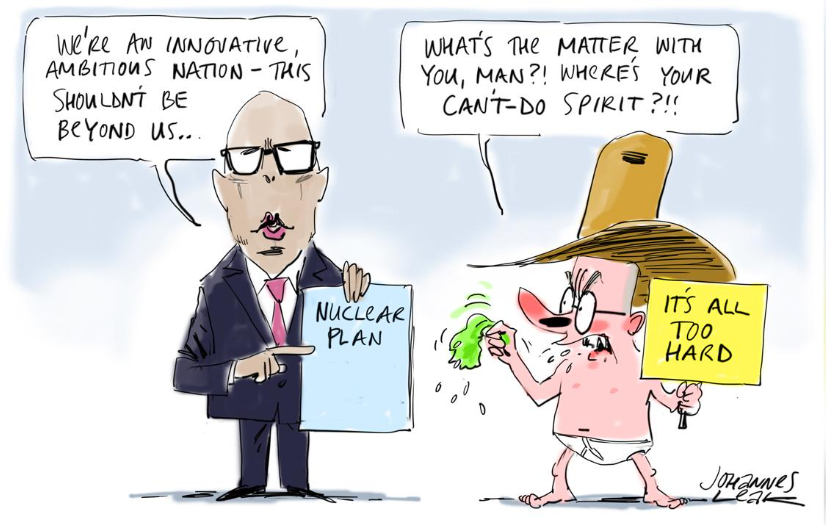
Chaotic and only occasional wind and solar generation is what you get when infants run the show. Now in a ‘wait til your father gets home’ moment, governments of an adult bent are taking a firm grip on energy policy. Ditching the suicidal renewable energy targets and plumping for nuclear power, principally because it works.
The Finns are in, the French led the way (and they’re demanding more) and now the Italians have joined Europe’s nuclear power renaissance.
The sudden and sensible shift to nuclear is being driven by the critical necessity of having reliable and affordable power. Namely, electricity delivered as and when we need it – rather than having delivery dictated by sunshine and/or the weather – and at prices that every household and business can afford.
Carpetbaggers – who’ve already pocketed $billions in wind and solar subsidies and hope to pocket hundreds of $billions more – are, naturally enough, thoroughly incensed. Just like the bratty teen being sent to her room without her smart phone, this crowd can’t understand why the party should end now.
In Australia, Peter Dutton – Opposition Leader of the Federal Liberal/National Coalition – is playing the role of the stern father, ready to take charge of an energy system that has been all but destroyed by ideologues armed with arts degrees and a band of mercenary, rent-seeking crony capitalists.
As The Australian’s Peter Credlin explains below, the tantrums from those hoping to profit from the greatest economic and environmental fraud of all time will only get worse.
Why Peter Dutton has turned energy debate on its head
The Australian
Peta Credlin
27 June 2024
Labor’s hysterical over-reaction to the Coalition’s commitment to nuclear power betrays the weakness of its arguments. It insists that nuclear power is impractical, too expensive, potentially dangerous and would take too long.
Yet how can it be perfectly practical to have nuclear power at sea but not on land; economic for at least 33 other countries to have nuclear power but not for us; not dangerous to have a medical nuclear reactor a stone’s throw from houses at Lucas Heights in Sydney but dangerous to have more; and too time consuming to have nuclear plants that will take a decade to build when the Snowy 2.0 pumped hydro plant will take at least that long to become operational?
For all the government’s hype about renewable wind and solar power, and its expansion from almost nothing two decades back to about 30 per cent of total electricity generation now, reliable and inexpensive coal-fired power still provides almost 60 per cent of our total electricity.
Far from producing cheaper power, as the government claims, cutting coal-fired power back to under 10 per cent of the total in just six years will create massive disruption, vast additional costs and widespread blackouts.
Peter Dutton’s proposed seven nuclear reactors won’t solve the whole power problem that decades of running the power system to reduce emissions rather than produce affordable and reliable power has created.
Still, because nuclear is the only currently proven means of providing zero-emissions baseload power in the long term, they’re a necessary part of getting to net zero and keeping the lights on.
If the government’s claims are correct – that renewable energy is the cheapest form of power – why is it still being subsidised through the renewable energy certificates that power generators are forced to buy, to the tune of well over $3bn a year? And if weather-dependent renewable power really can keep the lights on, why are the Victorian and NSW Labor governments now paying millions in subsidies to keep coal-fired power stations open?
And if the system really is generating the cheapest possible power, why have both federal and state Labor governments started to directly subsidise the power bills of households? Subsidising renewable power to incentivise its take-up, then subsidising coal-fired power to keep the lights on and finally subsidising households to make electricity affordable is hardly the sign of a rational energy system.
Yet affordable and reliable electricity is the absolute foundation of modern life, needed for everything from heating and lighting to charging our phones, paying our bills and, increasingly, keeping our cars on the road.
As a recent Menzies Research Centre study concluded, after considering power costs in various countries, some with a preponderance of nuclear power and others with more renewables, “systems with a larger portion of stable base-load power in their overall electricity mix tend to deliver cheaper power than those that are more heavily reliant on intermittent and peaking power”.
Anthony Albanese wants the next election to be a referendum on nuclear power now that Peter Dutton has so clearly committed to it. In fact, now that the opposition has committed to a very different way to get to net-zero emissions by 2050, via emissions-free nuclear power, the next election will finally be the contest over energy policy that both sides have been avoiding for a decade and one that the Prime Minister could easily lose.
An early sign of problems ahead is the PM’s insistence that Dutton cannot cost the opposition’s nuclear policy even though, two years into government and with all the resources of government at his disposal, the Prime Minister still can’t put a cost on his own green energy transition.
We do know that, far from cutting power bills by $275 per household per year as the government promised at the election, power bills have since increased by up to $1000. We do know that Energy Minister Chris Bowen thinks that moving from a power supply dependent upon fossil fuels to one almost entirely based on renewable energy is the biggest transition since the Industrial Revolution and that it will require the erection of 40 large wind turbines every single month and the installation of 22,000 solar panels every single day for eight years, plus up to 28,000km of new transmission lines – because that’s what Bowen has told us would be needed.
We also know that the cost of the extra transmission lines alone will be at least $80bn because that’s what Labor said pre-election. And we further know that the green energy transition is way behind schedule because that’s what the energy market operator says, plus without getting more gas urgently into the system blackouts could be widespread by the end of the year. Because it doesn’t matter how much wind and solar power is installed, there has to be back-up power to keep the lights on when weather fails us.
By far the most efficient way to “firm” renewables is via gas “peaker” plants, yet the extra gas needed to make the green transition work is exactly what the climate zealots insist on keeping in the ground.
At about $3m each, the nearly 4000 two-megawatt wind turbines that the government says we need would cost about $12bn (and that’s without any construction infrastructure). And at about $8000 each, the four million new nine kilowatt home solar systems that the government says we need would cost about $32bn. So that’s $44bn to provide a potential maximum of 54,000 megawatts of power that, due to intermittency, would only produce, on average, about 18,000 megawatts of power at any one time.
Given that this doesn’t include firming and doesn’t include the necessary extra transmission lines, just on these back-of-the-envelope calculations, even the $56bn that the CSIRO says it would cost to install the seven, thousand megawatt 24/7 nuclear power plants that Peter Dutton is backing doesn’t look too bad.
In fact, Dutton’s position is much stronger than that, with the recent Net Zero Australia study involving three universities and headed by a former chief scientist putting the cost of getting to net zero, without nuclear, given all the firming and unavoidable overbuild of infrastructure needed, at an eye-watering $1.5 trillion by 2030.
While the CSIRO study, which Labor endlessly cites, claims that firmed renewables are the cheapest form of power, that’s based on dubious assumptions about the long-term price of gas and coal, faulty assumptions about the life expectancy of nuclear power plants, ignoring the recycling costs of spent panels and turbines, and a failure to include in its calculations the cost of home solar because it’s initially paid for by the householder. As shown by the now near-daily headlines about potential blackouts and heavy industries (and jobs) moving offshore where electricity and gas is cheaper, energy policy in this country has become a slow-motion train wreck.
Finally, Dutton has injected a note of realism into the debate by offering an alternative that reduces emissions without jeopardising security of supply. The government’s response – asinine cartoons about deformed fish and the rushed appointment of a turncoat Liberal to a supposedly independent climate authority – shows just how debauched our public debate has become. Because the government can’t demand Dutton’s costing without also producing its own we might finally be able to make some energy decisions based on rational judgment rather than green religion.
The Australian
The Menzies Research Centre study on nuclear power and power prices is available here: MRC_1040_Electricity+Prices+Report_FA
 STOP THESE THINGS
In USA, the same people who worked so hard to destroy it are now all for it. Then-Senator John “Lurch” Kerry, a self-styled “Vietnam war hero” who was actually a coward who married wealth, cast the deciding vote in the Senate to terminate the research program at EBR-II, destroy the reactor that Nobel Physics Laureate Hans Bethe had described as “the best research reactor ever built,” and fill the building with concrete just to make sure a new one couldn’t be built there.
Are they sensible adults, or just opportunistic finger-in-the-wind politicians?
Subsidies don’t eliminate expenses for homeowners. They just hide them in your tax bill.
“The trash cost alone doubles the cost of solar.:”
— Vaclav Smil
Its easy to make opponents of nuclear power look stupid because they are, but I am afraid that the nuclear move is functioning as a figleaf to cover the nakedness of the Coalition policy which absurdly includes a commitment to unreliable energy and stops short of saying out loud the simple truth that we will have to burn coal for decades to come to keep the lights on. That is dangerously duplicitous and also gutless.
As far as I can see they haven’t even told people about the ABC of intermittent energy and the Tipping Point that we have reached, so the public can be aware of the fix we are in. Admittedly I don’t think the IPA and CIS have put those ideas about either, and they are supposed to be fighting the battle of ideas and information in a way that we dont expect from conservative political parties (sadly.)