
****
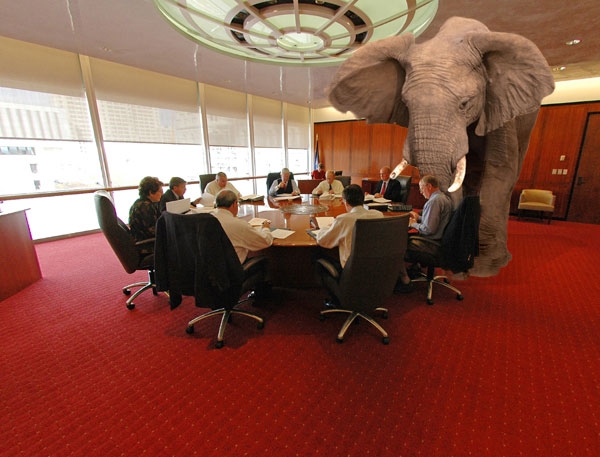
Britain’s insane wind power policy is, like elsewhere, the invisible policy-pachyderm.
No-one with skin in the political game dares to speak about its true costs, its full impacts on power punters, or on how it threatens the very ability of a grid designed for on-demand generation sources to function, with the addition of an utterly unreliable; and, therefore, utterly pointless power source.
STT has been watching Britain’s wind power fiasco unfold for some time now, and here’s just a few examples:
James Delingpole: UK’s Wind Power Debacle Reaches “High Farce”
Wind Power Goes AWOL Right When Freezing Brits Need It Most
UK’s Out of Control Wind Power Debacle Sets Brits up for Winters of Discontent
Brits Belted by Insanely Expensive and Utterly Unreliable Wind Power
In a “sure, the elephant’s there, but if we ignore it’ll go away” approach to political think-speak, the Brits’ political betters are staying schtum, as Chris Booker reports.
No one is talking about our utterly mad energy policy
The Telegraph
Christopher Booker
28 March 2015
All the major parties are signed up to the policy set in train by Ed Miliband’s Climate Change Act. They don’t know what they are doing
One reason why this election campaign seems so trivial and unreal is the number of important national issues that will scarcely be mentioned. Several of these I shall cover in the weeks ahead. But high on the list is our reckless and dangerous national energy policy.
Last week, scarcely noticed south of the border, came the news of the premature closure of Britain’s second largest power station. The giant Longannet plant in Fife, with its 2,400-megawatt capacity, can still supply two thirds of all Scotland’s average electricity needs.
The reasons given for Longannet’s closure early next year were partly the crippling cost of the Government’s “carbon” taxes and the additional £40 million it is being charged for connection to the grid. But the immediate trigger for the decision was Longannet’s failure to win a contract to supply back-up for Scotland’s ever-rising number of wind farms at times when there is insufficient wind.
Even Scotland’s energy minister, Fergus Ewing, called the closure of Longannet “a national scandal”, laying the blame squarely on “Westminster” – which is curious considering that his government’s policy is that by 2020 Scotland should produce 100 per cent of its electricity from “renewables”.
(In other words, that it should be able to rely on unsubsidised back-up from fossil fuel plants in England when there is too little wind, while selling heavily subsidised wind power back to England when there is too much.)
But Longannet’s real crime is that the 4.5 million tons of coal it burns each year make it the biggest CO2 emitter in Scotland. Which is also, of course, why we will hear nothing about Britain’s energy future in this election: because all the major parties are signed up to the policy set in train by Ed Miliband’s Climate Change Act committing us to reduce our “carbon” emissions by 80 per cent within 35 years.
The policy on which they are all agreed, set out in the Coalition’s “2050 Pathways for tackling climate change”, centres on three main steps, each more bizarre than the last. Step one is that we should “decarbonise” our economy, not just by closing down the coal and gas-fired power stations that supply more than 70 per cent of our electricity, but by chucking out all those gas appliances 90 per cent of us use for cooking and heating.
Step two is that we should double our production of electricity, which we would then use, not just for cooking and heating but also for virtually all our transport (electric cars, trains etc). Step three is that all this electricity should be generated from “zero carbon” sources, mainly from thousands more wind turbines and a fleet of new nuclear power stations.
The only problem is that none of this insane make-believe can possibly come about. When the wind doesn’t blow, the only power to keep our lights on, our homes heated and our electric cars running would be that from those supposed new nuclear power stations.
At the present rate, with only one new nuclear power plant dubiously in view by 2024, producing electricity four times as expensive as that from coal, not even tens of thousands of diesel generators could produce enough back-up power to keep our computer-dependent economy functioning at all. (Last Tuesday evening, wind was producing less than 1 per cent of the power we were using).
But not a word of this will we hear in the election campaign: partly because all our main political parties have signed up to it, but even more because virtually none of our politicians have the slightest clue what it is they are signed up to.
The Telegraph
 STOP THESE THINGS
I find it amazing that know-body has mentioned Ukip. They are against being in the EU and hate Wind and Solar. Why is this so?
Longannet coal fired power station is located exactly where it needs to be. Half way between Edinburgh and Glasgow and across the River Forth from the Grangemouth industrial facility.
If Longannet is to be closed then this should only occur when Hydro and Nuclear or even Gas are positioned so as to be able to fully take over from it directly! And not before. The facility is also rail served by coal trains. Removing this source of revenue freight traffic from the recently reopened railway line to Alloa could place the reinstated passenger service into jeopardy. The lose of jobs in the area from the closure of Longannet could also have an effect. Is this not the time to be encouraging the use of public rail transport?
Surely a better idea in the short term would be to clean up Longannet and to place covers on all train load coal to the site so as to limit airborne coal dust particles when in transit. And when the time is right, then and only then should the facility be wound down.
Better use should be made of existing Hydro whilst 4th or even 5th generation Nuclear could also come on line. A closed cycle Gas peaking plant could perhaps be a future option for the Longannet site so as to maintain jobs in the area. But a sufficient buffer zone would have to be taken into account.
‘Infrasound’ has been found to occur at some of these facilities. We do not want a repeat of the mistakes that we have encountered with Industrial Wind!
If a viable source of renewable energy that is pollution free can be found in future then so be it. But covering the entire planet with INDUSTRIAL WIND TURBINES is not the answer! For myself I feel that the only way for future generations to proceed is to get off the grid altogether! This is sustainable and can increase in tandem with global population growth. This in my opinion is the area we should be focused on. Leave electricity production for industry, hospitals, street lights, etc.
And to anyone who states, well you use electricity Crispin. I say well so do INDUSTRIAL WIND TURBINES!
As for the subject of Ed Miliband, I would draw your attention to his comments in the article link below. He seems to think that complaining about BIG WIND should be considered taboo!
http://www.theguardian.com/environment/2009/mar/24/wind-farms-opposition-ed-miliband
Reblogged this on Wolsten and commented:
No sign of an intelligent discussion on the true cost of subsidies in the election campaign, and Scotland’s insane march towards decarbonisation.
It’s unusual for Booker to get it ever so slightly wrong. Yesterday’s Press & Journal – the Voice of the North (of Scotland) has a couple of pieces of interest; we have them on our facebook page.
The post currently pinned relates to the wind industry and, amazingly, the CEO of the Inverness Chamber of Commerce attempting to put the blame for any potential tourism revenue loss on to campaigners, in particular the Save Loch Ness campaign.
The second is an article relating to David Cameron – the Prime Minister – with the leader of the Scottish Tory Party – punting the Tory manifesto, in which they have given the line which they will take with onshore wind. It should be borne in mind, of course, that some of the matters on which they speak are devolved to the Scottish Parliament, even were the Tories to get in in Westminster. We live in very uncertain times in the UK at the moment.