

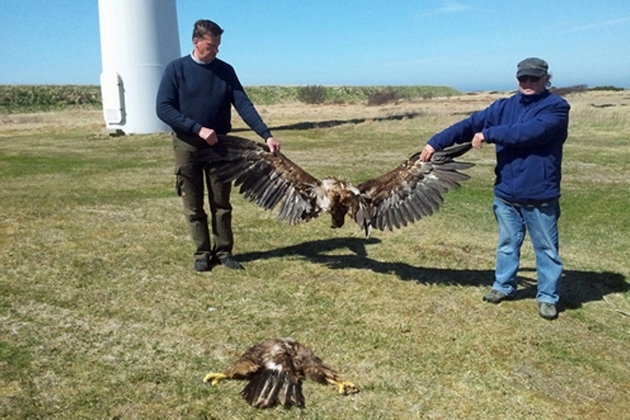
Robert Bryce, who is a Senior Fellow of the Manhattan Institute for Policy Research, recently made a presentation to a hearing of the Senate Committee on the Environment and Public Works, USA, entitled Killing Wildlife in the name of Climate Change.
****
This well-referenced piece makes the following arguments:
- Wind energy companies are not being treated equally when it comes to enforcement of wildlife laws
- Widespread deployment of wind turbines is not an effective climate-change strategy
- Policymakers are implementing an energy policy that is a known killer of wildlife in exchange for what are infinitesimally small reductions in carbon dioxide emissions.
You can read the full paper here.
 STOP THESE THINGS
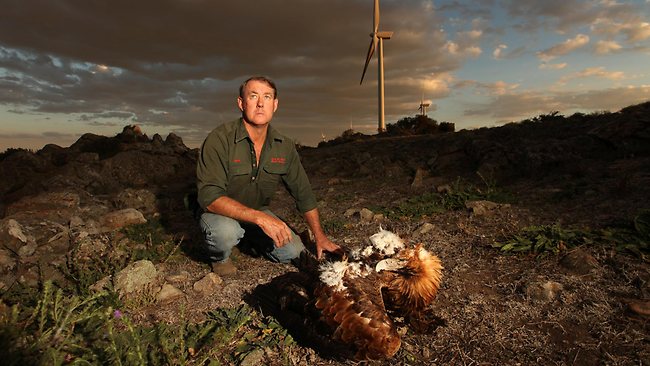
Every single wind turbine generator should be shut down immediately until each of them is retrofitted with protective grills around the blades. The WTG designers were complete and utter idiots for not designing the most elementary component of the equipment for use on hilltops and ridges in the middle of avian corridors, flyways, breeding, foraging and nesting areas.
This is the 21st century not the stone age.
Today is 3/202014.
15 east Kern County wind development projects have been approved with most of them operational. They’re not only getting away with murder, they’re keeping money earmarked in writing for the California Condor Recovery Program.
The California Condor Recovery Program has received a meager $763,000 of the nearly $3 million owed to them for the funding and endowments stated in the Environmental Impact Reports.
For example Alta East will fulfill the following mitigation measures according to the EIR:
http://www.co.kern.ca.us/planning/pdfs/eirs/AltaEast/Index.htm
Location 1.
Volume 1
Executive Summary, Mitigation Monitoring and Reporting Program
Click to access MMRP.pdf
Mitigation Monitoring Program For Alta East Wind Project Environmental Impact Report
Document page 46 & 47 of 51 d.
d. Funding for conservation measures such as radio telemetry, condor feeding programs, or other such measures as deemed appropriate shall be provided to the California Condor Recovery Program. Funding shall be calculated at six (6) units per one hundred (100) turbines installed as part of the project. Prior to the issuance of any building or grading permits for the first (1st) turbine, the project proponent shall fund six telemetry units in the amount of $188,100 ($4,150 per unit plus an “endowment” of $163,200to be used for tracking data over an eight-year period). Prior to the issuance of any building or grading permits for the one-hundred-and-first (101st) turbine, the project proponent shall fund six additional telemetry units in the amount of $188,100 ($4,150 per unit plus an endowment of $163,200 to be used for tracking data over an eight year period). The total funding to be provided shall not exceed $376,200.
Document page 48 to 49.
MM 4.21-9
7. Prior to turbine commissioning or any turbine operation, the project proponent, in consultation with the BLM (on federal lands) and/or Kern County Planning and Community Development Department (on private lands) shall implement one of the following options for reducing impacts to the California Condors:
A) The project proponent shall provide a plan to the BLM, the CDFG, and the USFWS for review and approval for implementing full-time human observation, during daylight hours, for condor activities on the project site and a sufficient buffer outside the project to ensure that if a condor is sighted turbines may be safely shut down prior to a condor reaching the strike hazard. This distance will be determined in close coordination with USFWS and CDFG, defined as the turbine operation area (TOA), for the term of the grant. The condor observation site(s) within the TOA will be identified in the plan and shall be staffed by a qualified avian biologist who is approved by the BLM, the CDFG, and the USFWS. The observation sites will provide 100% coverage of the project area plus buffer to ensure that a condor could not visually be missed should it be flying in the area. Observation shall be conducted year-round during all daylight hours of operations, including 30 minutes prior to sunrise and 30 minutes after sunset. By accessing the project’s SCADA system, each approved observer will have the authority to curtail all turbine operations in the TOA if a condor enters this area. These protocols could be adapted, with approval from FWS and CDFG, if future data collection and analyses demonstrate the newly proposed protocols would meet a 100% avoidance criteria.
or
B) The project proponent shall submit for review and approval a Condor Monitoring and Avoidance Plan utilizing a reliable Condor Monitoring System (CMS) that will detect VHF-tagged condors. The purpose of this plan is to outline the procedures and compliance steps undertaken by the project proponent to implement focused curtailment of proposed wind turbine generators when a California Condor is detected with a range of up to, but not exceeding 16 miles away.
The placement of any such CMS will be approved by Kern County in consultation with USFWS, CDFG, BLM and shall include at a minimum the following components:
• Receiver with datalogger
• Antenna switchbox with amplifier
• Omnidirectional antenna
• PC with Internet connection
• Transmitter for receiver qualification testing, as well as for use as a sentinel signal once permanently deployed.
The system shall be active during daytime hours, which includes 30 minutes prior to sunrise and 30 minutes after sunset, for a period of 3 years. During this initial testing period, the project proponent shall submit quarterly reports to Kern County, USFWS, CDFG, and BLM regarding the system’s findings and curtailment activities. After a period of 3 years, the system will be evaluated by Kern County, BLM, USFWS, and CDFG for overall effectiveness in detecting and implementing focused curtailment related to reducing impacts to the California condor. If after a period of 3 years it is determined by the reviewing agencies that additional measures or modifications to the system are necessary to ensure the system is effective in detecting and implementing focused curtailment measures.
The Bryce paper is a lucid cogent explanation of wind turbine facts.
He should be compulsory reading for anyone interested in the truth about the deceptive and misleading claims of the wind industry in tackling climate change.
“Climate change scarecrows” indeed!
The destruction of birds is appalling, as to is the destruction of the environment of all creatures.
Have any of these projects had environmental assessments made of creatures that are not on the endangered lists, BEFORE they turn the environment into a factory, with follow up assessments undertaken throughout the years after factories begin to operate? Have any of these areas lost or had a significant reduction in species, could the growing size of projects and the adding to them by other projects be shifting specie away from their normal environment and ‘cramming’ them into smaller areas?
Could species become rare and or endangered because they have been moved on by these factories? Evaluation of numbers of all species found in an area should be compulsory before and following start up of these factories.