
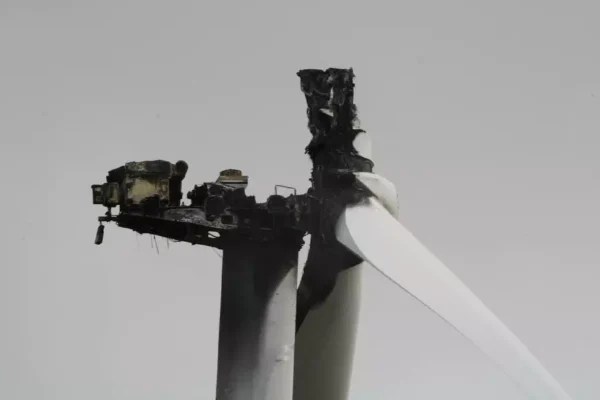
Part-time power has no commercial value, which is why wind and solar are utterly pointless. Every single MW of wind or solar has to be “backed up” with another MW from a dispatchable source, which in the main means coal, gas, nuclear or hydro.
Contemplate where your power comes from on a calm night, and chances are you’ll realise that the grand wind and solar ‘transition’ is pure hoax.
At this point in the narrative the cultist starts ranting about giant batteries, green hydrogen and (now and again) pumped hydro, ignorant of the fact that batteries don’t generate electricity, that green hydrogen is a myth and that pumped hydro uses more electricity than it ever returns.
Despite the countless $billions thrown at giant lithium-ion batteries, their total capacity (worldwide) amounts to little more than a rounding error.
In the piece below, Francis Menton picks up the thread with a full-frontal assault on the nonsense that net-zero carbon oxide gas emissions targets can be satisfied using wind and solar alone.
Why There Will Never Be A Zero Emissions Electricity System Powered Mainly By Wind And Sun
Manhattan Contrarian
Francis Menton
21 September 2024
“Net Zero” — That’s the two-word slogan that has been adopted as the official goal of every virtuous state or country for decarbonizing its energy system. The “net” part is backhanded recognition that some parts of the energy system (like maybe air travel or steelmaking) may never be fully de-carbonized. Thus some kind of offsets or indulgences may need to be accepted to claim achievement of the goal.
But the “net” thing is not for the easy parts of decarbonization. And by the easy parts, I mean the generation of electricity, and the powering of anything that can be run on electricity or batteries. In electrifiable parts of the energy system, there is to be no tolerance for “net”; only “zero emissions” will do. The official line is that zero emissions electricity is easy and cheap because it can be provided by the wind and sun.
The official line is wrong. As the build-out of these wind and solar generation systems continues to progress, it has become increasingly obvious that there will never be a zero-emissions electricity system powered mainly by wind and sun.
The reason should be obvious to everyone although, for some reason I cannot understand, it is not. The reason is that the intermittency of wind and solar generators means that they require full back-up from some other source. But the back-up source will by hypothesis be woefully underused and idle most of the time so long as most of the electricity comes from wind and sun. No back-up source can possibly be economical under these conditions, and therefore nobody will develop and deploy such a source.
This issue has already arisen in many places, as increasing generation from wind and sun has put natural gas power plants into back-up mode, running half or less of the time.
Now consider how things are supposed to proceed as we move to zero-emissions electricity. First, we build more and more wind and solar facilities. Second, we disallow natural gas or any other hydrocarbon fuel as the back-up. Now the back-up must itself be zero-emissions, and also dispatchable.
In New York, our regulators have devised the acronym DEFR (“Dispatchable Emissions-Free Resource”). Several possibilities have been suggested as the DEFR, the main ones being nuclear, hydrogen, and batteries. All possibilities for the DEFR that have been suggested share the characteristic that they don’t exist today at anything close to the scale that will be needed to fully back up an electricity system powered mainly by wind and sun. In other words, somebody will have to make a huge investment in one or more of these things on a grand scale if we are to have an electricity system powered mainly by wind and sun.
Given New York’s political environment, the regulators who have raised the need for the DEFR have generally buried their discussion of the subject deep in lengthy documents. Roger Caiazza, the Pragmatic Environmentalist of New York, has done yeoman’s work in digging up and highlighting these items. Roger has created a “Dispatchable Emissions Free Resource Page” where he has accumulated the key information.
For example, we have the Scoping Plan of the Climate Action Council, which Roger describes as “the ‘official’ Hochul Administration strategy description of the Climate Act transition.” The document is some 800+ pages of text plus appendices. Somehow, Roger made it to page 49 of Appendix G, where he found this quote:
During a week with persistently low solar and wind generation, additional firm zero-carbon resources, beyond the contributions of existing nuclear, imports, and hydro, are needed to avoid a significant shortfall; Figure 34 demonstrates the system needs during this type of week. During the first day of this week, most of the short-duration battery storage is quickly depleted, and there are still several days in which wind and solar are not sufficient to meet demand. A zero-carbon firm resource becomes essential to maintaining system reliability during such instances. In the modeled pathways, the need for a firm zero-carbon resource is met with hydrogen-based resources; ultimately, this system need could be met by a number of different emerging technologies.
Here is the Figure 34 that they mention:
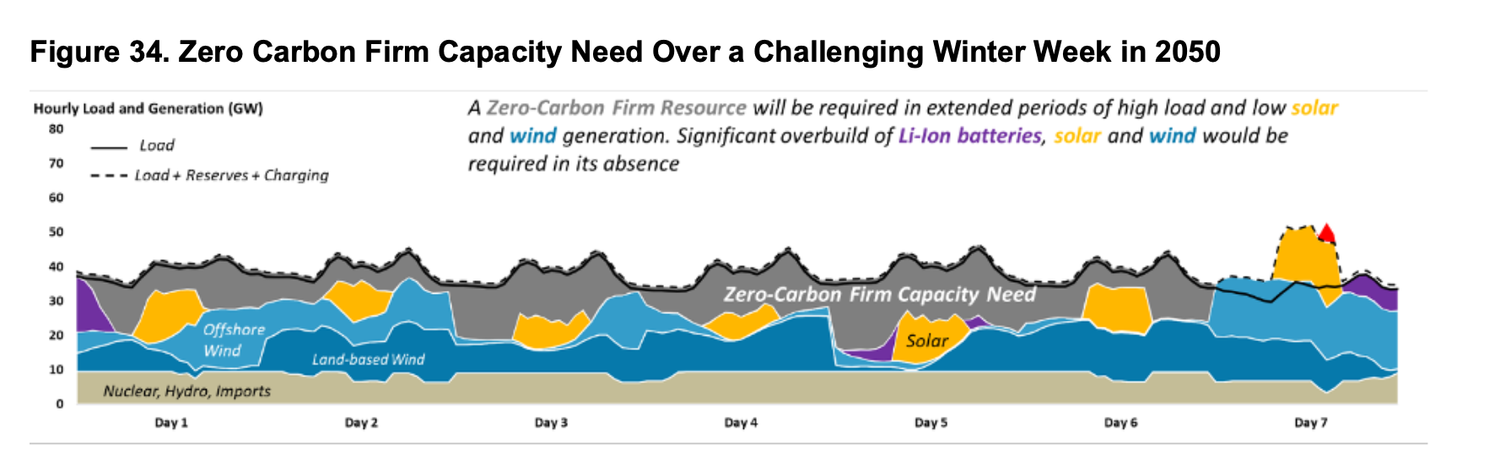
It may be a little hard to read, but the dark gray is what they label the “Zero-Carbon Firm Capacity Need.” The width of that dark gray section gets up to well over 20 GW during the illustrated low wind/sun week. For reference, New York State’s current average electricity usage is well less than 20 GW. Meanwhile, even during this low wind/sun week there are times when this DEFR is not called on at all, and other times when it is called on for only a few GW.
So without saying so in as many words, they are telling us that as part of a predominantly wind/sun system we will need to build DEFRs of capacity equal to or greater than our entire current average electricity usage. But if the electricity system is powered mainly by wind and sun, then by definition the DEFRs are only going to operate a minority of the time.
We will have now built an entire fleet of new nuclear power plants capable of fulfilling our entire peak electricity demand. Or maybe it’s an entire fleet of new hydrogen power plants of same capacity, or an entire fleet of grid-scale batteries of same capacity, only to keep them idle most of the time.
These are extremely capital-intensive facilities, which can only hope to be economical if they are operated to as much of their capacity as possible. Instead the proposal is that will be intentionally kept idle most of the time.
Who is going to make the investment in these DEFRs that will be kept mostly idle. Certainly, no private investors will do it without enormous government subsidies.
And if we were to build an entire system of these DEFRs capable of supplying all of our electricity needs to back up worst-case wind/sun lulls, wouldn’t it make far more sense just to leave out the wind and solar generation and go with the DEFRs all the time? Of course it would.
At some point this is going to become too obvious to ignore.
Manhattan Contrarian

 STOP THESE THINGS
The rush to load wind power on the grid should have stopped many years ago when the Australian wind watchers, Anton Lang, the Miskelly team and others, demonstrated the existence of severe wind droughts lasting several days on a continental scale. They used the registered windmills of SE Australia as proxy wind recorders to track the continuous output of the windmills, recorded by the Market Operator. These are public records. https://anero.id/energy/wind-energy
Here is a thought experiment.
Imagine a history of farming and food production written without any record of studies on the reliability of the water supply and rainfall records.
I think in reality you will find obsessive interest in rainfall records with intensive focus on droughts for good reasons!
Now contemplate the history of the wind power industry and look for comparable studies of the wind and solar resources.
Where are the studies of wind droughts?
When did people even start to mention wind droughts?
Here is an intriguing factoid, my colleague John Mclean, found that the first two Assessment Reports of the IPCC recommended surveys of the world’s wind resources to explore the possibilities of large-scale wind power.
I wonder what they found and why the official meteorologists have never breathed a word about wind droughts that I am aware of.