
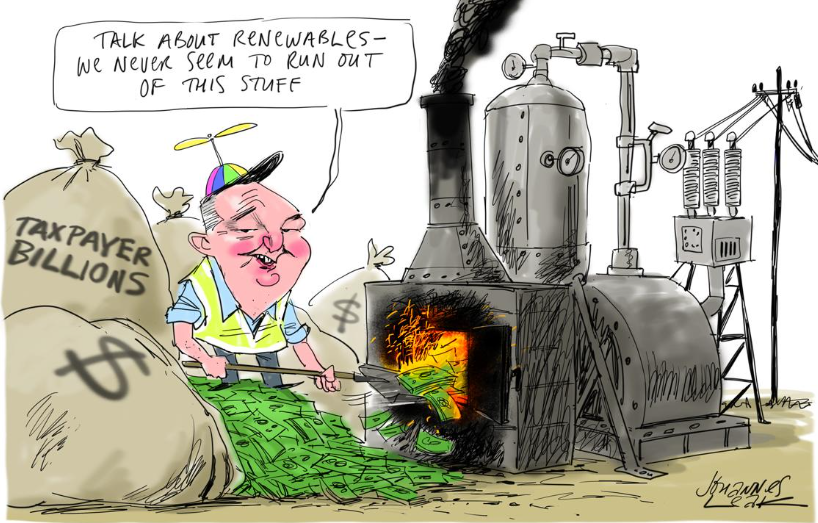
Propagandists pushing the wind and solar transition are struggling to explain away the crushing power bills that inevitably follow. Every state or country (without exception) that is attempting to run on sunshine and breezes suffers rocketing retail power bills.
Wind powered Denmark and wind and solar powered Germany suffer Europe’s highest power prices, by a country mile.
Those self-inflicted disasters are closely followed by South Australia, which leads the Australian states in both wind and solar generation capacity and retail power prices. On a purchasing power parity basis, South Australia suffers the highest power prices in the world. And, as detailed below, things can only get worse.
In the first article, Colin Packham does his very best to explain away a surge in Australian wholesale power prices, which he blames on a burst of calm weather.
Too witless to understand the idiocy of his own argument, Colin – who has been pushing the grand wind and solar scam for years, as if he’s in on it – manages to embarrass himself, by revealing his childish ignorance of both electricity production and economics. STT provides the necessary corrections.
Although, perhaps, the best answer to Colin’s starry-eyed view about the grand wind and solar transition is in The Advertiser article that follows from a month ago, reporting on the South Australian businesses being smashed with 45-60% increases in their retail power bills in just 12 months.
Wholesale electricity prices jumped in winter in blow for bill relief next year
The Australian
Colin Packham
18 October 2024
The cost of wholesale electricity rose during winter as periods of depressed renewable energy generation coincided with soaring demand for power in bitterly cold weather, data from the Australian Energy Regulator has shown, tempering hopes of sustained bill relief for households and businesses in 2025.
Electricity bills are shaping as a critical election issue, with the next annual tariffs for 2025 expected to be announced just months ahead of an election that must be held by May, and Labor is desperate for continued bill relief after jumps of more than 20 per cent amid a global energy crunch when it assumed office.
In a blow for hopes of rapid falls in electricity bills, the AER said that while wholesale electricity prices during the three months to September 30 were lower than the previous quarter, they were up significantly from the same period one year earlier.
Year-on-year prices were significantly higher across all regions, with Tasmania up 290 per cent, Victoria up 114 per cent and South Australia up 76 per cent, it said.
The increase was fuelled, the AER said, by a spike in demand for electricity in July and early August as Australia suffered through another wind drought when electricity production from the zero-emission source plunged. The issue was compounded by a drought in Tasmania, which relies heavily on pumped hydro.
[Wrong, Colin. Tasmania’s hydro output relies on its dams which store water and, after generating electricity in their hydro plants, release it once and for all in rivers, with the water flowing out to sea. There is no pumped hydro in Tasmania. However, when it stops raining for a prolonged period (ie drought), Tasmania’s hydro system will literally run dry and produce nothing much at all, as it did in 2016.]
“Variability in output in July and early August resulted in the need for more expensive firming resources such as batteries, hydro and (gas power generation),” the AER said.
[Note to Colin. That little piece of propaganda gives the impression that batteries provide a significant volume of power when wind and solar output collapses. It is in fact the reverse. Gas power generation (notably in brackets to suggest that it doesn’t even feature in the equation) sits right behind coal-fired power as the mainstay of Australia’s Eastern Grid. Batteries do not contribute any significant volumes of power, and sit at the margins, providing frequency control to prevent the grid collapsing when wind and solar output collapse. The batteries will dispatch power only long enough to allow gas or diesel generators to fire up and take over.]
The regulator noted that from mid-August to September the weather improved and wind generation increased, tempering the impact on quarterly wholesale electricity prices.
[See The Advertiser article below as to retail prices in Australia’s renewable energy capital, South Australia.]
Still, higher wholesale prices during the period are a headwind to hopes for lower tariffs known as the Default Market Offer.
The Default Market Offer is calculated annually as the AER considers the wholesale cost of electricity, the toll of transporting electricity, and the cost of compliance with government rules and regulations.
Wholesale prices are the biggest, most influential component of the Default Market Offer, but the AER will use several years of data rather than one single 12-month period so the most recent jump is not a death knell for hopes of lower bills.
[More propaganda from the AER. Australians have been hearing this guff for years. The reality is laid out in the next article from The Advertiser.]
The AER will announce a draft Default Market Offer in March, ahead of the election that pits two different visions for Australia’s future energy grid against each other.
Labor is under mounting pressure amid a cost-of-living crisis that has seen a record number of Australians unable to pay their utility bills, a stark contrast to the pledge made by Prime Minister Anthony Albanese when in opposition. Labor campaigned on a platform of electricity savings of $275 a year.
Labor has set the aggressive target of having renewable energy generate 82 per cent of Australia’s electricity by 2030, and federal Energy Minister Chris Bowen said the AER report illustrates the plan is working, with a growing number of occasions wholesale electricity prices were $0.
“This latest report shows electricity prices are going down in the majority of our east coast grid, and more instances of spot prices under $0, proving our Reliable Renewables Plan is working,” said Mr Bowen.
Negative wholesale prices occur when renewable energy generation is so plentiful that it more than meets demand. Negative wholesale prices drag down the average cost of producing electricity, which eventually determines the price paid by households and businesses.
[Colin is evidently no economist and has absolutely no understanding of how markets work. There is a world of difference between the price charged for a good or service and the cost of delivering it. Whatever happens to the wholesale price of electricity, it has absolutely no bearing on the cost of producing it for a generator . More embarrassing bunkum from Colin.]
But the Coalition will seize on the year-on-year increase as evidence of the pitfalls of a renewable energy-dominated grid. The Coalition insists relying on renewables exposes Australia to periods when the wind is not blowing or the sun is not shining, and Labor is incentivising the exit of baseload power, most notably coal, which could step in.
Coal is rapidly retiring as the traditional fuel source struggles to compete financially with renewables. Coal has much higher operational costs than renewables and ever-increasing amounts of renewable energy are driving coal out.
[Colin once again embarrasses himself. He might explain what amount of renewable energy is being produced on a calm night, for example. And explain how, when wind and solar are producing nothing at all, “renewable energy” is driving out any other reliable source, including coal-fired power? Again, operational costs have no bearing on the price charged for wind and solar, which is dependent in the first instance on the value of the Renewable Energy Certificates they receive (the $90 per MWh cost of which is included in retail power bills) and, in the second instance, on the capital cost of having coal-fired and gas-fired generators – with a combined capacity sufficient to meet total demand when wind and solar output amounts to nothing (eg calm nights) – laying idle but ready to dispatch at a minute’s notice. Taxpayers are now paying hidden capacity payments to keep those plants online to prevent total grid collapse. Another fun fact overlooked by Colin]
The Coalition has proposed seven nuclear power stations to fill the void, but has yet to release costings of its plan, though polls indicate growing support for the plan.
The Australian

Meanwhile, back in reality land, a place where households and businesses pay retail power prices based on the true actual cost of attempting to run on sunshine and breezes, South Australians are being smashed.
SA is the economic backwater heralded by cultists as the wind and solar capital of the world. A place where Labor politicians cheered when they blew up their perfectly reliable coal-fired power plants 7 years ago.
Here’s the results of that lunacy.
‘Screwing up the country’ JP Drake blames rush to renewables for power hikes crippling businesses
The Advertiser
Natalie Vikhrov
4 September 2024
A prominent supermarket boss has taken aim at the country’s “rush to renewables”, saying the rapid shift was to blame for power price hikes.
Drakes Supermarkets boss John-Paul Drake has blasted the “rush to renewables” for soaring power bills which threaten the company’s growth.
Drakes, which employs more than 6000 people, has seen energy costs rocket from $10m in 2023 to an estimated $14.5m this year and issued a grim warning about renewables “screwing up the country.”
Drakes was among iconic South Australian companies surveyed by The Advertiser to find the impact of crippling power bills — it revealed they are grappling with mammoth increases of up to 60 per cent, with one saying it has been forced to pass on costs to customers.
Mr Drake said the business needed to remain in competition with supermarket giants Coles and Woolworths which meant they could not increase the cost of goods to offset their rising power bills costs.
He believes part of the reason for spiralling bills is Australia’s “rush” to shift to renewables.
“I think this is the reason we are paying so much more for electricity, because we are trying to go all to renewables,” he said.
“I think we have got to be very cautious about trying to be green and realise how much it has screwed up the whole of the country.”
The supermarket chain has opened three new sites across the state in the past year but Mr Drake said without the burden of hefty power bills, they would be able to do more.
“It means we don’t grow as much, which means we can’t employ more people, which means we can’t buy more sites,” he said.
“It causes us to be very cautious about how we move forward, it makes us not as optimistic about what we can do.”
Businesses have told The Advertiser they are seeing significant jumps in their power prices when their contracts wrap up and they go to market for a new agreement.
Seeley International, which produces airconditioning and gas heaters, also saw an almost 60 per cent increase in their power bills.
Group managing director Jon Seeley said their electricity use has remained fairly steady but their bills have soared.
Mr Seeley said the company has had to increase prices to make up for the growing power costs.
“We have to regularly review our cost base, including power prices and wages and all other costs and we do have to pass on price increases through to our customers,” he said.
But he added they try to do this “as little as possible” and typically follow broad inflation.
To mitigate growing power costs, Mr Seeley said the business has sought to modify its electricity use which includes investing in new, more efficient equipment.
He added they were looking at including solar in their factory extension works at Lonsdale but as a company with a “relatively energy intensive manufacturing process, even if we cover our roof with solar panels, it doesn’t make a huge difference.”
According to an SA Business Chamber report, South Australia has experienced the biggest increase in electricity bills in Australia.
Angove Family Winemakers joint managing director Richard Angove said they have seen around a 45 per cent increase in their power bills after they went to market for a new energy contract last November.
In recent years the company has approximately halved its grape intake which has significantly reduced the company’s energy use. However Mr Angove said that has not been reflected in their growing power bills.
He said energy prices were an economy-wide problem leading to inflationary pressures for businesses across the board.
“The business environment has never been as tough, possibly with the exception of world wars,” he said.
“However, we’re resilient and we do have plans in place to create efficiencies where we can.
“We’re currently investigating more solar on our vineyard … we’re looking at improvements for better efficiencies.
“We’re always looking at our product portfolio, ensuring that our product mix is right, delivering the highest margins for us.”
Meanwhile, Golden North Ice Cream has seen a 48.6 per cent increase in their power bills.
Managing director Peter Adamo said in 2023, their average monthly bill was $34,000. This year, it comes around $50,000 per month.
“It’s a big cost due to refrigeration. (These are) challenging times, especially operating in a regional town in the Mid North, it just puts more cost pressures.”
Mr Adamo said while they haven’t passed on those increases to customers yet, if prices continue to go up “we won’t be able to absorb it, so there will be price increases”.
The Advertiser
 STOP THESE THINGS
test comments aren’t appearing again.
Come on Australia, WAKE UP. CLIMATE CHANGE IS A HOAX. CO2 is our friend, and so is coal nuclear and fossil fuels!
Colin Packham shared the Packham Williams medal this year, it was awarded for misleading reporting on energy issues. Colin and Perry Williams established the standard and the medal, like the Rothman Medal and the Brownlow, was struck to immortalize their achievement with an annual award. Perry could not contest the award because he was promoted and stopped writing regular columns.
Colin shared the podium with Ben Potter was was the curator of the Financial Review Carbon Challenge
https://newcatallaxy.blog/2024/07/14/the-packham-williams-medal-2/
Ordinarily, we don’t refer to Packham’s work because it is so embarrassing, infantile propaganda. But that article had enough in it to work with. His ignorance is astonishing – the line about pumped hydro in Tasmania was just one example – the fact that this clown is the main energy reporter for a National daily beggars belief. The current guff about attacking misinformation and disinformation ought to have Packham fact checked out of existence. Sadly, he will continue unchecked – and the public will continue to led astray with utter bunkum.