
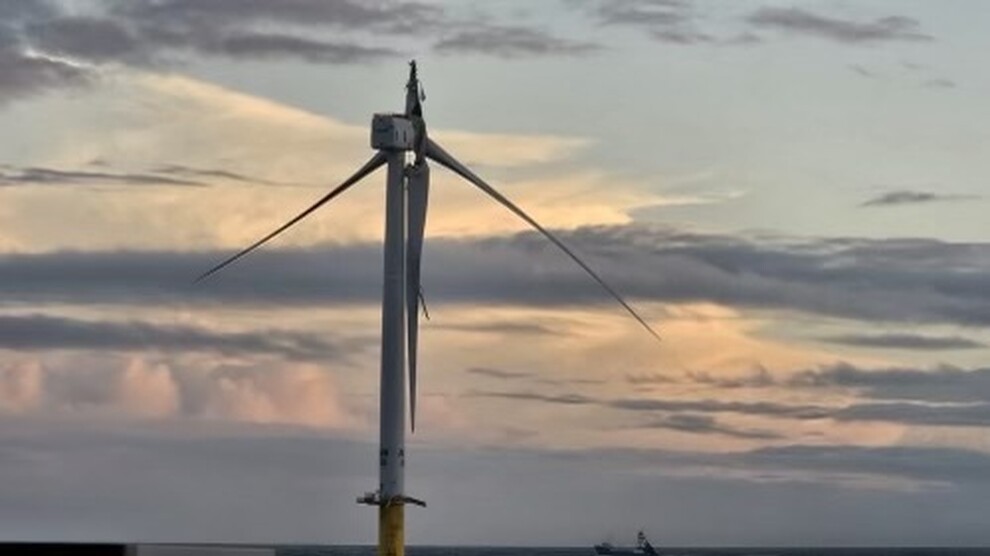
When the wind isn’t knocking the stuffing out of these things (see above), it struggles to keep them spinning as more turbines get added to any given location.
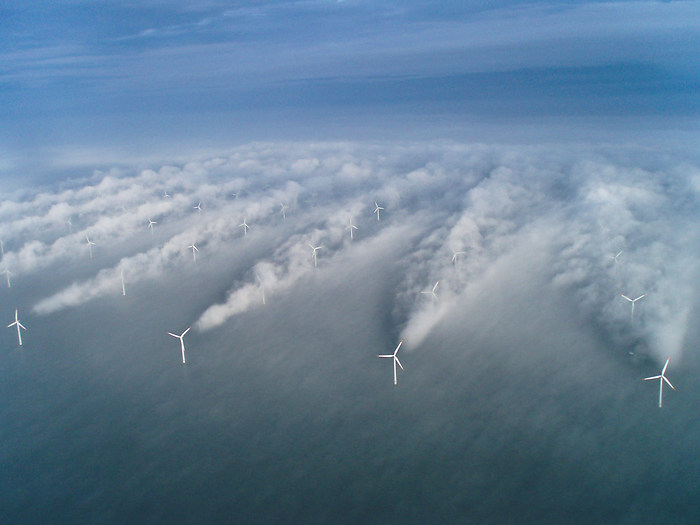
Known as ‘wake effects’, every wind turbine downwind from another receives less air and/or a less direct flow of air towards its blades, reducing efficiency and therefore the output of every downwind turbine.
Of course, anyone with the temerity to point out the obvious physical limitations of wind power (an already pathetically limited generation source) gets treated with full-blown ridicule, as No Tricks Zone reports below.
German Professor: Wake Effect Decreases Wind Farm Efficiency, Contributes To Warming
No Tricks Zone
Klima Nachrichten (translated by Pierre Gosselin)
18 September 2024
Professor Gerd Ganteför was called a lot of names when he reported on the so-called wake effect of wind turbines on the high seas in spring 2024. Wind turbines in wind farms not only take the wind away from each other, they can also have an impact on the wind behind the turbines up to 100 kilometers away.
In the meantime, the realization has also reached the windpark operators. The company Orstedt, which is heavily involved in so-called renewable energies, has some interesting results on its website. In a nutshell, it says that the turbines in the network deliver less yield, which means that the profitability per turbine decreases.
Overall, electricity production increases with more wind farms, but also the time until the investment per turbine pays off. The yield decreases if the calculated 4,000 – 4,500 hours of electricity generation per year are not achieved. The effect is likely to increase with more and more wind farms. It’s like a downward spiral. Let’s see what the German response to this is. It wouldn’t be surprising if it was to pay even more feed-in tariffs.
The size of the German areas is not the decisive factor. ‘Theoretically, much higher capacities than 70 gigawatts could be built there,’ says Martin Dörenkämper from Fraunhofer IWES in Oldenburg.
Admittedly, the wake effects would increase if the wind turbines were planned even closer together than they already are. But overall electricity production would still increase, even if the yield per turbine were lower. The question is therefore not whether Germany has enough space for 70 gigawatts, but how many terawatt hours of electricity can be produced each year – and at what price.
The higher the power density and the lower the yield per turbine, the more difficult it will be for the operator to refinance the construction and generate a return on investment.”
In his video, Ganteför explains that it is now possible to visualize the wake effect with the help of radar images from the Sentinel 2 satellite. In spring, he was ridiculed for this theory.
He points out that the wake effect can have various effects. On the one hand, there are the turbines on land, which could receive less wind, and the possible warming behind the turbines. Also there’s the influence of precipitation. Ganteför calls for more research in this area.
Two years ago, the Fraunhofer Institute Hereon already pointed out another problem. Another effect: disturbing the stratification of the water can have an impact on plankton production, i.e. the start of the food chain.
Another consequence of wake vortices is the reduction of shear-related processes on the sea surface. In other words, the turbulent mixing of the water surface caused by the winds is reduced for dozens of kilometers around the wind farm.
Water is usually stratified, e.g. a layer of warmer water lies on top of a layer of cold water.
The natural stratification is disturbed by the wind farms. Due to the reduced mixing, a more stable stratification of the water is favored. This was particularly noticeable during the decline in summer stratification. The natural stratification of the water is particularly striking in summer and decreases towards the fall. In the area of the wind farms, however, a more stable stratification was calculated outside of the seasonal fluctuation.
What do the results mean for the North Sea?
‘The magnitude of the induced mean changes does not indicate serious local effects, but far-reaching structural changes are occurring in the system,’ says Christiansen. ‘The changes in currents and mixing are likely to affect plankton production and food web structure and may influence the functioning of protected areas. It is therefore important to take these consequences into account when developing marine protection concepts,’ says Prof. Corinna Schrum, and Hereon Institute Director. Schrum provides an outlook for the implementation of the results, adding that further studies are required to analyze possible feedbacks on the air-sea exchange. A change in this exchange has a potential impact on regional atmospheric conditions and ecosystem dynamics and will be the subject of further studies.”
That doesn’t sound like settled science at all.
No Tricks Zone
 STOP THESE THINGS
If energy is extracted from the force of the movement of the air through the atmosphere, can anyone not believe that the wind would slow down? Do any of the developers think at all? Ans. Of course they do, and they darn well know exactly what they are doing. Why do they ignore it? Because the regulators allow them to do so. There is too much public money flowing to developers and too many large contributions flowing to NGO’s. The lies are lies of omission. Ever wonder why the oath in court reads: “Do you swear to tell the truth, the whole truth, and nothing but the truth, so help you God?” Lack of integrity and will in the executive branches of government allow these omissions to affect every aspect of our lives.
No matter which way they try to cut the mustard they still cannot man up and get a grip of what for many is a touch off the bleeding obvious.
From day one of the great renewable gumball rally all that has been highlighted in this article has still not and never will be addressed.
The impact of close proximity of turbine locations, the impact on the eco system and still no proven ecological friendly disposal of all the component parts all conveveniently forgot on the high alter of profit and continual subsidies and constraint payments.
The world demands 24/7 reliable energy and without continual fossil nuclear back up the renewable route as being drive is not the panacea to all the world’s energy problems.
In “Introduction to the Theory of Flow Machines,” Oxford Pergamon
Press, 1966, Albert Betz explained that the maximum kinetic energy that can be extracted from a flowing fluid is 57%. A simple thought experiment demonstrates it cannot be 100%: If you extracted all the kinetic energy, the downstream velocity would be zero. The fluid doesn’t disappear. So the upstream flow would pile up and stop too, etc.
In another article that Gosselin translated (maybe it was reported on Stop These Things), the author reported that land-surface humidity and temperature were changed, with upstream and downstream effects swapping roles depending upon the season.
Chinese researchers found biodiversity and productivity effects.
Details and more in my book “Where Will We Get Our Energy?” A comprehensive end-to-end life-cycle system-engineering analysis of the entire energy landscape. Everything quantified. No vague handwaving. 350 bibliographic citations so you can verify I didn’t just make up stuff.