

The wind and solar ‘industries’ were built on lies and run on subsidies. The electricity that the occasionally produce has no commercial value, simply because it can’t be delivered as and when power consumers need it. And because their output can’t be controlled, producers get paid a fortune to produce nothing at all to prevent the instability they generate from completely destroying the grid.
As wind and solar capacity increases, the story has had to shift to cover the ‘big intermittency’ problem.
Lies about wind and solar being perfect compliments, and about the wind always blowing somewhere, have been replaced with lies about giant batteries filling the gaps on calm nights – when wind and solar producing absolutely nothing at all.
In the piece below, David Gardner tackles the latter with some hard numbers.
Batteries not included
The Spectator
David Gardner
12 September 2024
‘The illusory truth effect (also known as the illusion of truth effect, validity effect, truth effect, or the reiteration effect) is the tendency to believe false information to be correct after repeated exposure.’ – Wikipedia, the free encyclopedia.
In plain English, if you repeat a lie often enough, most people will eventually accept it as the truth. Here are a few you may have heard.
‘Renewables are the cheapest form of energy.’ ‘Nuclear energy is up to six times more expensive than renewable energy.’
It is too difficult for the average voter to fact-check these statements, so they are accepted as truth with a bit of help from the media.
Recently, however, the media have begun to add the words ‘and batteries’ when reporting on new renewable energy developments. No fanfare, they just slip it in!
Battery storage units, which are used to maintain supply when the wind isn’t blowing or the sun isn’t shining, are a critical part of the renewable energy industry. They are used to balance the grid and cover the gaps during wind droughts, storms, hail damage, fire, cyclones, or mechanical failure.
There is a plan for OECD countries to cease all coal-fired electricity generation by 2030 or 2040 at the latest. The push to increase renewables seven-fold between 2023 and 2050 is on in spades.
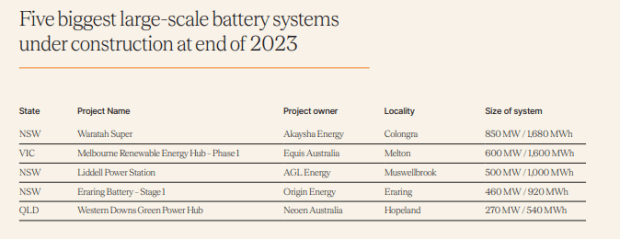
SOURCE – CLEAN ENERGY COUNCIL AUSTRALIA
Proponents of the ‘Climate Crisis’ have recently realised that the closure of coal and gas generation equipment is likely to lead to an unstable energy grid, intermittent power, and potential blackouts. To alleviate this problem, there is a concerted effort to encourage investment in ‘The Big Battery’. Within this battery world, there are currently around 30 projects in operation or under construction. These projects will, when completed, provide 5 Gigawatts of clean power for a total of two hours without a recharge.
Australia’s East Coast peak daily power consumption is currently around 65 Gigawatts.
Yes, 65 Gigawatts, not 5 Gigawatts…
Inferred, but not said, is the desire to aim for battery storage equal to 65 Gigawatts so that it can replace the current coal and gas-fired generators. The trouble is, the current predictions (with no gas or coal, and charging 15 million EVs) are for our power usage to increase to over 160 Gigawatts by 2050.
In February of this year, in Victoria, six high-voltage power line towers were brought down by a storm with 120 km/hour winds. 500,000 homes were left without power. This continued for many days. Once isolated, extra power was brought online to replace the loss. This extra power was mainly sourced from interstate gas and coal generators.
Consider these facts:
- Commercial solar panels are less than 20 per cent efficient on an annual basis. Their usable lifespan is 20 years [Note to David: try half that, their efficiency and output diminishes rapidly after a decade in service].
- A wind turbine (onshore) is around 30 per cent efficient on an annual basis. Their usable lifespan is 25 years [Note to David: try half that, after 12 years it often becomes uneconomic to repair them and they are completely replaced]. Wind tolerance of more than 12 km/hour and less than 90 km/hour. Ideal 60 km/hour.
- A big battery capable of storing and supplying 700 Megawatts for two hours is currently costs around $1.1 billion to build with a lifespan of 15 years [Note to Dave: there is no evidence to support that. Large scale batteries have been in service for less than 8 years – the big battery in SA came into service in 2018, it is highly unlikely to be operating at the same level in 2033].
- A big battery capable of grid supply for a day, or even longer (say 4-5 days) has not been invented yet.
- A nuclear generator (Example – APR1400, four built in UAE) can produce 1,400 Megawatts of clean power 24 hours per day for over 80 years with an annual efficiency of over 95 per cent. The cost of this generator is $9.5 billion.
- A big battery capable of storing/delivering 1,400 Megawatts of continuous power for five days is estimated to cost $168 billion – if it could be built!
- To compete with a nuclear reactor, over an 80-year period wind and solar would be replaced four times for (solar) and three and a half times for (wind), at the then current day costs.
The batteries would need to be replaced every 15 years, which is over five times in the same period. This is the most expensive item of a green energy transition.
Compare a 1,400 Megawatt wind and solar system, and batteries, with a nuclear generator, over 20 years.
Total asset cost for renewables is $232.25 billion.
Total asset cost for nuclear is $2.375 billion.
When you take into account all these additional factors, renewables are a trillion dollar disaster.
In the commercial world, all assets are amortised over their expected life-span. No board of directors would approve the above costs (some unknown) without calling for an extensive cost/analysis together with a ‘return on investment’ projection.
If it was their money, rather than ours, the entire project would be thrown out as nothing more than an illusion.
The Spectator

 STOP THESE THINGS
Both David and the Stop These Things editors were optimistic. My calculations about storage, using real data for California, Texas, USA as a whole, Denmark, Germany, and EU as a whole, show that the requirement is closer to 1,000 hours. I tried to analyze Australia but AEMO data are a confusing mess, and AEMO is not helpful in interpreting them. Assuming batteries existed that could hold a charge for half a year, at today’s Tesla prices ($US 0.50/Wh) and warranty period (10 years), assuming no cost for transport, installation, maintenance, decommissioning, recycling, destruction, and landfill, the USA cost would be only three times total GDP — every year — forever. Adding the other costs might bring the price to thirty times total GDP — every year — forever. http://vandyke.mynetgear.com/Worse.html
Then there’s the materials problem. For USA alone, batteries would require 1.6 times more copper, thirteen times more nickel, thirty times more cobalt, … than are known to exist in recoverable deposits.
Details and more in my book “Where Will We Get Our Energy?” A comprehensive end-to-end life-cycle system-engineering analysis of the entire energy landscape. Everything quantified. No vague handwaving. 350 bibliographic citations so you can verify I didn’t just make up stuff.
A wind turbine (onshore) is around 30 per cent efficient on an annual basis.
It is true that the average capacity factor of onshore wind is near 30%. However for some strange reason people have not yet got hold of the fact that the real problem with the wind is not the average CF but the severe wind droughts when the CF is under 10%, sometimes approaching zero for short periods.
It looks as though David and practically everyone else, has not read any of the thousands of words that I have written, many for the Spectator, to promote awareness of the pioneering work of the Miskelly team and Anton Lang. This suggests that my efforts have been wasted
If the wind was anywhere near 30% all the time we could overbuild to get what we want, as ghastly as that would be. But you have to look lowest point, in the way that the effectiveness of fence depends on the lowest part (or an open gate), likewise the flood levee, the dam and the chain that is only as strong as the weakest link.
There are two types of lies. Lies of commission are told deliberately to deceive.
Lying by ommission occurs when we deliberately don’t tell people things that we know.
And then to be fair there is simple carelessness, or absentmindedness, like the Met Bureaus of the world that never bothered to tell us about wind droughts.
In case people missed them this is my series in The Spectator.
https://www.flickerpower.com/index.php/search/categories/general/the-energy-crisis-how-we-got-here-and-how-to-move-on
And this briefing note from 2020 contains the essential references to Lang and Miskelly.
https://www.flickerpower.com/index.php/search/categories/renewables/20-2-four-icebergs-in-the-path-of-renewables-titanic
That is part of a series of note that were circulated to 800 state and federal reps and a list of journalists.
https://www.flickerpower.com/index.php/search/categories/general/list-of-briefing-notes
This article may be behind the times. I thought they had given up on promising batteries would solve all the problems and now Hydrogen is the big equalizer.
Of course, hydrogen is a bigger scam even than batteries.
Jeff, in Australia the usual suspects are really excited about so-called big batteries, although the Energy Realists were alert to this nonsense years ago, we dont have enough reach to make an impact
https://www.flickerpower.com/index.php/search/categories/renewables/21-12-the-capacity-of-big-batteries
https://www.flickerpower.com/index.php/search/categories/general/22-7-the-magic-pudding-of-energy-storage
On hydrogen.
Misplaced excitement.
https://www.flickerpower.com/index.php/search/categories/technology/21-9-green-hydrogen
The real cost.
https://www.flickerpower.com/index.php/search/categories/general/21-18-the-cost-of-green-hydrogen
Some of the estimates in this article are super conservative. For example, quoting a life of 15 years for a lithium battery is super conservative. The performance of a lithium battery of any size starts to degrade as soon as it is put into service. So it is not true that it can deliver its rated output steadily for 15 years. That output will diminish over time. Think your smartphone battery as it gets older. Similarly, the life of wind turbines in some instances, as measured in reality, is somewhat less than quoted – ie. more like 9 years.
Also, a nuclear power station cannot be said to deliver 24/7 x 365 days per year. Even nuclear power plants have to be taken down for maintenance occasionally.
Having said all of that, nuclear plants efficiency of about 92-95% is much better than around 20-22% for solar.
However, even with those adjustments, the relative cost differences remain pretty close to those quoted in the article.
Looking at the same rated output, irrespective of their asset life, compared to nuclear, to have any possibility of producing the same rated capacity with a wind plant you would have to provide a plant with somewhere near 3 x the rated output for wind and 4-5 times for solar for them all to provide the same output in the end. That makes the difference between your numbers even greater.
Although it makes little difference in the end, to quote 24/7 x 365 for nuclear, it just leaves the gate open for the Greens, MUA, CFMEU and consequently the ALP and other ideologues to make up yet more spurious arguments against the analysis here.
I agree, just STT!
Ross Elliott
>
We’ll stick with the metric of 24 x 365 because it’s true. The only time a nuclear plant will be incapable of delivering is during scheduled maintenance, otherwise it’ll be delivering power around the clock.
Continuous reactors and homogeneous reactors were studied in the 1960s, but Admiral Hyman Rickover convinced the AEC to go with the same design as USA submarines — pressurized light-water reactors. My article “Revisiting Mobile Paste Reactor Fuel” was published in Nuclear Technology 209, 11 (12 June 2023) pp 1840-1858, doi 10.1080/00295450.2023.2205551.
A paste of tiny fuel particles plus sodium circulates through the reactor with a residence of a few hours, with a tiny fraction sent continuously for on-site reprocessing. Instead of being out of service 15 days per year, it might be out of service 15 days per decade for inspection, and thirty days every five decades to replace worn parts. I’ll send a PDF if you don’t want to pay Taylor & Francis’s exorbitant fee ($US 61).
During scheduled maintenance, as opposed to when the wind randomly stops blowing, there are plans in place for other assets to cover the demand.