
Only wealthy Westerners have the luxury of pretending to get their power from sunshine and breezes. Elsewhere, there are billions scrambling to have power delivered reliably and affordably, as if their lives and economic futures depend upon it. Which they absolutely do.
For as long as cynical NGOs keep peddling ridiculously expensive solar panels – seen as ‘fake electricity’ by those lumbered with it – and forcing tinpot governments to sign up to costly and pointless wind and/or solar power schemes, the ratio of haves to have-nots is likely to stay that way for the foreseeable future.
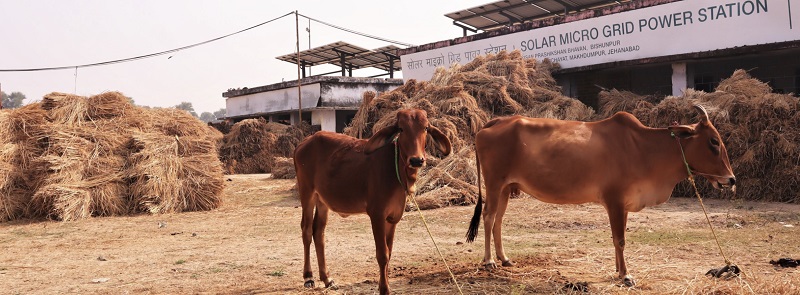
Across India, communities lumbered with expensive and completely impractical solar generation systems – referred to by the likes of Greenpeace as “solar villages” – are rejecting meddling outside interference, out of hand. In one case, locals simply turned the solar microgrid into a cowshed (see above).
As Vijay Jayaraj reports below, power hungry Indians – sick of fake electricity – are rejecting pointless solar schemes and demanding affordable power, reliably delivered.
World’s Most Populous Nation Has Put Solar Out To Pasture. Other Countries Should Follow Suit
Daily Caller
Vijay Jayaraj
10 July 2024
During his debate with former President Donald Trump, President Joe Biden claimed: “The only existential threat to humanity is climate change.” What if I told you that it is not climate change but climate policies that are the real existential threat to billions across our planet?
The allure of a green utopia masks the harsh realities of providing affordable and reliable electricity. Americans could soon wake up to a dystopian future if the proposed Net Zero and Build Back Better initiatives — both aimed at an illogical proliferation of unreliable renewables and a clamp down on dependable fossil fuels — are implemented.
Nowhere is this better reflected than in remote regions of India where solar panels — believed to provide clean and green energy — ultimately resulted in being used to construct cattle sheds.
The transformation of Dharnai in the state of Bihar into a “solar village” was marked by great enthusiasm and high expectations. Villagers were told the solar micro-grid would provide reliable electricity for agriculture, social activities and daily living. The promise engendered a naïve trust in a technology that has failed repeatedly around the world.
The news of this Greenpeace initiative quickly spread as international news media showcased it as a success story for “renewable” energy in a third world country.
CNN International’s “Connect the World” said Dharnai’s micro-grid provided a continuous supply of electricity. For an unaware viewer sitting in, say, rural Kentucky, solar energy would have appeared to be making great strides as a dependable energy source.
But the Dharnai system would end up on the long list of grand solar failures.
“As soon as we got solar power connections, there were also warnings to not use high power electrical appliances like television, refrigerator, motor and others,” said a villager. “These conditions are not there if you use thermal power. Then what is the use of such a power? The solar energy tariff was also higher compared to thermal power.”
A village shopkeeper said: “But after three years, the batteries were exhausted and it was never repaired. … No one uses solar power anymore here.” Hopefully, the solar panels will last longer as shelter for cows.
Eventually, the village was connected to the main grid, which provided fully reliable coal-powered electricity at a third of the price of the solar power.
Dharnai is not an isolated case. Several other large-scale solar projects in rural India have had a similar fate. Writing for the publication Mongabay, Mainsh Kumar said: “Once (grid) electricity reaches unelectrified villages, the infrastructure and funds used in installation of such off-grid plants could prove futile.”
While green nonprofits and the liberal mainstream media have the embarrassment of a ballyhooed solar project being converted to cattle sheds, conventional energy sources like coal continue to power India’s more than 1.3 billion people and the industries their economies depend on.
India saw a record jump in electricity demand this year, partly due to increased use of air conditioning units and other electrical appliances as more of the population achieved the financial wherewithal to afford them. During power shortages, coal often has come to the rescue. India allows its coal plants to increase coal stockpiles and import additional fuel without restrictions.
India will add more than 15 gigawatts in the year ending March 2025 (the most in nine years) and aims to add a total of 90 gigawatts of coal-fired capacity by 2032.
Energy reality is inescapable in a growing economy like India’s, and only sources such as coal, oil and natural gas can meet the demand. Fossil fuels can be counted on to supply the energy necessary for modern life, and “green” sources cannot.
India’s stance is to put economic growth ahead of any climate-based agenda to reduce the use of fossil fuels. This was reaffirmed when the country refused to set an earlier target for its net zero commitment, delaying it until 2070.
The story of Dharnai serves as a cautionary tale for the implementation of renewable energy projects in rural India, where pragmatism is the official choice over pie in the sky.
Daily Caller
 STOP THESE THINGS
India has enormous thorium reserves, and does not have one million tonnes of uranium above ground, mined, milled, and refined as we have in USA. So thorium reactors make sense for them, and they are conducting research and development. But thorium isn’t fissionable; it’s fertile. Fissionable uranium-233 needs to be bred from thorium-232 in a reactor. The breeding ratio is only about 1% per year, compared to breeding Pu-239 from U-238 at 5% per year. To start the fleet, India will need U-235 or Pu-239. But they know how to get both of them.
Brazil has thorium, too, at least in a few places such as Guarapiri, but not nearly as much as India.