

Apart from the tendency of these things to self-incinerate and set the country ablaze, there’s their ability to wreck local weather patterns and, in the mother of all ironies, raise local temperatures – beyond those of the surrounding areas unaffected by these whirling wonders.
Spear hundreds of 300m high wind turbines into ocean environments and it’s only natural that that environment changes. Downwind air currents are cut and buffeted by the blades of turbines up wind. The phenomenon known as ‘wake turbulence’ reduces output from each turbine within a cluster of turbines, because it reduces and interferes with wind speed and direction within that cluster.
One topic that cool interests our followers, is just a significant is the effect these things have on local weather. In this piece from the archives, Issac Orr delves into the data to conclude that these things are wrecking the climate now, rather than ‘saving’ us from weather threats 50 years from now.
Harvard Study Finds Wind Turbines Will Cause More Warming In Minnesota Than Emissions Reductions Would Avert
American Experiment
Issac Orr
6 October 2020
A 2018 study conducted by scientists from Harvard, published in the academic journal Joule, found that wind turbines cause significant local increases in surface temperatures in the areas where they are located. Wind turbines cause local temperature increases at the surface of the earth by causing air to mix throughout portions of the atmosphere, and Minnesota would be one of the states impacted most by this phenomenon.
Warming Wind Turbines
According to the study, wind turbines measuring between 100 and 150 meters (328ft to 498 ft) operating at night can pull down warmer air from as far as 1,640 feet in the air down to the surface, warming the surface of the earth, where it would impact the people, plants, and animals living near the turbines.
The study looks at what would happen if the United States tried to obtain all of its energy from wind turbines. It found the mixing of warmer air and cooler air results in a temperature increase of 0.54 degrees Celsius (0.97 degrees F) in the areas where the wind turbines would be located, as you can see in the figure below from the study. The amount of warming experienced in some regions would be even greater, as Southwestern Minnesota could see a temperature increase of 0.6-0.8 degrees C due to wind turbines, while Northeastern Minnesota would see an increase of 0.3-0.5 degrees C.
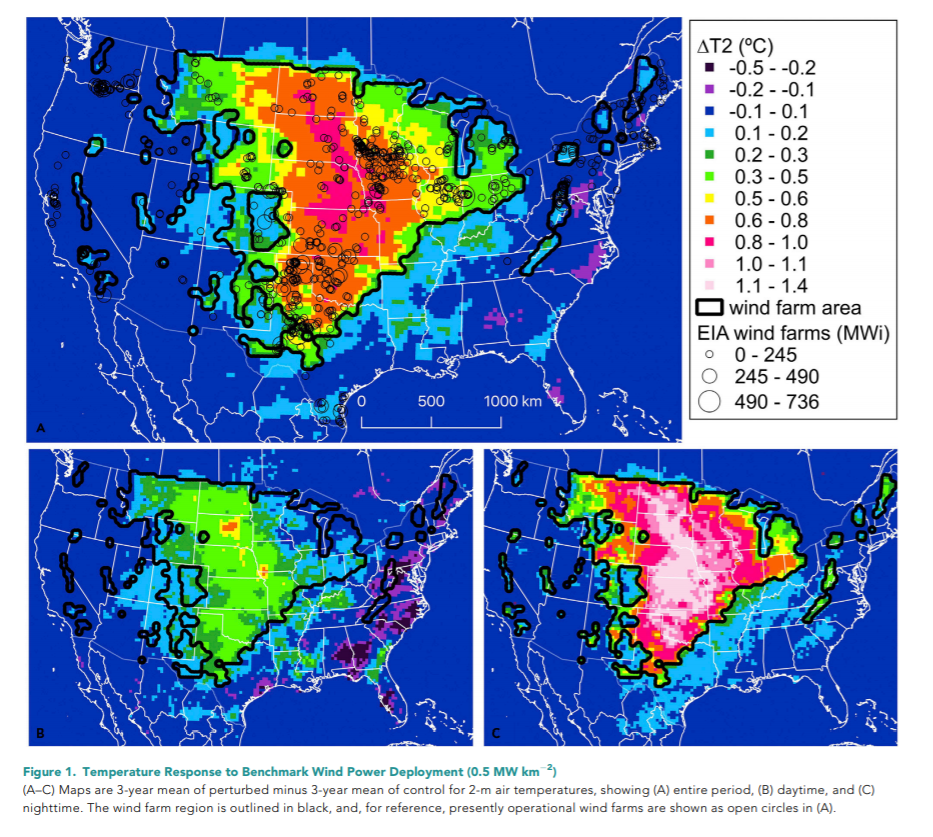
Most of the warming would occur at night, according to the study:
“The wind farm region experiences warmer average temperatures (Figure 1A), with about twice the warming effect at night compared with during the day (Figures 1B and 1C). Warming was generally stronger nearer to the center of the wind farm region.”
All Energy Sources Have Impacts
This study is interesting because it acknowledges that all energy sources, whether they be coal, natural gas, wind or solar have environmental impacts. It seems to be one of the few studies that attempts to evaluate the costs of wind turbines, along with their supposed benefits, and use this cost/benefit to figure out which sources of energy have the fewest environmental impacts. The authors claim this will be important when discussing which carbon-free sources of electricity will be used in the future, but I believe it informs our current energy decisions,.
According to the study:
“The climatic impacts differ in (at least) two important dimensions. First, the direct climatic impact of wind power is immediate but would disappear if the turbines were removed, while the climatic benefits of reducing emissions grows with the cumulative reduction in emissions and persists for millennia. Second, the direct climatic impacts of wind power are predominantly local to the wind farm region, while the benefits of reduced emissions are global.”
In other words, the warming impact of wind turbines is immediate, and highly localized in the areas that are the “hosts” to the installations. The supposed benefits of reducing carbon dioxide emissions are global, not local. This means places like Minnesota will see an increase in temperature from wind turbines that exceeds amount of potential future global warming that would be averted from completely reducing Minnesota’s greenhouse gas emissions to zero.
Minnesota Emissions Reductions
According to the Minnesota Pollution Control Agency, Minnesota emitted about 150 million metric tons of greenhouse gases in 2016. Using the same logic used by the Obama Administration to craft the Clean Power Plan, if we completely eliminated all of these emissions to zero, it would avert only 0.004 degrees C by 2100, which is an amount far too small to measure!
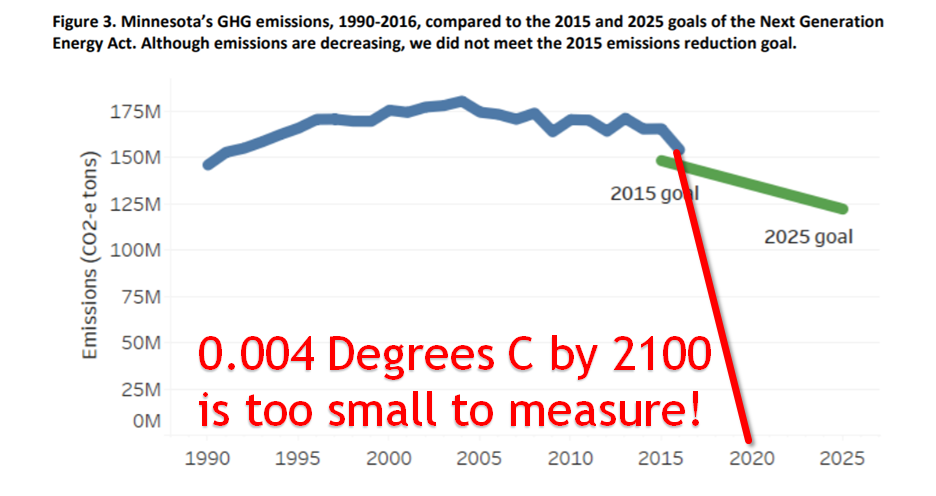
In fact, the amount of global warming averted (0.004 degrees C) would be 138 times smaller than the warming Minnesota would incur from building out wind turbines to power all of our electricity use (0.54 degrees C), as you can see in Figure 5(d) from the study below.

The orange dotted line shows surface temperature increases in the areas with wind turbines, and the orange solid line shows the temperature impact of wind turbines on the entire continental United States. The blue and grey shaded areas show the differences in surface temperatures in the United States from reducing our national emissions.
As you can see, surface temperatures in the United States increase more due to wind turbines mixing air in the atmosphere than would be offset by reducing emissions. This is especially true in areas like Minnesota, where the wind turbines would be operating.
The only time that reduced emissions might impact surface temperatures more than the wind turbines, themselves, is if the entire world reduces their carbon dioxide emissions, but if you believe China will actually reduce their emissions, I’ve got a bridge to sell you.
Conclusion
In light of this study, it makes zero sense to build wind in Minnesota if our Governor truly wants to “make sure there is still ice on that lake in January,” because surface temperatures will increase much more from the wind turbines than they would fall by reducing emissions. A note to the Governor, increasing surface temperatures would reduce the amount of ice on that lake in January.
Center of the American Experiment has been one of the leading organizations advocating for Minnesota to repeal its antiquated ban on new nuclear power plants. We have also been some of the strongest supporters of allowing hydroelectric power that we already purchase from Canada to count toward our renewable energy mandates.
If Governor Walz and liberal legislators worry about the impact of global warming on Minnesota, then they need to own up to the fact that the surface temperature impacts of wind turbines mixing air in the atmosphere will far outweigh the amount of warming that would be averted from reducing emissions and seek to legalize new nuclear, large hydro, and promote carbon capture and sequestration technologies that provide reliable electricity without carbon dioxide emissions.
In the spirit of full fairness, it should be noted that the findings of this study are based on General Circulation Models (GMS), which overestimate the amount of global warming that is observed with weather balloons and satellites by a factor of two, so the results of this study may well be as legitimate as Governor Walz’s COVID-19 models.
However, it should be noted that all of the policies renewable energy specialist interest groups try to pass in Minnesota to avert climate change are also based on GCM’s, so it is highly inconsistent for them to trumpet GCM’s as gospel in one instance (when it promotes something they like), and completely ignore them in another (when their findings conflict with their policy preferences).
American Experiment

 STOP THESE THINGS
About seventy years ago, Albert Betz computed that it is impossible to extract more than 57% of the kinetic energy from any moving fluid using turbines. Think about this: If you stop it altogether (i.e., extract all the kinetic energy), the flow behind the turbine would pile up and increase the pressure, force your turbine to turn, and produce downstream flow. And it doesn’t matter how many turbines you put in series.
Wind turbines also change humidity upstream and downstream, in opposite patterns depending upon the season.
Details in my book “Where Will We Get Our Energy?” A Comprehensive end-to-end life-cycle system-engineering study of the entire energy landscape. Everything quantified. No vague handwaving. 350 bibliographic citations so you can verify I didn’t just make up stuff. Tell me if you find a mistake, or about something I should have included but didn’t.