
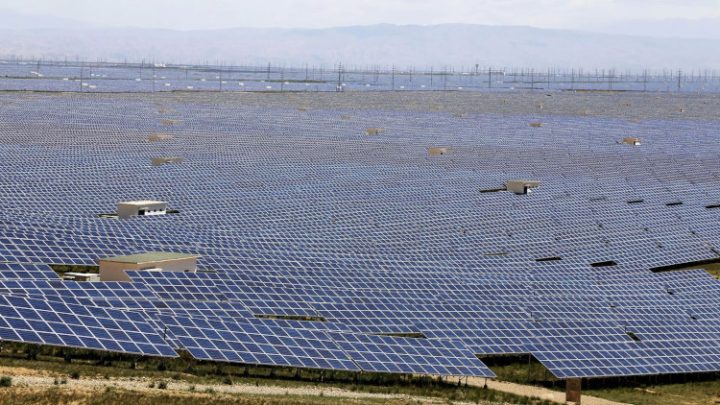
Whether it’s pristine ancient forests or prime agricultural land, wind and solar outfits will destroy it in a heartbeat. If left to the cynical rent-seeking class, there won’t be an inch of the planet worth saving, after they have carpeted it with millions of acres of part-time power producing panels and speared millions of these things into the rest.
Remember this has absolutely nothing to do with generating reliable and affordable electricity. It is always and everywhere about the subsidies that can be gleaned from the greatest economic and environmental fraud in history. So far, so cynical.
Which brings us to the scale of the disaster that’s unfolding across the West, under the guise of the grand wind and solar ‘transition’.
In the first piece John Constable draws focus on the inherent hypocrisy demonstrated by the modern eco-fascists – who would destroy every last patch of paradise, if there was a ‘green’ buck to be made (at someone else’s expense).
In the second, the team from Jo Nova points out that an ever-reliable nuclear power plant can produce power around-the-clock and do so using a tiny fraction of the land required by distant and diffuse wind and solar operations.
The terrifying scale of the ‘green’ revolution
The Spectator
John Constable
25 August 2024
Many have been emotionally drawn to the green revolution in the belief that renewable energy will restore our personal and community independence. According to this, by investing in green technology, Britain will gain freedom from coal barons and gouging sheikhs, and deliver a grass-roots, democratic energy system. Ed Miliband played into this on Friday when he blamed the energy price cap being raised on the ‘failed energy policy we inherited, which has left our country at the mercy of international gas markets controlled by dictators.’
Others believe green energy represents the free spirit and harmony with nature. ‘What would you rather have in your neighbourhood?’, I remember being asked in 2005. ‘A little wind turbine swirling gently in the breeze, or a nuclear power station and pylons?’
As it is turning out, and particularly so now that Ed Miliband is back in charge of energy policy after 14 years in the wilderness, the green transition means armies of gargantuan wind turbines on land and sea; great blue-black mirror of solar panels glazing over thousands of acres of farmland; a neurotic spider’s web of grid cables criss-crossing the country; and dozens and dozens of whining substations and vast Area 51-like compounds of shipping-container sized lithium-ion batteries.
As if that were not bad enough, it transpires that in spite of all this green industrialisation we will still require nuclear and conventional gas turbine power stations. We may not use them as much, but reliability is an issue with wind and solar, and therefore generators are needed to guarantee security of supply at times when the British weather fails to deliver. ‘Who knew, except everyone?’ as the Americans say.
Still, the sheer immensity of low carbon industrialisation is coming as an unwelcome shock to those who only a few years ago would have at least passively supported wind and solar development.
There was clearly a profound misunderstanding about the physical character of renewable energy power systems. But no one should in fact be surprised. The physics of renewable energy are inescapable.
While there is a substantial quantity of energy in the wind, the thermodynamic quality of that energy is very low. It is for this reason that there are no organisms that derive their metabolic energy from wind, an extraordinary fact given its widespread availability at unthreatening temperatures. Wind energy is simply too chaotic to support life.
Solar radiation is somewhat better. Indeed, outside the earth’s atmosphere it is of fairly high quality. But on the surface of the planet and seen from the perspective of a leaf or a photovoltaic cell it is hindered by atmospheric interference, clouds and airborne dust, and critically by the rotation of the earth. Plants do derive energy from sunshine, but they are relatively simple organisms, and they do not move rapidly or have complex nervous systems.
The low energy density of wind and sun means that extremely large collection devices are needed – enormous wind turbines with large blades, vast areas of solar panels. It is necessarily a capital-intensive and very expensive system.
A concrete example will make this clear. The 1,400 Megawatts (MW) Sophia Offshore Wind Farm on the Dogger Bank is currently under construction and will cover an area of nearly 600 square kilometres (it would just about fit into Middlesex). It is one of many major wind installations that the government is intending to drive through in its ambition to quadruple offshore capacity. We currently produce about 15 Gigawatts (GW) of operational offshore wind power. To meet this quadrupling of capacity, we would need around 30 more Sophia Offshore wind farms.
The Sophia will use the Siemens Gamesa SG 14-222 DD, one of the largest wind turbines on the market, with a generating capacity of 14 MW. It has three blades 108m in length, each weighing 65 tonnes. The nacelle, the box containing the generator at the top of the tower, weighs 500 tonnes, which Siemens proudly describes as a lightweight machine. Compared to other brands, this may even be true.
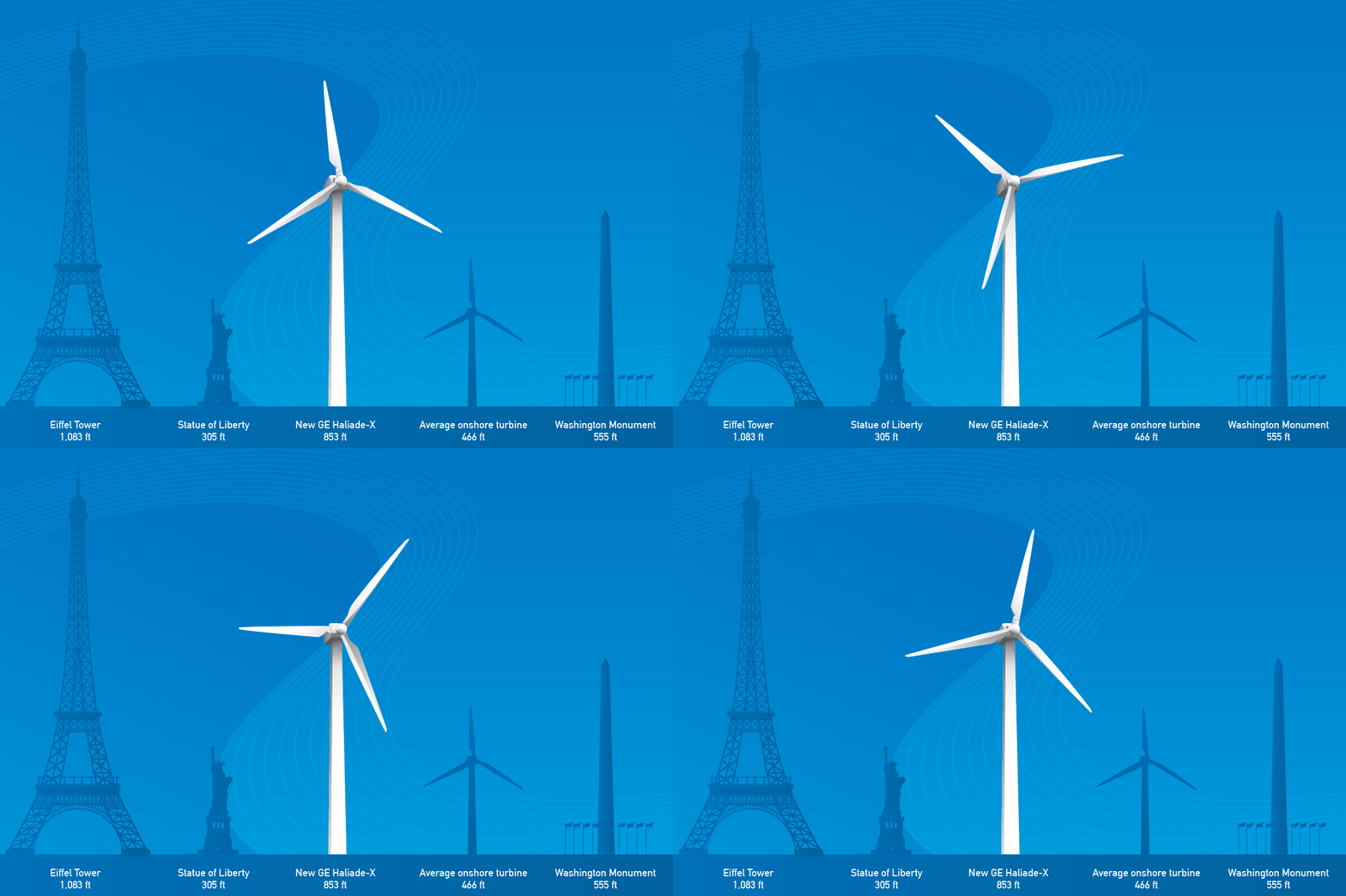
The overall height of the turbine is 252m, only 60m short of Britain’s tallest building, the Shard. It foundations will, according to Sophia’s own publicity, be 80 to 90m in length and weigh 1,200 to 1,400 tonnes each. The total weight of each turbine – blades, nacelle, tower and foundations – is likely to be nudging towards 3,000 tonnes.
Sofia will use 100 of these structures, so we can estimate that the wind farm alone accounts for about 300,000 tonnes of industrial equipment, mostly steel, some concrete, and fibre-glass reinforced epoxy in the blades. (For reference, a Queen Elizabeth class aircraft carrier weighs a mere 65,000 tonnes.) And this is before we have taken into account the offshore substations and the cables connecting each turbine and the shoreline.
Multiply all this by 30 to meet the government’s offshore wind targets, and you arrive at nine million tons of industrial equipment for the additional offshore installations alone. For scale, recall that the UK’s total annual production of steel is only six million tons, and you can begin to appreciate the magnitude of Ed Miliband’s plans for the country. This Wind and Sun King makes Louis XIV lookhumble.
The total manufacturing mass involved in Sophia is difficult for anyone outside the project to calculate, but the order of magnitude is clear: it’s huge, and regardless of your views on its beauty, it’s certainly not going to be cheap. Sophia states that its total capital cost is in the region of £3 billion, a great deal for an asset exposed to the North Sea and likely to have a short economic lifetime.
Onshore wind farms weigh less than Sophia’s marine leviathans but are of broadly similar dimensions. The Vestas V136 4.2 MW, for example, has blades of 76m and hub heights up to 166m, giving a total overall height of over 240m. The Eiffel Tower is only 60 meters taller. These are the sorts of devices that Ed Miliband now thinks acceptable next to rural dwellings.
But relative to their size, these wind farms do not produce much energy. Sophia, for example, will produce around six Terawatt hours (TWh) per year, according to the company’s website. Although this is unlikely to be maintained over the entire lifetime of the windfarm, this is still only equivalent to about 2 per cent of total annual UK demand for electricity. Given the sheer size of Sophia that really isn’t very much – only around 0.01 TWh per square kilometre.
Solar, as predicted from theory, is slightly better, but still abysmal. Mr Miliband recently overruled the recommendations of his own planning inspectors to consent to a 500 MW photovoltaic installation on 2,500 acres (10 square kilometres) of Suffolk farmland near Newmarket. It is about 15 miles long, and comprises around one million solar panels. In spite of the site’s gross magnitude, it will generate only about 0.5 TWh of electrical energy per year. This is a very poor exchange for the energy or food that could be otherwise grown on the land.
For comparison, consider the Sizewell B nuclear power station, also in Suffolk, and running since 1995. The site occupies a land area of about 0.5 square kilometres, less than a thousandth of Sophia’s area. Still, Sizewell B generates more energy, as much as 10 TWh a year. It is, very roughly, 1,500 times more productive than the Sophia wind farm, and 300 times more productive than the Sunnica solar farm when it comes to space. On this land use basis, Sizewell C, now under construction, can plausibly claim to be 1,000 times more productive than solar and 3,000 times more so than onshore wind.
That is typical for conventional power stations: they are small and highly productive compared to renewables. Correcting the severe physical defects of wind and solar generation requires capital equipment on the grandest of scales, and as a result the adoption of renewables results in a low productivity system which is intrinsically expensive and resource hungry compared to the fossil and nuclear alternatives.
Moreover, most of the extraction, conversion and delivery of renewables is at present manufactured by a fossil-fuelled global economy – primarily in Asia and in particular China.
But if, as the government seems to want, green equipment is produced domestically, then the costs will rise dramatically. In this case, is not even clear that there would enough of an energy return to justify the costs of a wind or solar project. The profit margin would be very thin, or even non-existent. At best, the renewable energy sector would not only be the largest consumer of its own energy output, but encompass the bulk of the British economy. Those owning green energy businesses would possess levels of relative wealth and power not seen since the gentry and aristocracy of the pre-coal economies of Europe. One imagines that this would be politically extremely controversial.
So, there is more to the industrial dystopia of wind turbines and solar farms than mere aesthetics and a counterproductive climate policy.
The Spectator
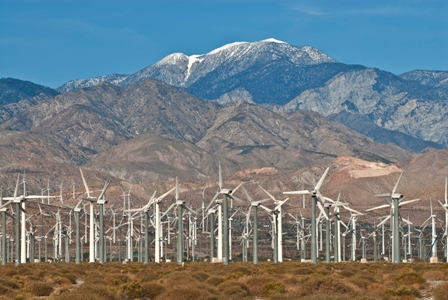
Industrial wind plants afflicts 3,000 times as much of the surface of Earth as a nuclear plant does
Jo Nova Blog
Jo Nova
28 August 2024
John Constable puts some numbers on The terrifying scale of the green revolution in The Spectator this week.
Ponder just the scale of the Sophia Offshore industrial wind plant being built off the UK. The wind is free, but to collect enough of it to power 2% of the country, the UK will have to build 100 wind turbines, some 200 kilometers out in the North Sea. Each blade is 108m long and weighs 65 tons, or about as much as a semi-trailer. When the wind blows hard enough, about 200 tons of matter will rotate above the ocean. The box holding all the spinning parts together weighs another 500 tons and needs to be suspended 140 meters up in the air over the waves and during storms.
Each of the 100 turbines will reach 250 meters high, which is “only 60m short of Britain’s tallest building”. So much effort and so little to show for it.
To make sure the whole thing doesn’t fall in the drink with the first stiff breeze, the turbines need to be weighed down with more than a thousand tons of concrete embedded in the sea floor.
The blades will be “recyclable” they say, but who will clean all that concrete out of the wilderness 30 years from now I wonder? Let’s ask Greenpeace!
All up, each windmill weighs around 3,000 tons, and the entire farm-that-grows-nothing will consume 300,000 tons of industrial material and cover 600 square kilometers.
All this to make just a random 2% of the UK’s electricity, not necessarily when it’s needed, either, so even if the UK built 50 plants just like it, they’d still need to build an entire functioning generation network as back up.
The Sophia plant will cost about £3 billion, and won’t last very long (compared to a normal power plant). But it will kill some whales and eagles, confuse Air Force and shipping radars and hypnotize some crabs. It may deafen a few porpoises too, not that they will complain. (Where are the Greens?)
Two whole converter stations will also be built — one at sea and one onshore — to collect and convert the green electrons so they can be squeezed through the 200 kilometer long subsea cable. These decks (in yellow below) were made in Indonesia, where they still have affordable electricity.
If President Xi wanted to knock out the entire power station, by the way, he wouldn’t need to fire any missiles or send in a SWAT team. A Chinese cargo ship could just accidentally drag its anchor across the 200 kilometer cable somewhere. It’s been known to happen.
As John Constable says, the 30 year old Sizewell B nuclear plant uses half a square kilometre and still makes 10TWh of reliable electricity. The Sophia wind plant uses 600 square kilometres to make 6 TWh of random power.
The wind plant effectively afflicts 3,000 times as much of the surface of Earth as a nuclear plant does for the amount of energy made, yet the Greens cheer it on. What have they become…
Jo Nova Blog
 STOP THESE THINGS
John remarked briefly at the end of his article on energy return on energy invested (EROI). EROI at least 7 is needed for economic viability. Solar with buffering and biomass are 4.8. Wind with buffering is 11. Nuclear is 100. Hydro is 105.
Daniel Weißbach, G. Ruprecht, A. Huke, K. Czerski, S. Gottlieb, and A. Hussein. Energy intensities, EROIs (energy returned on invested), energy payback times of electricity generating plants. Energy, 52:210–221, April 2013. http://dx.doi.org/10.1016/j.energy.2013.01.029.
Details in my book “Where Will We Get Our Energy?” Everything quantified. No vague handwaving. 350 bibliographic citations so you can verify that I didn’t just make up stuff.
In Ontario the siting of these turbines is shown in this map: https://ccsage.wordpress.com/wp-content/uploads/2012/08/top-map-ontario-wind-turbines-aug-11-2012.jpg top-map-ontario-wind-turbines-aug-11-2012 JPEG Image · 120 KB As you can see they’ve ruined the shoreline communities. These communities were the destination of tourists because of the magnificent Great Lakes. The Liberal government that allowed this to happen, by taking away the rights of residents and municipally elected representatives to oppose this. They were decimated at the polls and even lost their party status.The Conservative Government promised to stop this and protect the people being harmed. The harm continues. The mainstream media is silent. The Conservative government is currently allowing contracts to be extended, proposing to allow more turbines. They have not protected the people and communities experiencing the harm. An insider says they’re ‘weak at the knees’ and afraid of negative ramifications.
>