

In another you ‘couldn’t make it up’ moment, the wind industry has been busted burning tonnes of diesel to keep turbines spinning in an effort to prevent them freezing solid during cold weather.
In Scotland, the ‘fossil fuel’ consumption outbreak involves burning diesel in local generators, which send power into the turbines to keep them spinning to prevent them locking up solid.
Ordinarily, in that situation the turbines simply suck power out of the grid. Another fun fact you’re never told about.
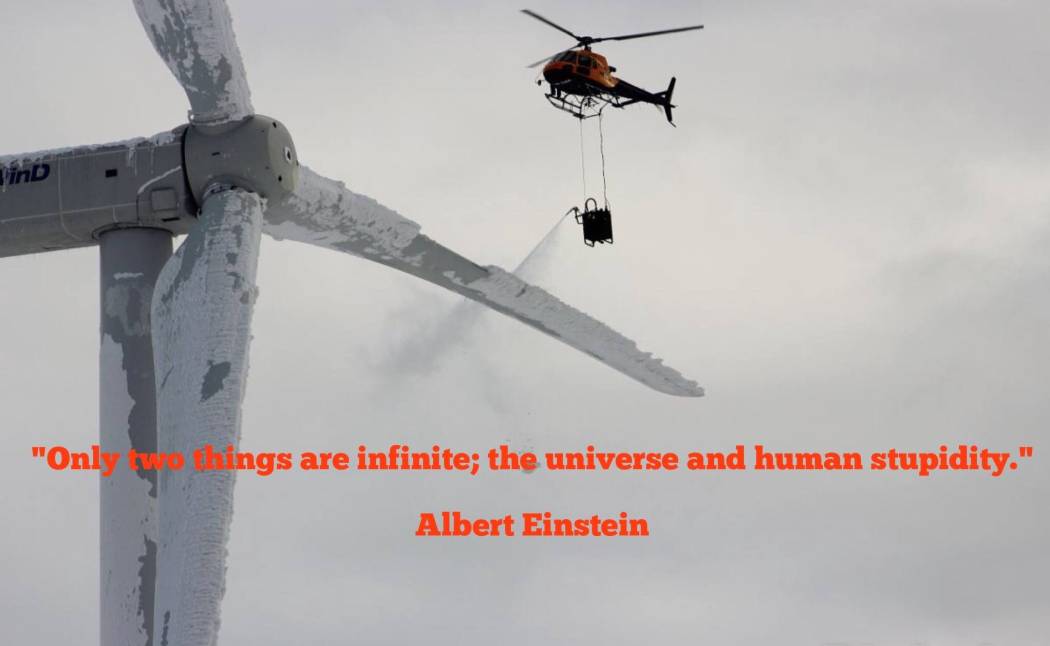
The other method used to remove ice from the blades involves burning diesel to boil water, create steam and the steam is then sprayed over the blade, from a self-contained boiler slung underneath a helicopter (see pic below).
John Gideon Hartnett takes a look at yet another ridiculous aspect of the most ridiculous power generation source, there is.
Another climate myth busted
The Spectator
John Gideon Hartnett
6 August 2024
What I like to call ‘climate cult’ wind farms expose the myth that wind can replace hydrocarbon fuels for power generation. The following story is typical of the problems associated with using wind turbines to generate electricity in a cold environment.
Apparently, diesel-fuelled generators are being used to power some wind turbines as a way of de-icing them in cold weather, that is, to keep them rotating. Also, it appears that the wind turbines have been drawing electric power directly from the grid instead of supplying it to the grid.
Scotland’s wind turbines have been secretly using fossil fuels.
The revelation is now fueling environmental, health and safety concerns, especially since the diesel-generated turbines were running for up to six hours a day.
Scottish Power said the company was forced to hook up 71 windmills to the fossil fuel supply after a fault on its grid. The move was an attempt to keep the turbines warm and working during the cold month of December.
South Scotland Labor MSP Colin Smyth said regardless of the reasons, using diesel to deice faulty turbines is “environmental madness”.
Source: Straight Arrow News
I don’t agree that diesel is a ‘fossil’ fuel. It is not. Read Abiogenic Deep Origin of Hydrocarbons: Not Fossils But Primordial.
Nevertheless, those pushing these technologies are so blind to the physical realities of the world that they are prepared to ignore failures while pretending to efficiently generate electricity. I say ‘failures’ because wind energy was put out of service the day the Industrial Revolution was fired up (pun intended) with carbon-based fuels, from petroleum and coal. And in the case of modern wind turbines, they do not always generate electricity; they sometimes consume it from the grid.
Green energy needs the hydrocarbon-based fuel it claims to replace.
Hydrocarbon-based fuels were provided providentially by the Creator of this planet for our use. That includes coal, which has been demonised in the Western press as some sort of evil. But those who run that line must have forgotten to tell China, because they build two coal-fired power stations every other week. No other source of non-nuclear power is as reliable for baseload generation.
How will wind turbines work in a globally cooling climate as Earth heads into a grand solar minimum and temperatures plummet? This case from Scotland may give us a hint. As cloud cover increases with cooler weather, and more precipitation occurs, how will solar perform? It won’t.
The two worst choices for electricity generation in cold, wet, and stormy environments are solar and wind. Solar is obvious. No sun means no power generation. But you might think wind is a much better choice under those conditions.
However, wind turbine rotors have to be shut down if the wind becomes too strong and/or rapidly changes in strength. They are shut down when too much ice forms or when there is insufficient wind. And now we have learned in Scotland they just turn on the diesel generators when that happens or they draw power directly from the grid.
Where are all the real engineers? Were they fired?
In regards to wind turbines going forward, once their presence in the market has destroyed all the coal or natural gas electricity generators, how are they going to keep the rotors turning and the lights on?
These devices are based on a rotating shaft with a massive bearing, that suffers massive frictional forces. In this case, only a high-quality heavy-duty oil can lubricate this system and I am sure it would need to be regularly replaced.
Massive amounts of carbon-based oil are needed for the lubrication of all gears and bearings in a wind turbine system, which is mechanical in its nature. In 2019, wind turbine applications were estimated to consume around 80 per cent of the total supply of synthetic lubricants. Synthetic lubricants are manufactured using chemically modified petroleum components rather than whole crude oil. These are used in the wind turbine gearboxes, generator bearings, and open gear systems such as pitch and yaw gears.
Now we also know that icing causes the rotors to stop turning so diesel power has to be used to keep the bearings warm during cold weather. The diesel generator is needed to get the blades turning on start-up to overcome the limiting friction of the bearing or when the speed of the rotor drops too low.
In this case in Scotland, 71 windmills on the farm were supplied with diesel power. Each windmill has its own diesel generator. Just think of that.
What about the manufacturing of these windmills?
The blades are made from tons of fibreglass. Manufacturing fibreglass requires the mining of silica sand, limestone, kaolin clay, dolomite, and other minerals, which requires diesel-driven machines. These minerals are melted in a furnace at high temperatures (around 1,400°C) to produce the glass. Where does that heat come from? Not solar or wind power, that is for sure. The resin in the fibreglass comes from alcohol or petroleum-based manufacturing processes.
The metal structure is made from steel that requires tons of coking coal (carbon) essential to make pig iron, which is made from iron ore in a blast furnace at temperatures up to 2,200°C. The coal and iron ore is mined from the ground with giant diesel-powered machines and trucks. The steel is made with pig iron and added carbon in another furnace powered by massive electric currents. Carbon is a critical element in steel making, as it reacts with iron to form the desired steel alloy. None of this comes from wind and solar power.
Wind turbine power generation is inherently intermittent and unreliable. It can hardly called green as the wind turbines require enormous amounts of hydrocarbons in their manufacture and continued operation.
The Spectator
 STOP THESE THINGS
All very informative. And also quite irrelevant. Environmental extremism is a religion, and religions by definition are immune from awkward and contrary facts. Not that the facts as detailed above ever get to the general public (AKA voters) in any case, because virtually every form of communication – print, broadcast, social media and academia – presents only one side of the argument and ensures that they don’t hear, see or read of about them.
Thanks for your comment, Nicholas but STT does not consider what we have been doing since December 2012 irrelevant. To the contrary. The fact you read our post, engaged with it and felt compelled to comment proves the point. The problem isn’t the cultist, it’s the acquiescence of the great bulk of people who are blind to what is occurring. This site is dedicated to educating a subset of that group, not deradicalizing deranged zealots.
Over the last decade we have been joined by hundreds of commentators on dozens of sites, doing much the same. We doubt the legacy media has anything like the influence you suggest. Not anymore. Whatever remaining credibility it had was destroyed by its covid hysteria, and its rabid climate catastrophism is, likewise, being increasingly viewed with derision.
The resin binding fiberglass is epoxy because polyester resins are destroyed by solar UV. About 40% of epoxy is Bisphenol-A, which is banned in food packaging in many countries because it’s carcinogenic. The average wind turbine sheds about 65 kg of microplastic particles, mostly epoxy, every year. But if the Bisphenol-A gets into food from turbine blades instead of packaging, that’s OK because of climate, or something.