
Corporates claiming to run on nothing but sunshine and breezes is just another form of greenwashing. Whether it’s tales about producing ‘green’ iron or ‘green’ hydrogen, the truth never gets a look in. And it’s the same when major energy users claim to be exclusively powered by wind and/or solar.
In every case these operators ensure that they remain connected to the same grid that powers everybody else; the same grid that runs on coal, gas or nuclear. Such that reliable power is never far away.
Even where the green-washer purports to disconnect, there will be a bank of diesel generators or gas turbines close and handy when the sun sets, the wind stops blowing or the battery runs flat.
Any business worth running requires power as and when it needs it; not when the sun’s up or the wind is blowing.
And that very much includes data centres that sit at the heart of the Internet.
Knowing that their staggering and constant power use has capacity to generate poor corporate ‘optics’, electronic data handling outfits – like America’s Switch – pitch up stories about using 100% ‘renewable’ energy, 100% of the time.
As Francis Menton reports below, it’s a claim that is 100% pure and unadulterated bunkum.
Zero Emissions Grid Demonstration Project Follies: No Fraudulent Demonstration Projects Allowed!
Manhattan Contrarian
Francis Menton
13 August 2024
Even as I regularly repeat my calls for a Zero Emissions Grid Demonstration Project, I’m ready for the next move in the back and forth.
Suppose someone claims that a steady zero emissions electricity supply has been achieved? How can we determine and verify whether that is true? The facts can be sufficiently complex, and the incentives sufficiently perverse, that fraudulent claims are to be expected.
Consider the simple case of El Hierro Island. They set out in 2008 with the objective of building a wind/storage electricity system that would provide the island with zero-emissions electricity.
To this day, the website of the wind/storage electricity company, Gorona del Viento, proclaims on its opening page “An island 100% renewable energy.” Proceed through the website, and you will find lots of happy talk about tons of carbon emissions saved, and about hours of 100% renewable generation. But if you are persistent, and finally get to the detailed charts of the latest statistics, you find that the percent of electricity from the wind/storage system for the most recent full year (2023) was only 35%.
Because El Hierro is an island, it lacks the ability to cheat by sneaking in some electricity from gas or coal from a neighboring state or country and not counting it.
But now consider the case Switch Inc., which is one of the largest (maybe the very largest) companies that specialize in operating data centers.
Like its colleagues in Big Tech, Switch is obsessed with the desire to show its virtue by claiming to have “emissions” as low as possible, preferably zero.
As I discussed previously in posts here and here, the likes of Google, Microsoft, Meta, Apple and Amazon all have the same obsession, and they all put out annual “sustainability” reports that loudly proclaim their virtue in the headlines and introductions; but then, all of them ultimately admit in the fine print that their emissions are actually increasing with the voracious energy demands of data centers and AI.
Well, such honesty is not good enough for Switch. Go to their website here and you will find this unequivocal statement: “All Switch data centers have run on 100% renewable energy since 2016.”
Really? How have they accomplished that? Of course, you will not find sufficient detail in their own statements to check the veracity of their claim. However, Bill Ponton has done an excellent analysis at RealClearEnergy on August 6 definitively proving that their claim is fraudulent.
The title is “Tech Titan’s Quest for Net Zero.” [See below]
Although Switch has supposedly contracted for sufficient solar power and backup storage to supply the steady electricity requirements of its facilities, in fact basic math shows that they have not purchased nearly sufficient quantities of either to accomplish the job. Despite their claims to the contrary, they are thus sneaking undisclosed amounts of power from reliable hydrocarbon sources to keep their centers operational 24/7.
Checking into Switch’s claim of “100% renewable” energy for its data centers, Ponton focuses on a particular center (Citadel) outside Reno, Nevada. He goes to Switch’s 10K for 2021, where Switch discloses that it has contracted for 130MW of renewable (in this case, solar) power to run the facility. But is that enough?
To figure that out, you would need to know what is the baseload power requirement of the facility, and also how much storage is available to turn the intermittent solar power into a continuous baseload supply.
Switch omits that information from its 10K, but Ponton tracks it down in an article about the facility in Greentech Media for July 2020: the baseload power requirement of the facility is 30MW, and the available battery is a 60MW/240MWh Tesla Megapack.
So is 130 MW of solar arrays plus 240 MWh of storage sufficient to provide 30 MW of firm baseload power? Ponton goes through the calculations, and here is the conclusion:
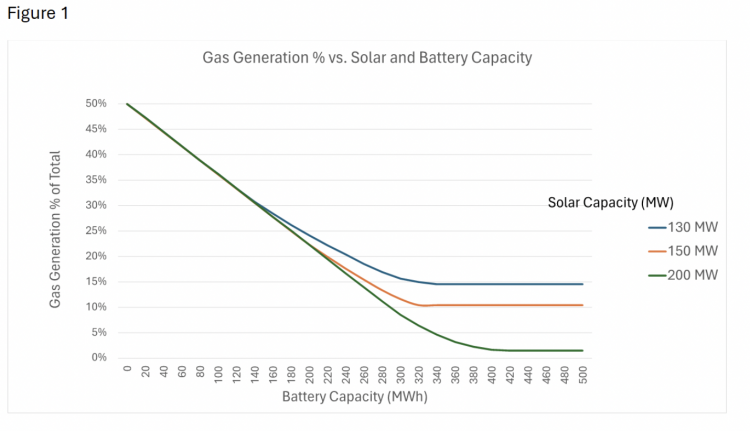
For more than half of the year from September through March, solar generation is not enough to handle both daytime and nighttime demand of 720 MWh. Increasing battery storage from 240 MWh to 330 MWh will have some effect in reducing the system’s dependence on gas power backup, but above 330 MWh of battery capacity, the system is limited by its solar capacity.
Switch has the option of increasing both its solar and battery capacity to reduce the percentage of gas generation required to back up the system. However, even with 200 MW of solar capacity and 420 MWh of battery capacity, gas will need to generate 1% of the total energy required to provide steady-state baseload of 30 MW both day and night.
So they would need to nearly double the storage capacity (240 MWh to 420 MWh) and multiply the solar generation capacity by more than 1.5 (130 MW to 200 MW), and still that would leave them needing to draw their supply 1% of the time from backup natural gas.
Now 1% of the time may not seem like very much. But 1% of a year is 87 hours, which is close to 4 days. And for those four days, you need the whole 30 MW of gas power that you would need to run the data center the whole time with no solar power at all. You need to keep the gas plant fully maintained and ready to step in at all times. And you need to pay the gas plant’s full cost of capital even though it may be idle 99% of the time.
If I am reading Mr. Ponton’s piece correctly, even to get to the figures of 200 MW of solar arrays and 420 MWh of storage to provide 30 MW of baseload power, he is assuming (1) zero turnaround losses on stored energy, and (2) no such thing as a cloudy day reducing solar irradiance.
I’ll let Mr. Ponton run the numbers on his spreadsheet, but I’ll bet that one good fully-overcast week in December or January could send the storage need from 420 MWh to a multiple of that.
Ponton provides this as a link to all of his calculations.
So the mighty Switch Inc. is exposed as no more honest about its assertions of zero emissions than our friend gkam.
The moral is that we should accept no claim of achievement of zero emissions electricity from anyone who maintains a continuing connection to a grid with hydrocarbon generation on it. Otherwise, there is way to much potential for cheating.
Manhattan Contrarian

Tech Titan’s Quest for Net Zero
Real Clear Energy
Bill Ponton
6 August 2024
All technology titans aspire to the goal of operating with 100% renewable energy. In reality, few, if any, have reached that goal. Their annual reports are laced with incessant net zero happy talk, but buried deep in those same pages is the admission that they are not even close to attaining their goals.
However, there are some companies that state that they have reached their goal of running on 100% renewable energy. Switch Inc. is one of those companies.
Switch is the brainchild of Rob Roy, Switch’s Founder and CEO, who in 2002 acquired a former Enron data center in Nevada and parlayed it into a formidable company. Switch states on its website that since January 2016, all Switch data centers have been powered by 100% renewable energy.
In its 2021 10-K form filed with the SEC, Switch states that its Citadel Campus near Reno, Nevada, designed to be the world’s largest data center, has up to 130 MW of 100% renewable power available to the facility. However, the report is conspicuously missing any reference to the baseload power requirement of the facility. Data centers have a relatively flat demand profile so it would be quite a trick to convert 130 MW of solar generation into something that a data center could utilize to run 24/7.
An article in Greentech Media provides a clue. It states that with the addition of a 60 MW/240-MWh Tesla Megapack installation, Switch turns 130 MW of solar capacity into 30 MW of “quasi-baseload” renewables. The battery converts daytime bell-shaped solar generation into nighttime dispatchable power.
For most readers this explanation would be suffice. However, for the inquisitive, there is an easy way to calculate whether 130 MW of solar capacity would provide 30 MW of steady baseload with the assistance of 60 MW/240 MWh Tesla Megapack.
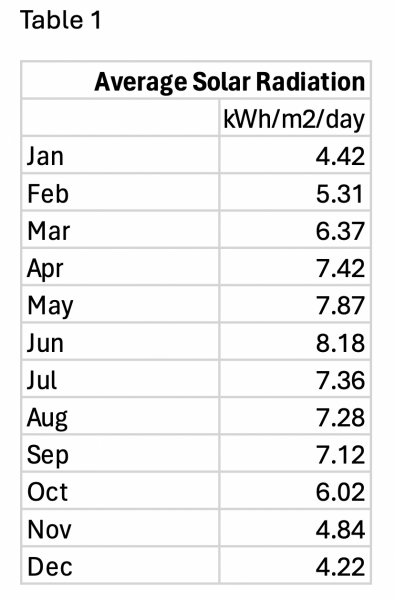
The first step is to determine the daily solar irradiance (kWh/m2/day) received during each month at the solar facility near Las Vegas from which Switch purchases its renewable energy (see Table 1).
The NREL PV Calculator is a useful tool for computing the solar irradiance at a specific location and the solar power generation for a particular nameplate solar power capacity at that location. Assuming, 30 MW of steady-state power consumption and 130 MW of solar power capacity (as the GTM article concludes), solar generation, daytime demand and nighttime demand are as follows (see Table 2).
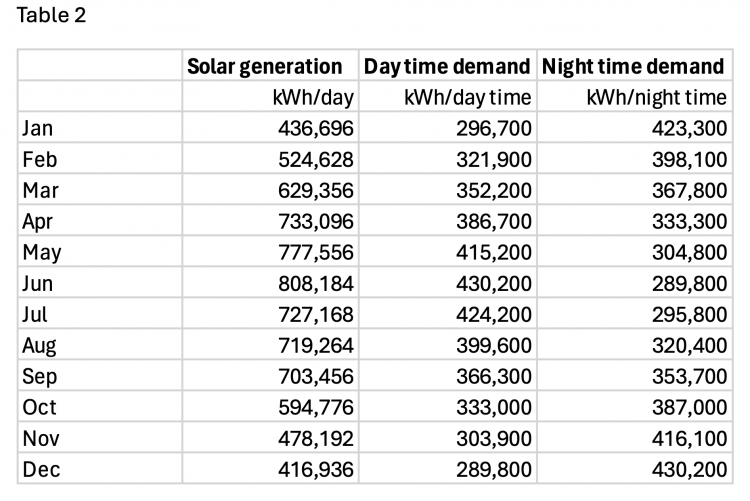
For more than half of the year from September through March, solar generation is not enough to handle both daytime and nighttime demand of 720 MWh.
Increasing battery storage from 240 MWh to 330 MWh will have some effect in reducing the system’s dependence on gas power backup, but above 330 MWh of battery capacity, the system is limited by its solar capacity.
Switch has the option of increasing both its solar and battery capacity to reduce the percentage of gas generation required to back up the system. However, even with 200 MW of solar capacity and 420 MWh of battery capacity, gas will need to generate 1% of the total energy required to provide steady-state baseload of 30 MW both day and night (see Figure 1).
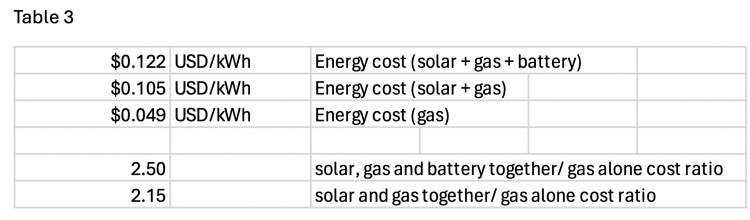
Switch pays a premium for its solar/battery scheme. Assuming EIA capital cost estimates and the 25-year average price for natural gas, energy cost would be over twice as much with solar power capacity of 130 MW and battery energy capacity of 240 MWh versus natural gas power of 30 MW. (See Table 3).
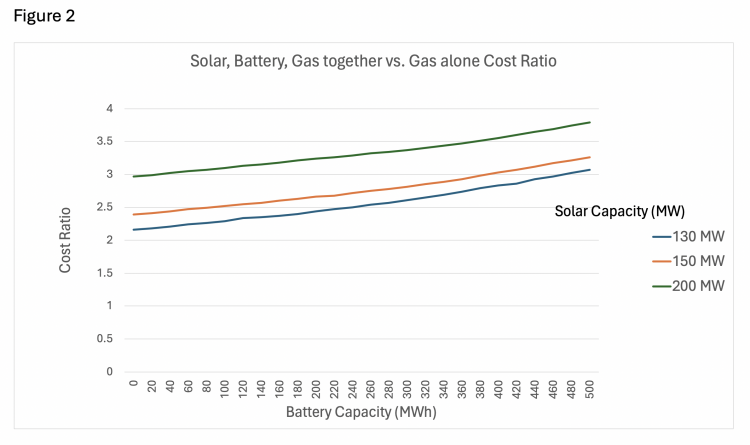
To keep gas generation at 1% of total with 200 MW of solar capacity and 420 MWh of battery capacity, Switch will need to pay 3.6 times more than it would cost with gas alone. (see Figure 2).
An observant reader will note that my analysis only takes into consideration diurnal patterns and 20% of the time the solar array is obscured by at least 80% cloud cover.
Both solar and battery capacity would need to scale considerably to sustain steady-state output power throughout the overcast period. For those readers interested in reviewing my calculations, I provide a link to them here.
Real Clear Energy

 STOP THESE THINGS
Suppose you get a variety pack of… well anything, but let’s use yogurt. It contains equal measures of strawberry, blueberry and peach yogurt. The only thing you and your party have to eat are regular delivery of these variety packs and the total rate of yogurt delivery is just enough to keep you alive.
You grab all the strawberry yogurt and eat it and it is enough for you. That’s working great, so you proclaim that everyone can live well just by eating the strawberry.
What’s wrong with your logic? Worse that that, sometimes the packs contain no strawberry and sometimes it contains extra. But you continue to claim that everyone can live just on the strawberry.