
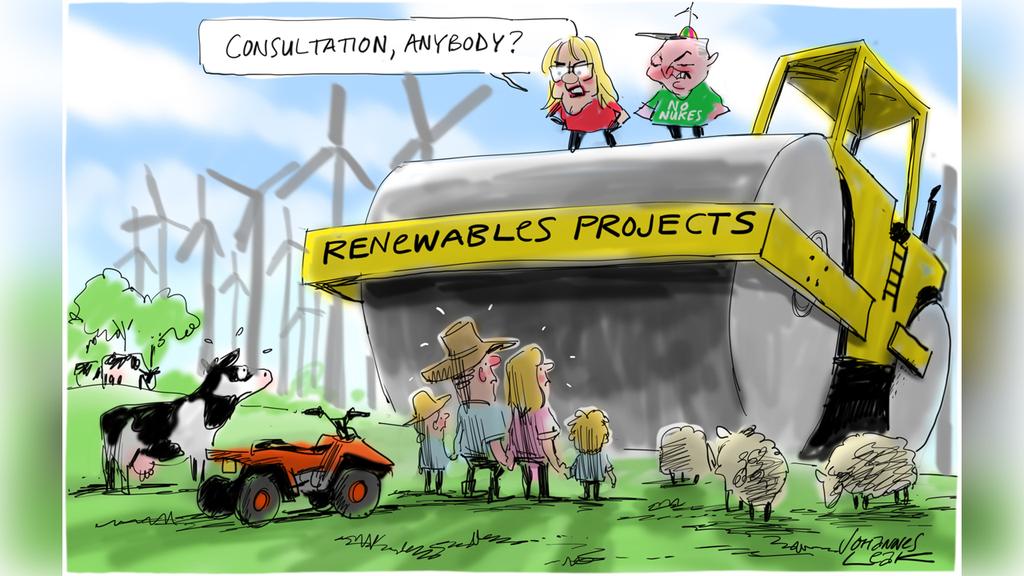
Rejecting the overtures of liars and scammers is easy. For years the wind and solar industries have made an art form of both. Now, slowly but surely, communities have learned to spot the lies and community defenders are driving the scammers out of town.
STT recently reported on the growing number of landholders who are rejecting deals to host wind turbines or solar panels on their properties and landholders who are ripping up their contracts even after they’ve signed them.
The most recent event, involved 9 farmers from Armidale in NSW, who had signed up to host some 55, 7MW turbines between them, pulling out of their contracts, on the basis that they had been lied to about the very substantial decommissioning costs they face when these things give up the ghost, after 12 to 15 years or so.
That post – No Deal: More Panicked Farmers Join Rush to Rip-up Contracts to Host Wind Turbines – had over 3,000 hits in a week and helped send the wind and sun cult into an outrage about their inability to dictate how property owners use their own land. How dare they reject the Great Leap Forward!
In the aftermath of what is clearly a disaster for wind and solar rent-seekers, Professor Ian Plimer – one of Australia’s leading advocates for reliable and affordable energy – gave this interview on Sky News.
‘About bloody time’: Armidale wind farm project shelved after landholders change their minds
Sky News
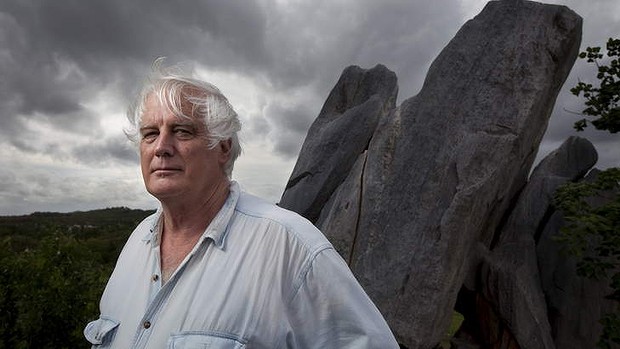
Danica De Giorgio an Prof Ian Plimer
13 August 2024
A wind farm proposal for north-west New South Wales has been scrapped following a change of mind from some of the nine landowners whose properties took in the project’s boundaries.
Ark Energy was behind the bid to build a 55-turbine Doughboy Wind Farm, 50 kilometres east of Armidale.
Geologist Ian Plimer joined Sky News host Danica De Giorgio to discuss why it is becoming more and more common for landowners to change their minds about wind farms.
“It’s getting more and more common for landowners to change their minds on this because they are getting more informed and they realise that when a wind turbine industrial facility closes, the bill is theirs to clean up,” Mr Plimer said.
“It’s not cheaper and there’s billions being sent overseas, and I think finally the farm community is waking up saying, ‘this is not good for me. This is not good for the nation. This is not good for my local community and we’re not going to sign up’.”
Transcript
Danica De Giorgio: The green energy back flipping in this country has claimed yet another victim. A wind farm proposal for Northwest New South Wales has been scrapped following a change of mind from some of the nine landowners whose properties took in the project’s boundaries.
Ark Energy was behind the bid to build a 55 turbine Doughboy wind Farm monstrosity. Joining me now is esteemed geologist, Professor Ian Plimer. Thank you very much for joining us on the show. Look, firstly, how unusual is it for landowners to change their minds, and why do you think that they are indeed backing out of these projects?
Prof Ian Plimer: Well, it’s getting more and more common for landowners to change their minds on this because they’re getting more informed and they realise that when a wind turbine industrial facility closes, the bill is theirs to clean up, that’s not going to help them very much. And some of the early wind developments got farmers in during a drought, and farmers viewed this as drought-proofing.
This Eastern fall country, east of Armidale is prized agricultural land. It’s land where foreign corporations with the assistance of city-based governments are trying to override the wishes of farm people so they can make electricity. Now, that electricity is not reliable, it’s not cheaper, and there’s billions being sent overseas. And I think finally the farm community is waking up saying, “This is not good for me. This is not good for the nation. This is not good for my local community, and we are not going to sign up.” This is happening country-wide. I’m talking to a farmer’s group next week. They are starting to get their political voice and it’s taken a long time. And all I can say is it’s about bloody time.
Danica De Giorgio: Yeah, it is about time. And yeah, I’m not surprised either. In the end, they don’t want these monstrosities being dug up on their land. It’s just bizarre. Now look, Labor has granted planning approval for New South Wales’s Central-West Orana renewable energy zone. And this is apparently an Australian first. Professor, firstly, one on earth is a renewable energy zone?
Prof Ian Plimer: Well, the name Orana rings bells. Now, we once had governments who wanted to build a super city between Bathurst and Orange, Orana it was going to be called, and that was about half a century ago. Now that failed. There’s been not one street put in, not one building put in.
And the sceptic on me says, “Well, I wonder if this is the same thing,” because here we’ve got state and federal governments want to harvest perfectly good farmlands for low-grade energy. And the area where they want to put this is prime agricultural land to the east and west of Gulgong.
And here we grow grapes, run sheep, there’s forests, there’s crops, and there’s a lot of national parks in that area. So they’re wanting to, again, override the interest of the local people, put in a harebrained scheme to actually build a renewable energy zone where they can basically destroy for a very long period of time, prime agricultural and forest land.
Now, we have to remember that wind turbines shed a very, very poisonous chemical called bisphenol. That bisphenol stays in the soils, it gets into the waterways, it destroys the land. We know that with solar facilities, they leak out cadmium, they leak out lead, and these stay in the soils and they’re there for a very long period of time, if not forever. So if we want to have this to boost the economy, it’s got to be low cost, it’s got to lower the electricity bill.
And our electricity bills, a large proportion of that is from transmission and distribution costs. And if you’re going to put electricity generating well away from the existing grids, that can only lead to electricity prices going up. And that we’ve seen with the renewables.
And I take it a slightly different view, the view of the farmers actually, and this is in essence a war on food. It’s a war conducted by those who live in cities against the low population areas, which are food producers.
And this war on food has the stamp of state government, it has a stamp of the federal government and they have created a false problem. And the false problem is that too many emissions of carbon dioxide drive climate change. Now, that’s never been shown. And if it could be shown, then we’d celebrate because emitting carbon dioxide makes plants grow. And we’ve got satellite information over the last 30 years saying we’ve had a greening of the planet due to the slight increase in carbon dioxide. So they’re wanting it both ways.
And I hope, again, the farming communities in those areas, especially the areas north of Mudgee, the wine growing areas, have enough muscle to say, “No, this is madness. We want to go back to what we had, which was cheap, reliable energy.”
Danica De Giorgio: Absolutely. And fair enough. Absolutely fair enough. Now, the WA government has ruled out any change to its longstanding policy on uranium mining, insisting that the future is indeed renewables. Professor, we can hardly be surprised that Labor states like Western Australia are really ideologically opposed to uranium mining and all because Labor won’t accept nuclear energy.
Prof Ian Plimer: Well, I’m not surprised at all, but they seem to accept nuclear energy if they get cancer and use some of the products that come out of the nuclear reactor at Lucas Heights. So again, they want to bet each way on this.
Now, Western Australia is geologically an area where we do find uranium, especially in some of the Salt Lakes, but the really big uranium deposits are here in South Australia and also the Northern Territory. So in terms of the global scene, it doesn’t matter very much.
In terms of Western Australia, it doesn’t matter very much for them either because they are getting massive royalties out of iron ore and out of gas. If Western Australia was a little bit more impoverished, they may well have a different view, but the ideological basis of their decision really does need to be questioned.
For example, if they’re doing this to lower carbon dioxide emissions, then you have to look at the renewables of Germany and they produce 400 grams of carbon dioxide per kilowatt-hour.
France, which is nuclear, produces 40 grams per kilowatt-hour. If you look at the Australian example, AEMO tell us that gas releases 59 grams per kilowatt-hour. And the CSIRO tells us that any future nuclear in Australia will release 31 grams of carbon dioxide per kilowatt-hour. So Western Australia is blessed with having cheap energy, massive royalties from the Pilbara and from the gas and from gold, and they have the luxury of not being able to think into the future.
And the future will always be nuclear power generated cheaply. Long-term nuclear power and Western Australia is basically taken ideological decision unrelated to reality. But the royalties keep rolling in.
Danica De Giorgio: Yeah, the royalties do certainly keep rolling in for Western Australia. But yeah, as you said, not when it comes to renewable energy. Professor Ian Plimer, great to have you on. Thanks for joining us.
Sky News
 STOP THESE THINGS
“AEMO tell us that gas releases 59 grams per kilowatt-hour.”
If AEMO told you that, they were lying. Perhaps it is a typo or a bit of mumbling and he meant 590 grams. Of course, it depends heavily on whether it is a combined cycle generator or a single cycle turbine. Generally, emissions of CO2 from gas are 1/2 those from coal.
Does Germany’s 400 grams of CO2 per kWh include electricity imported from Poland’s lignite-fired power plants?