

A decade back, householders with solar panels were the smuggest cats around. These days, not so much.
In the beginning, they crowed about the (ludicrously generous) returns from the Government underwritten Feed In Tariffs (FIT) they received for power sent back to the grid (which in many Australian states often topped $0.50 per KWh, the equivalent of $500 per MWh – at a time when coal-fired plants were delivering power all day, every day for less than $30 per MWh).
And they revelled in the upfront subsidies which covered a very substantial proportion of the cost of their panels
Now, it’s all moaning and gnashing of teeth.
Governments were knocked down in the rush, as the well-heeled signed up for millions of cut-priced panels which literally gave them a license to print money. All of which was born by taxpayers, across the board.
With their initial budgets well and truly blown, governments started to reel in the subsidies and/or cut the FITs. In Australia, the figures vary, but most now get about 10% of what was initially on offer. And they don’t like it.
With their ageing panels degrading – or fatally faulting – the smugness of the ‘we’ve got solar’ set is being wiped out by a new reality: economics.
Cory Bernardi (a former Federal Senator for South Australia) outlines below the new sinking feeling being experienced by those who signed up to the great subsidised solar scam.
The Sun is Setting on Solar
Confidential Daily
Cory Bernardi
24 July 2024
The great solar con is crumbling as the world wakes up to the inefficiency and overselling of this toxic future landfill content.
While many householders who have been on the receiving end of generous subsidies to put these panels on their home may see things differently, the data tells a clear tale.
The global capacity for solar panel manufacturing is around 1,600 GW while the demand is less than one third of that capacity (500 GW). That means prices are falling in a desperate drive to pump demand but consumers are wary.
They’ve been sold the dream of free power so many times, that they see their power bills rising and dismiss the rhetoric.
First off, the affordability of solar is entirely dependent on taxpayer subsidies. That means those who can afford the many thousands to install solar do so at the expense of others.
Many years ago, I spent roughly 20K to save around 6K per annum on our power bill. Yes, it was a large power bill (for a large home) but around half of the cost of installation was subsidised by taxpayers.
Part of the attractiveness was a feed in tariff that was super competitive for any power we exported into the grid.
But those days are gone with most feed in tariffs around 10% of the price you pay for the electricity they sell to you.
But even that’s not enough with some providers now limiting the amount you can supply to the grid. I was told recently that one family is now being charged for anything they feed-in in excess of that limit!
My latest bill (for a much smaller home with solar) arrived this week and any savings from my panels was more than offset by the assorted supply charges and fees introduced.
Incredibly, as power prices rise, the wisdom of solar installation becomes less appealing.
With so much ‘free power’ available we always seem to be paying more. If that doesn’t bell the cat on the con then I don’t know what will.
But the problems with solar go much further than that.
The disgraceful use of prime agricultural land for ‘solar farms’ is a direct threat to our food future. Not to mention what the disposal of the array of toxic components in each panel will do to the environment when their 25 year lifespan is up.
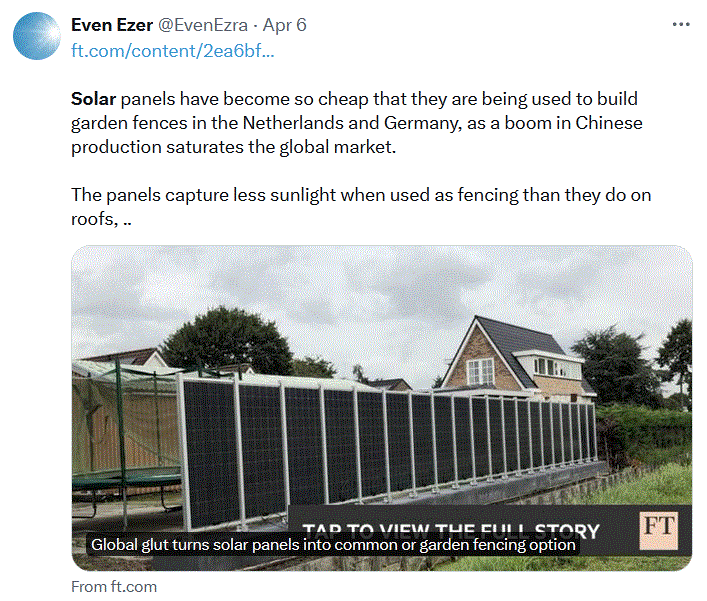
For a decade or so, around four fifths of the solar supply has come out of China leading the Financial Times to report:
“There is overcapacity in every segment, starting with polysilicon and finishing with the module,” said Yana Hryshko, head of global solar supply chain research at the consultancy Wood Mackenzie.
According to BloombergNEF, panel prices have plunged more than 60 percent since July 2022.
Blogger Jo Nova was even more pointed in her observations.
But there’s an argument to be made that the grid itself has reached the limit. The Duck Curve has been quacking on grids in California and Australia for years. Ponder that in towns like Alice Springs the microgrid is in danger of falling over when a cloud rolls in, and only 1 in 4 homes there have solar panels. Indeed, in the sunny centre of Australia, the limit for solar power appears to be just 13% — meaning it’s hard to stabilise the grid when more than 13% of the annual supply is made from solar power.
So just as a global solar industry is imploding the Australian government has decided to spend a billion of your dollars so Australia can become a solar manufacturing superpower.
It’s another extraordinary case of government ideology trumping reality.
Thought for the Day
“It’s better to admit you walked through the wrong door than spend your life in the wrong room.”
Unknown
Confidential Daily
 STOP THESE THINGS
Get back the inferior sunshine power generation board as soon as possible! They have led to many wildfires!
When we have sunshine ,Do I still need electric lights?
energy 。It’s a term coined by Thomas Young in 1807 to mean “work”, “force” …Therefore, using green, clean to describe energy, is not scientific! It is liberal arts Politicians cheat on the masses。