

If a 9-year-old proposed wind and solar as a generation system, you’d give her a gold star but tell her to do better next time. You’d go on to explain that electricity is needed around-the-clock, irrespective of the weather, and that households and businesses want to operate without interruption.
Your tutorial on energy supply and demand would then focus on the need to have every single MW of wind and solar generation capacity matched by another MW of dispatchable and controllable generation provided by coal, gas, nuclear or hydro, to cover those regular events when the sun sets and/or calm weather sets in.
The bright pupil would get it in a heartbeat, and wonder why on earth we have designed energy policies to destroy the system that has served us reliably over the best part of a century?
In the piece below, Roger Caiazza details the data that shows why wind and solar have no hope of ever providing meaningful power, ever.
Wind and Solar Resource Availability Fatal Flaw
Watts Up With That?
Roger Caiazza
4 June 2024
As a retired electric utility meteorologist, I have been following issues associated with wind and solar resource availability for many years. My thinking has evolved to the point where I now believe that in a rational world it would be recognized that any electric grid relying on wind and solar is doomed to failure. This post explains why.
Background
The North American Electric Reliability Corporation (NERC) recently convened a webinar for the Cold Weather Preparedness Small Group Advisory Sessions (SGAS) to “provide an educational opportunity for registered entities to meet with NERC and Regional Entity representatives to discuss the cold weather preparedness Standards and possible compliance approaches in an open and non-audit environment.” The impetus for this initiative was the February 2021 Texas event described in the following slide. The regulatory fallout for this event is not finished but the need to discuss how best to address these events is so acute that SGAS was established in “an open and non-audit environment”.
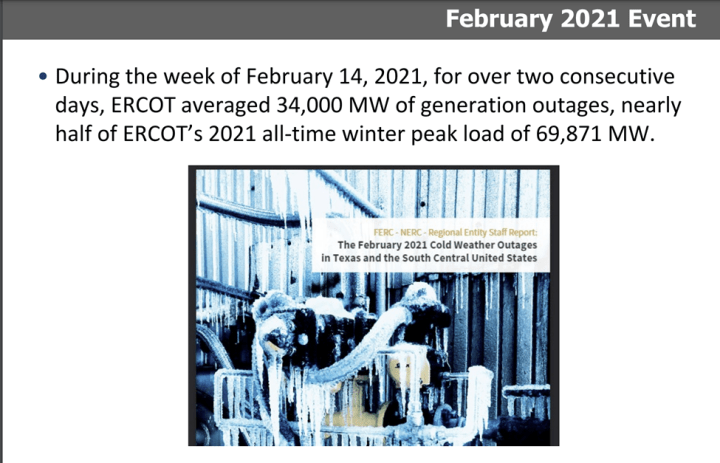
Source: May 6, 2024 NERC Cold Weather Preparedness Small Group Advisory Session
The takeaway point is that there are already electric grid resource adequacy issues in the existing system during extreme weather events. I am most concerned about the future grid that relies on weather impacted resources. Even though Texas has substantial wind and solar resources their presence did not contribute meaningfully to this Texas blackout. Instead, it was the failure of many components of the traditional generating and transmission systems to be sufficiently hardened to extreme cold. In the future the weather dependent grid will cause similar problems more frequently and, as I will show, may not be able to prevent a catastrophic blackout.
My primary concern is the feasibility for the New York Climate Act implementation plan. or more appropriately the lack of a proper feasibility analysis, that addresses the worst-case wind and solar energy resource drought.
In September 2021, I described the reliability challenges for the Climate Act described by the organizations responsible for electric system reliability. All the credible analyses done for future grid reliability point out the expected worst-case scenario – When New York electrifies heating and transportation the peak load will be in the winter when temperatures are coldest.
The Integration Analysis identified a multi-day period winter wind lull. The New York Independent System Operator has done similar analyses and showed that winter wind lulls that coincide with low solar availability and high loads will be the ultimate problem. The New York Department of Public Service also has identified the Renewable Energy Gap as a major issue. In my opinion, however, no analysis done to date has identified the worst-case scenario because they have all used relatively short periods of historical data.
All credible renewable resource projection analyses use historical meteorological data, projections of future load during those periods, and estimates of electric resource availability based on assumed deployment of wind, solar, energy storage, and other technologies needed to supply the expected load.
Hourly profiles of weather variables produced via the weather forecast modeling techniques are used to develop hourly demand forecasts and energy output profiles for wind and solar resources for the periods being studied. The credible analyses only differ in their assumptions for the characteristics of the buildouts and the sophistication of potential availability based on climatological and geographical constraints. Once the analysis is complete the resulting data can be used to identify the worst case.
The New York Independent System Operator (NYISO) is working with its consultant DNV to develop New York onshore wind, offshore wind, and solar resource availability. Their analysis uses a 23-year historical meteorological database for the New York State renewable resource areas. Similar analyses are underway in other regional transmission operator regions. It has also been recognized that larger areas need to be treated similarly.
The Electric Power Research Institute has a Low-Carbon Resources Initiative that has been looking at the North American continent. Researchers outside of the industry have also done analyses of wind and solar power droughts using the ERA5 reanalysis data from 1950 to the present. The reanalysis data analysis uses current weather forecast models and historical observations to provide hourly meteorological fields. These data can be further refined to finer scales to project the wind and solar resource availability.
Results
All these analyses find there are periods of low renewable resource availability. For example, the New York State Reliability Council Extreme Weather Working Group (EWWG) analyzed the high resolution NY offshore wind data provided by NYISO and its consultant DNV for offshore wind resources. The summary of the report stated:
The magnitude, duration, and widespread geographic impacts identified by this preliminary analysis are quite significant and will be compounded by load growth from electrification. This highlights the importance of reliability considerations associated with offshore wind and wind lulls be accounted for in upcoming reliability assessments, retirement studies, and system adequacy reviews to ensure sufficiency of system design to handle the large offshore wind volume expected to become operational in the next five to ten years.
The NYISO/DNV analysis used a 21-year database. In a similar type of analysis, the Independent System Operator of New England (ISO-NE) Operational Impact of Extreme Weather Events, the ERA5 data were used to prepare a database covering 1950 to 2021. The analysis evaluated 1, 5, and 21-day extreme cold and hot events.
One of the important results presented in the ISO-NE analysis was a table of projected system risk for weather events over the 72-year data record. In the analysis, system risk was defined as the aggregated unavailable supply plus the exceptional demand during the 21-day event. Note that the analysis considered sliding windows for the 21-day events by shifting the 21-day window every seven days.
The unsurprising point I want to highlight is that the system risk increases as the lookback period increases. If the resource adequacy planning for New England only looked at the last ten years, then the system risk would be 8,714 MW, but over the whole period the worst system risk was 9,160 and that represents an resource increase of 5.1%.
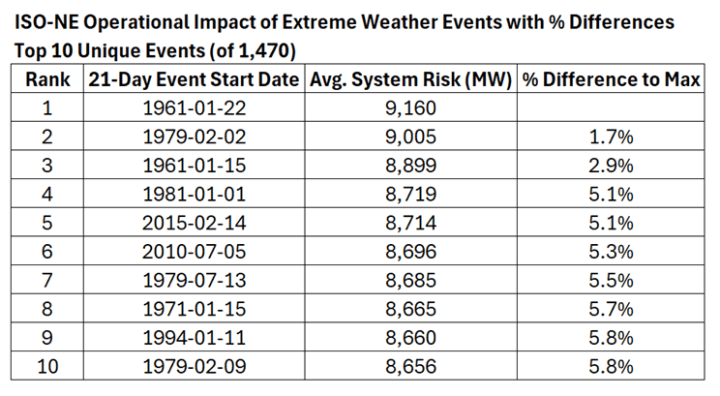
Source: ISO-NE Operational Impact of Extreme Weather Events, available here
Note that there was an EWWG analysis of Historical Weather and Climate Extremes for New York performed by Judith Curry and myself that identified the January 1961 event as the probable worst-case scenario. We found that there was a 15-day period from January 20 until February 3, 1961 that will likely turn out to be the worst-case cold wave. This was a period when high-pressure systems dominated the weather in the Northeast and those conditions mean light wind speeds.
Discussion
I do not think we can ever have an electric grid that will provide reliable power when it is needed the most. Today electric system resource adequacy planners don’t have to worry that many generating resources might not be available at the same time. In a future electric grid that relies on wind and solar the fact that those resources correlate in time and space is what I think is the insurmountable planning problem. All solar goes away at night and wind lulls affect entire regional transmission organization (RTO) areas at the same time. This issue is exacerbated by the fact that the wind lull will cover multiple RTO areas at the same time the highest load is expected.
The reason we can never trust a wind, solar, and energy storage grid is because if we depend on energy-limited resources that are a function of the weather, then a system designed to meet the worst-case is likely impractical. Consider the ISO-NE events where it was found that the most recent 10-year planning lookback period would plan for a system risk of 8,714 MW. However, if the planning horizon covered the period back to 1961, the worst-case to 1950, an additional 446 MW would be required to meet the system risk.
I cannot imagine a business case for the deployment of energy storage or the magical dispatchable emissions free resource that will only be needed once in 63 years. For one thing, the life expectancy of these technologies is much less than 63 years. Even over a shorter horizon such as the last ten years, how will a required facility be able to stay solvent when it runs so rarely without subsidies and very high payments when they do run.
As I described in an earlier article, the New York Department of Public Service (DPS) Proceeding 15-E-0302 technical conference Zero Emissions by 2040 highlighted concerns about this Gap resource gap and how it could be addressed. Besides the fact that the preferred candidate technologies have not been commercially proven, they all will be extraordinarily expensive. I believe that makes worst-case solutions impractical.
On the other hand, the alternative to ignore the worst case is unacceptable. In the net-zero fantasy world that is supposed to rely on wind and solar when heating and transportation is supposed to be electrified the need for reliable electricity is magnified. If we don’t provide resources for the observed worst case, when those conditions inevitably reoccur then there will be a blackout when electricity is needed the most to keep people from freezing to death in the dark because they are unable to flee.
The tradeoff between practicality and necessity is not going to be resolved by the resource adequacy planning groups doing the analyses described. I don’t think organizations like the New York State Reliability Council or NERC will make the decisions either. This is something that will have to be decided by politicians at the highest levels. Hopefully the problem will be considered in an open and transparent manner, but political lobbying pressures will be immense because the viability of the politically correct current plan to depend on wind and solar in New York and elsewhere is threatened.
Conclusion
I have long argued that New York should perform a feasibility study to determine if the net-zero outline to comply with the Climate Act in the Scoping Plan could possibly work. Francis Menton has convinced me that it would be better to do a demonstration project in some smaller jurisdiction to prove that it can work. The described tradeoff between the practicality of deploying resources for the observed worst-case resource deficit and the necessity to do so to prevent a catastrophic blackout should be a key consideration in either workability evaluation.
In my opinion any electric system that depends on wind and solar is impractical. Obviously, if the goal is a zero-emissions electric system then nuclear must be the cornerstone. If affordability is a concern, then the pragmatic acceptance of a large reduction in emissions rather than a zero target would allow the use of some natural gas as proposed by Russell Schussler and myself last year. Given the entrenched crony capitalists and special interests supporting wind and solar any shift in direction, even if necessary to protect health and safety, will be a tremendous lift.
Watts Up With That?
 STOP THESE THINGS
Instead of using 21 years of meteorological data for New York State as the NYISO did, or 36 years of meteorological data for all of North America as Shaner et al did, I have been using real generation data, so I don’t have to infer the relationship between meteorology and electric power.
My analyses for California, Texas, USA as a whole, Denmark, Germany, and EU as a whole, shows that rather than a few days, more than 1,000 hours of storage are necessary, and the storage device needs to hold it for at least half a year, not half a week. I tried to analyze Australia but the data are a confusing mess, and the Australian system operator is not helpful. I’d be surprised if it’s much different.
Details at http://vandyke.mynetgear.com/Worse.html, and in my book “Where Will We Get Our Energy?” Everything quantified. No vague handwaving. 350 bibliographic citations so you can check that I didn’t just make up stuff.
Yes using the generation of wind power in real time is more direct than the construction of the generation based on wind records and complex formulas including average hub heights.
Like you, Lang and Miskelly used the more or less continuous output from the windfleet in SE Australia from 2009 and the documented periods up to three days with little or no wind over the whole area where windmills were located.
The first Miskelly study covered a small corner with 2GW installed wind capacity) and the coverage extends almost over the full extent of the grid (11.4GW installed and the pattern of wind droughts has remained the same despite hopes that more coverage would provide less variability.
On the performance of gas during the 2021 crisis in Texas, I have seen allegations that the EPA demanded that pumps in the gas lines should be powered by RE. I have not been able to confirm that but you can see what happens when there is no RE.
Presumably the more adequate winterization of the gas system will alleviate the problem unless the capacity of gas is driven down to a critical level by the subsidised and mandated unreliables.
A pretty good article, but almost lost me right at the point above.
Yes, if gas had not been operating at 50% things would have been different. But if wind was not operating at 3 – 9% things would also have been different. How does one attribute all the blame to gas?
Additionally, consider indirect factors. If all that wind was not on the grid, then more dispatchable power would be available and there would have been enough marginal capacity, even with failures, to avoid the deaths.
The deaths in 2021 Texas winter can be laid confidently at wind energy’s feet and the scum who promoted it. The only reason gas gets the blame is that they were ready with articles to be published blaming gas. Those articles came out before the bodies thawed — almost as if they were already written.
The Texas debacle was caused by poor planning. There weren’t enough incentives for the fossil fueled plants to be available when it was really cold. Clearly wind can never provide power when it is really cold because cold in Texas weather is caused by a high-pressure system with light winds.
Guess what Texas is doing now? They are getting fossil-fired peaking plants built that will operate, presuming they provide the right incentives, during the cold weather. The point of my article is that the amount of peaking power contracted will only be sufficient for a certain level of wind drought. There is nothing to prevent a more severe drought and the result will be another catastrophe.
I am sure that we agree that it would be better to just build fossil and nuclear instead of wind and solar rather than propping up a fatally flawed system that uses a lot of weather-dependent wind.
Your last paragraph, yes. We wouldn’t need to artificially create incentives to make dispatchable power plants available, if we hadn’t engaged in the foolish debacle of building wind and solar in the first place.
It’s like shooting yourself in the foot and then feeling virtuous for hiring a wheelchair when you could have just not shot yourself in the foot in the first place.
It is taking a heck of a long time for people to learn the ABC of intermittent energy, it should have been apparent from the work of Anton Lang and the Miskelly team over a decade ago that wind and solar could only work as major providers with enough storage to ride through several windless windless nights in succession.
Major inquiries are required to find out why the meteorologists didn’t sound the alarm and also to find why there was no due diligence on the wind supply by the power system planners.
https://quadrant.org.au/opinion/doomed-planet/2024/06/things-that-go-slump-in-the-night/
The term intermittant does not resonate in the minds of many as any kind of issue to them. They drive to work in intermittent stop and go traffic and do many things intermittently and still get things done just fine.
I find the terms disabled and handicapped energy along with camouflage energy more effective. The wind and solar farms are handicapped parking that takes up too much space.
The point of the ABC of intermittent energy is to signal: A input of power to the grid has to meet the demand from nanosecond to nanosecond and if the supply falls short the lights will flicker.
B the continuity of wind and solar power is broken on nights when there is little or no wind.
C there is no feasible or affordable storage at grid scale to overcome the discontinuity.