
For more than 20 years, wind and solar were the safest bet in town. The rapid embrace of nuclear power around the globe means that no one in their right mind will lay a nickel on wind and solar. Critically dependent upon subsidies, sunshine and weather, wind and solar have no hope of competing with CO2 emissions free, reliable and affordable nuclear power. And it’s that reality that has sent carpetbaggers into a flat spin. They never saw it coming, so they’ve been caught flat-footed, too.
What was once easy and certain money has turned into a quagmire of risk and uncertainty. And all because Australia’s Liberal/National Coalition has polished up a policy that rests on government owned and built nuclear power plants, as Nick Cater details below.
Peter Dutton’s nuclear policy gives renewables investors a shock
The Australian
Nick Cater
23 June 2024
Peter Dutton gave us more than a routine policy announcement last week. He delivered a credible threat of competition to a featherbedded industry that has grown lazy on government largesse.
If renewable energy was the cheapest electricity source and nuclear the most expensive, the green energy barons would have nothing to fear from a nuclear competitor.
Yet the market reaction to Dutton’s intervention proved that investors don’t buy the government’s spin. They know that in a competitive market, nuclear generation will eat renewables’ lunch, just as coal once did before wind and solar were showered with subsidies and the market rules were altered in renewables’ favour.
The shift in the opposition’s policy settings would deter future investments and prompt current investors to reassess their positions, the Clean Energy Investor Group CEO Marilyne Crestias told the Sydney Morning Herald.
Prices in relatively free markets like ours are not determined by ministerial decree, nor can they be accurately predicted by scientists at the CSIRO, however good their spreadsheets.
Prices are a mechanism that coordinates fragmented knowledge and spreads it instantaneously, allowing investors to allocate scarce capital for the most productive purpose. If the prospect of nuclear power is causing financiers to go cold on renewables, then the price signal has done them a favour by saving them from making a dud investment.
The Clean Energy Investor Group is hardly a disinterested observer. It is the peak body for major renewable investors, including Macquarie, Blackrock, Neoen and Tilt Energy. Together, they own 76 clean energy assets worth $38 billion. The present value of those assets is now hostage to the electoral fortunes of Anthony Albanese, which is why cashed-up renewable energy investors are accumulating a war chest of hundreds of millions of dollars to keep Labor in power.
The influence of this powerful, crony-capitalist enterprise is one reason why Dutton has only an outside chance of turning nuclear into an election-winning issue. Polling on public support for nuclear has been trending in Dutton’s way, and the evidence from around the world is stacked in his favour.
The history of bad ideas shows them to be most potent when entrepreneurs discover ways of making a buck out of them, however. The influence of the cashed-up renewable energy sector in global politics and cultural institutions has made the Net Zero narrative all but impossible to dislodge.
Protecting the present value of trillions of dollars of global capital rests on maintaining the fiction that wind and solar power, backed up by numberless batteries yet to be built, pumped hydro yet to be installed is the key to rescuing the planet.
Trillions of dollars of capital have been misallocated to this purpose thanks to perverse incentives provided by politicians whose most pressing concern is not to save the planet, but to survive the next election.
Labor’s target of 82 per cent carbon-free electricity by 2030 was derived from the same Reputex modelling that gave Anthony Albanese the confidence to stick his neck out on power bills by promising a household saving of $275 by this time next year.
It is beyond the bounds of probability that either target will be met. Coal and gas generated 75 per cent of the electricity in the National Electricity Market over the weekend, a proportion that has barely shifted since Labor came to power.
Investment in renewable energy infrastructure is at its lowest level for eight years, and the rollout of new wind turbines, grid-scale solar, transmission and storage is hopelessly behind schedule.
The latest quarterly accounting report from the Department of Climate Change and Energy shows that Australia’s greenhouse gas emissions fell by 0.5 per cent in 2023. At that rate, the government won’t reach its 2030 target until 2051.
Australia is not the only country that was caught up the exuberance of the 2019 Paris climate conference and promised more than it could possibly deliver. It is hard to find a single Western economy that is remotely on track to meet its 2030 commitments, let alone the big one in 2050.
In a report published by the Fraser Institute last month, the Czech-Canadian scientist Vaclav Smill outlined the task ahead. More than 4 terawatts (TW) of electricity-generating capacity must be replaced, and nearly 1.5 billion gasoline and diesel vehicle engines must be converted to electricity.
Virtually all the world’s agricultural and crop-processing machinery must be replaced, including 50 million tractors and more than 100 million irrigation pumps. New heat sources must be developed to smelt iron, manufacture cement and glass, process chemicals, and preserve food. Over half a billion domestic, industrial and institutional gas furnaces must be abandoned.
Novel forms of motive power must be found for 120,000 merchant vessels, and we’ll need to develop a carbon-free way of keeping 25,000 jetliners in the air.
All this must be achieved in a single generation, even though we have yet to reach the peak of global fossil fuel consumption and deploy any zero-carbon large-scale processes to produce essential materials.
For Smil, the most disturbing thing about the net-zero fallacy is what it tells us about the economic, numerical and scientific illiteracy of a generation that is, on paper, the most educated in history. As Smil told the American author Robert Bryce in an email exchange, we live in a fully post-factual world.
The net-zero fallacy has taken root “because the soil is receptive: utterly brainless mass of mobile-bound individuals devoid of any historical perspective and any kindergarten common-sense understanding.”
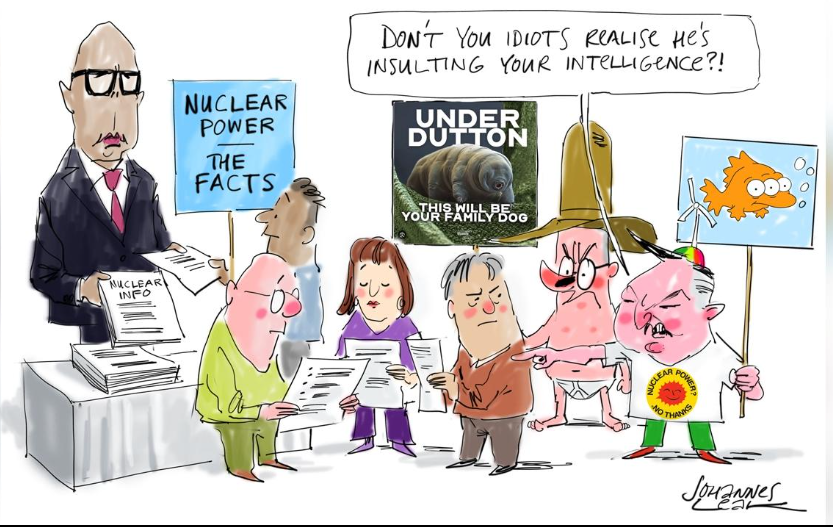
The cartoonish reaction to Dutton’s nuclear announcement last week was evidence of Smill’s point.
If there is a solid argument against legalising nuclear power in Australia, Chris Bowen has failed to produce it. Until he does, Dutton can safely regard the debate as won.
Yet politicians are not rewarded for winning fact-based arguments. They are rewarded by winning elections. As Thomas Sowell points out, one of the differences between economics and politics is that politicians are not forced to pay attention to long-term consequences.
“An elected official whose policies keep the public happy up through election day stands a good chance of being voted another term in office, even if those policies will have ruinous consequences in later years,” Sowell wrote in Basic Economics.
Yet the test of Dutton’s policy is whether it will increase competition in the market, offering a credible alternative to the un-trodden renewable-only path on which we are currently embarked.
The squeals from the renewable energy establishment last week suggest he is on the right track.
The Australian

 STOP THESE THINGS
Thanks for pointing that out, we got to try hard to educate the Aussie more