
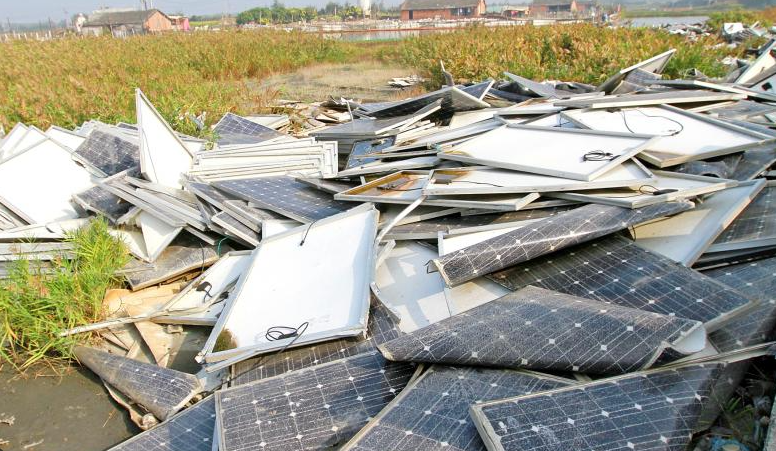
The inability to control wind and solar output is the very definition of chaos. Domestic solar panels reach their maximum output around noon. At midnight, not so much. Call it all or nothing.
Dealing with the noonday surge has become the bane of grid managers and the grand disruptor of once orderly power markets.
The disorderly and chaotic delivery of rooftop solar has one operator in Australia fighting back, in an effort to recoup some of the costs associated with dealing with what has come to be known as ‘electrical sewage’ – as the team from Jo Nova outline below.
Solar power at midday is so useless, they plan to start charging homeowners for generating it
Jo Nova Blog
Jo Nova
16 May 2024
The glut in solar power in Australia is so big that next year solar panel owners in Sydney will have to pay 1.2c a kilowatt hour to offload their unwanted energy between 10am and 3pm. Nearly a million homes in Sydney have solar panels, but only 7% of them have batteries, which means basically, thousands of homes installed hi-tech generators that aren’t very useful. Worse, other homes were forced to pay part of the costs for them. The only winner was China.
Finally, a tiny part of the strangled free market is re-asserting itself, which might slow down future installations, or trick a few people into installing a $9,000 battery. Naturally this unpredictable rule change will hurt the poorest solar owners, but benefit those wealthy enough to afford a battery.
Solar panel owners slugged by Ausgrid for generating too much power
by Caitlin Fitzsimmons, Sydney Morning Herald
The biggest electricity distributor on the east coast plans to charge households with solar panels to export their electricity to the grid during the middle of the day.
Ausgrid will impose a penalty of 1.2¢ a kilowatt-hour for any electricity exported to the grid between 10am and 3pm above a free threshold that varies by month. During peak demand times, between 4pm and 9pm, Ausgrid would pay 2.3¢ an hour as a reward to customers exporting solar to the grid.
The tariff will be charged by Ausgrid and the retailer will decide how to package it. It is opt-in from July this year, and mandatory from July next year.
The Sydney Morning Herald naturally thinks this is backwards and unfair, and in a sense it is, homeowners were led up the garden path. No one was given realistic information before they purchased another useless panel. But where was The Sydney Morning Herald? — it was selling the garden path. If they interviewed a few skeptics they could have told the hapless homeowners that the forced transition was artificial, unmanageable, and the conditions were doomed to be “adjusted” sooner or later.
Solar power at noon is electrical sewage
The wholesale market was trying to send the message. Negative spot prices show that solar is essentially a waste product at lunchtime which needs to be disposed off, a bit like electrical sewage.
Negative spot revenues didn’t really occur until we installed the last two million solar panels that we didn’t need. It is obviously a growing problem now, which suspiciously peaks in spring and summer and falls in winter months –matching the solar output profile by month.
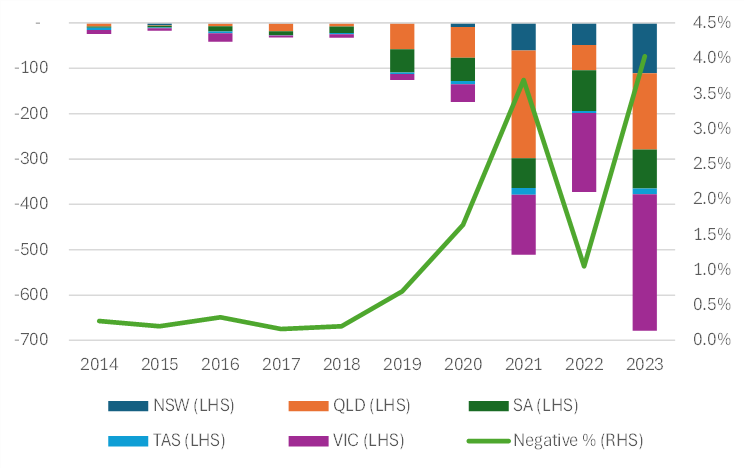
You might wonder why any generator would keep generating during a glut so bad they had to pay for every watt they generated. But it’s logical in a screwed market — the negative prices are close to the value of the “Renewable Energy Certificates” the government forces us all to pay to solar and wind operators. So solar owners can produce a product the market essentially doesn’t want, but the government forces us to pay to make it profitable. See how this works?
The point of a free market is that stupid ideas are supposed to be free to lose their own money. That’s a signal to stop doing it.
And if there was some use for solar power at midday, negative prices would have found it. If there was an AI supercomputer that needed to sleep 18 hours a day and only work at lunchtime, the owners would have been beating down the door to get paid to use that solar juice. It didn’t happen.
Here’s the solar power contribution to the NSW grid this month.
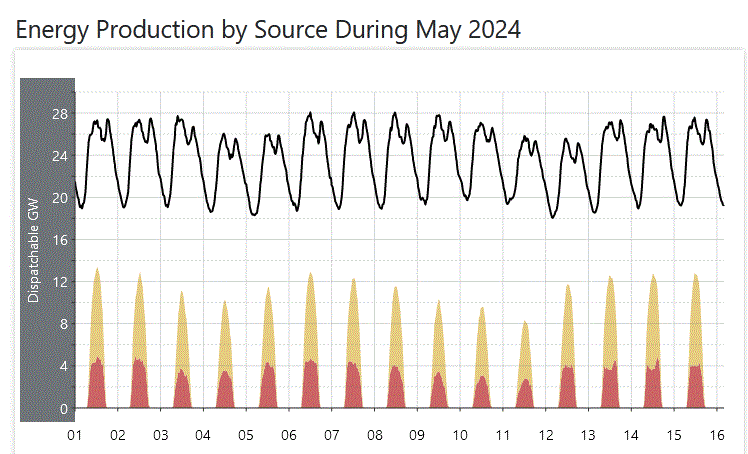
https://anero.id/energy/2024/may
During the solar spikes, hundreds of tons of exquisitely tuned infrastructure that could have kept running, just sits around and waits in case a cloud rolls over. And efficiency gained by solar is lost by the rest of the system.
Jo Nova Blog
 STOP THESE THINGS
Fortunately I live in SA so this will not affect me BUT that does not mean it will not in the future.
I am retired and live a quiet life – I am home during the day and do all my washing, cleaning etc then – I do have a TV along with heating which goes during the day and evening on colder days, especially through the winter.
During the summer it is very rarely needed for cooling. We have an electric oven and LPG hob. A new stove was purchased recently and while we wanted a full LPG stove/oven the cost was too much so we purchased another gas top electric oven.
During recent times baking or using the oven has been a nightmare – too many things spoiled due to restrictions on electric power.
I cannot understand why those living in NSW are not raising the roof on this proposal. If you work yes you may be able to set machines to do your washing and cook you dinner while you are at work so you use up some of the energy produced during the day – THAT IS IF YOU ARE WILLING TO CHANCE THEM NOT CAUSING A FIRE.
Something I do find strange with what is being proposed in NSW is —
“between 4pm and 9pm, Ausgrid would pay 2.3¢ an hour as a reward to customers exporting solar to the grid.” I am not sure just how much would be available to send to the grid from say 8pm – 9pm.
“What time is sunrise and sunset in Sydney? December experiences the longest hours of daylight with sunrise at approximately 5:30am and sunset at 8pm. June has the least hours of daylight with sunrise at approximately 7am and sunset at 5pm.”
Why is excess energy worth more at night than during the day. Those who work during the day will be slugged for what they are not using going to the grid but can recoup the loss at night when they will be paid more to ensure they are sending something to the grid.
Does this stink – yes if you are old, at home looking after children, or unemployed then you are going to be slugged for your ‘choice’ of lifestyle = energy use when it is needed most during daylight hours.
Will companies who have installed solar on their roofs to offset their costs also be slugged this way – will that cause prices to their customers rise as they try to keep their businesses operating!!!
NSW is a mess and it will no doubt flow onto other States.
So much easier, simpler and more efficient with Nuclear which will be available 24 hours a day 7 days a week 12 months a year, for use when its need.