

Generating occasional power in far-flung places means connecting wind turbines and solar panels, and that comes with a staggering additional cost. Costs that are totally avoidable and entirely unnecessary, when one considers that no one was short of power before the grand wind and solar ‘transition’ took off.
In Australia, it’s reckoned that the current 82% wind and solar target would require an additional 10,000 km of transmission lines (or more), over and above the current system which has worked just fine for generations. The estimated cost of the additional poles and wires is in the hundreds of $billions.
In Britain the grand transition requires a further 4,000 miles of undersea cables and another 1,000 miles of power lines which, as Paul Homewood explains below, will tack another £60 billion on top of the £54 billion already committed for grid upgrades required to deal with intermittent wind and solar coming from far-flung places, often out at sea. Adding £112 billion to the already staggering cost of Britain’s failed wind and solar experiment might sound like a snip, but try and tell that to Britain’s already embattled businesses and households.
£60 Billion More For Grid Upgrades
Not a Lot of People Know That
Paul Homewood
19 March 2024
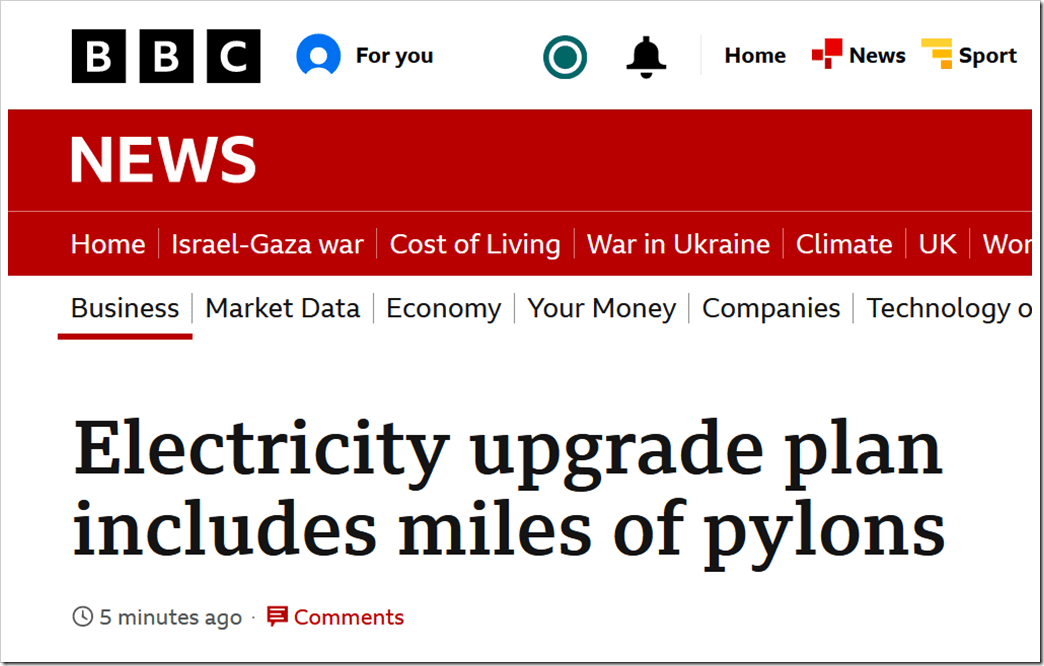
Electricity Upgrade Plan Included Miles of Pylons
BBC
Simon Jack
19 March 2024
The UK’s electricity network needs almost a further £60bn of upgrades to hit government decarbonisation targets by 2035, according to a new plan.
Some 4,000 miles of undersea cables and 1,000 miles of power lines including pylons are needed, National Grid’s Electricity Systems Operator said.
The investment would add between £20 to £30 a year to customer bills, it said.
The government said the ESO’s plans were preliminary and yet to pass a “robust planning process”.
The plans were written up by the ESO, the organisation which runs the electricity network and would run the updated system it is calling for too. It is currently owned by National Grid but will transfer into government ownership later this year.
Its latest £58bn estimate is for work needed between 2030 and 2035 and comes on top of a previous £54bn estimate for work taking place between now and 2030.
The additional infrastructure spend would help get the UK’s offshore wind from where it is produced out at sea, to where it is used by households across the country.
That would be key in making greener energy, according to the ESO, which said the project would be the largest build of its kind for seven decades.
The government said the plans would support more than 20,000 jobs, but these are preliminary ones that would have to go through a robust planning process – a stage at which many infrastructure plans have failed.
The ESO says this is the kind of ambitious plan needed to deliver clean, secure, decarbonised energy. It called for “swift and co-ordinated” progress, and said that without it, the country’s climate ambitions might be at risk.
“Great Britain is about to embark upon the biggest change to the electricity network since the high voltage transmission grid was established back in the 1950s,” it said.
New connections and more grid capacity will also be needed as people and companies switch to using electricity for their cars or heating their homes. Renewable forms of generating energy, including through solar and wind farms, will also change the way the grid is shaped.
The undersea cables will have to come ashore at various points, predominantly on the east coast of Scotland and England – and from there, on to places near urban centres via overhead pylons or at four times the cost, under the ground. Hot spots for the new pylons include West Wales and a route through East Anglia.
Speaking to the BBC, Jake Rigg, corporate affairs director at the ESO, said conversation with communities across the UK is ongoing.
Critics have said the plan would deface areas of outstanding national beauty by adding more pylons – the huge steel structures which have been accused of blighting landscapes.
https://www.bbc.co.uk/news/business-68601354
Including the cost of £54 billion already committed, this adds up to a gobsmacking £112 billion, a cost of over £4000 per household. The claim that bills will only rise by £20 a year clearly is a lie. Even if the cost is spread out over 20 years, it still amounts to £200 a year, and interest payments will drastically increase this. It is a sign of the times that we discuss these ludicrous amounts of money without batting an eyelid.
As we know with all public infrastructure projects, the eventual cost will be much more then budgeted. It is worth noting that the government decided to take the ESO into public ownership precisely because the National Grid and other owners of the transmission network demanded full compensation for these upgrades, which would increase electricity bills to an unacceptable degree. Instead the government will have to fund any overspend. And the full cost will simply be added to the already crippling National Debt.
I would emphasise that this project is solely concerned with the transmission network, and does not cover the distribution network, which will also require tens of billions to increase capacity to cope with increased demand.
The National Grid’s Beyond 2030 plan clearly states that the upgrade’s only purpose is to build more capacity to:
- Transmit power from offshore windfarms and other renewable generators, and carry it to where it will be used.
- Cope with increased demand for electricity, due to electric cars, heat pumps etc.
In short, this £112 billion needs to be spent in order to meet Net Zero objectives, and no other reason.
The report also claims that thousands of jobs will be created and GDP increased. This is the same tired old argument often wheeled out, and it ignores the fact that money spent on this will be diverted from other purposes.
But above all, the bill for this upgrade surely nails the lie for once and for all, that wind power is cheap.
Contracts have been awarded to offshore wind farms on the basis of their strike prices, when the true cost is in fact much greater. The government should never have agreed to the investment of tens of billions in wind farms without taking into account the full costs involved.
Not a Lot of People Know That

 STOP THESE THINGS
The difference between the £20 per year and the actual £200 or more isn’t eliminated by subsidies. It’s just hidden in your tax bills, where politicians hope you won’t notice it, mixed in with all the other fraud, waste, and abuse.
“The government should never have agreed to the investment of tens of billions in wind farms without taking into account the full costs involved.”
Here’s a shameless plug for my new book “Where Will We Get Our Energy?”:
The title of Chapter 4 is “Never Start a Vast Project with Half-Vast Plans.”
Thank you, STT, for highlighting the new – and potentially far more hideous threat – to Scotland – and Wales and parts of England, too.
Particularly under threat are the Highlands and Islands of Scotland, from SSEN – the electricity distribution network operator arm of the major wind farm developer SSE, and the owner of the northern part of Scotland’s grid, who are planning to festoon super pylons, huge substations and BESS – a stated prelude to even more wind farms – across our lands.
And for what?
Communities B4 Power Companies (https://www.communitiesb4powercompanies.co.uk/ ) has asked repeatedly for proof of need, and none has been forthcoming, from governments, SSEN, National Grid or Ofgem, the energy regulator, part of whose remit is to protect consumers.
Part of the documentation on CB4PC’s website states:
‘Future scenarios figures from OFGEM/ESO establish that the current peak electricity demand in Scotland is 4.4GW. With rising electricity use as part of the achievement of net zero, it is predicted that Scotland’s peak electricity demand is expected to be only 5.3GW in 2030 (a time when Minsters want to have 20GW onshore generation installed), 8.5GW in 2040, and 9.4GW in 2050.
So where is the huge potential increase going to go? England can’t take it for the foreseeable future. Or is this another hugely expensive boondoggle?
Simply combining the comparative costs of Weather-Dependent “Renewables” with their achieved productivity shows the cost of supplying a unit of power to the grid.
The numbers are here
https://edmhdotme.wpcomstaging.com/the-myth-of-cheap-renewables/
All that remote transmission infrastructure will become stranded assets when the penny finally drops that nuclear is the only economically viable solution.