
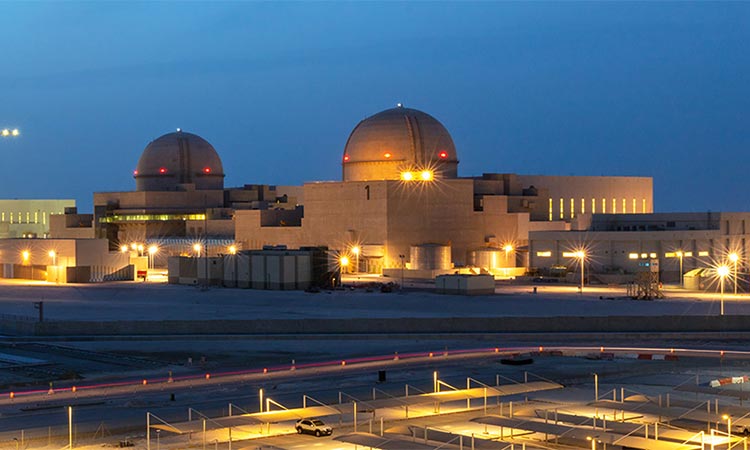
Chaotically intermittent wind and solar is simply no match for ever-reliable nuclear power. Always on, always available, no need for batteries, no need for back up. Capable of running all by itself and generating power, whatever the weather, nuclear power works. It’s that simple. The other thing in its favour is that it is the only stand-line generation source that does not generate carbon dioxide gas in the process. Whether or not CO2 troubles you, it most certainly troubles the politicos and media class. And that in itself creates an obstacle to maintaining (let alone building new) coal-fired power plants in this country.
As STT has pointed out once or twice, the rent seekers hoping to profit from the wind and solar scam are terrified of the prospect of a meaningful, long-term nuclear power policy. And it shows: the money for building new wind and solar factories has evaporated, in the veritable blink of an eye. As this extract from The Australian makes plain.
Pipeline of renewable energy projects falls 80pc, hurting the nation’s transition goals
The Australian
Colin Packham
13 March 2024
Spending on large scale renewable energy developments during 2023 fell nearly 80 per cent from the previous year, a hammer blow to federal Labor’s plan to rapidly accelerate the rollout of new zero emission energy sources.
Investment in big solar and wind projects plummeted to just $1.5bn in 2023 from $6.5bn in 2022, a 77 per cent fall, according to a new study by the Clean Energy Council. The sharp slowdown in financial commitments was blamed on a logjam in planning and environmental approvals, higher costs and tighter markets for equipment and labour.
An uncertain policy environment also contributed to the decline, with a long-term Renewable Energy Target set to wind up at the end of 2030.
Wind farms were the biggest drag on momentum, with no new financial commitments to big wind projects in 2023, compared with six in the previous year.
[There followed the usual bellowing, bleating and special pleading from rent seekers and their propaganda wings about dreaded uncertainty and the critical need for the extension of even greater subsidies, etc, etc.]
The Australian
The situation in 2024 hasn’t improved for wind and solar scammers. In fact, it has become literally terminal.
Central to the collapse in new construction of wind and solar factories is the Liberal/National Coalition’s recent announcement that it will take a nuclear power policy to the next Federal election. Pollsters show that the great majority of Australians are all in favour, and the younger the voter, the greater the degree of support.
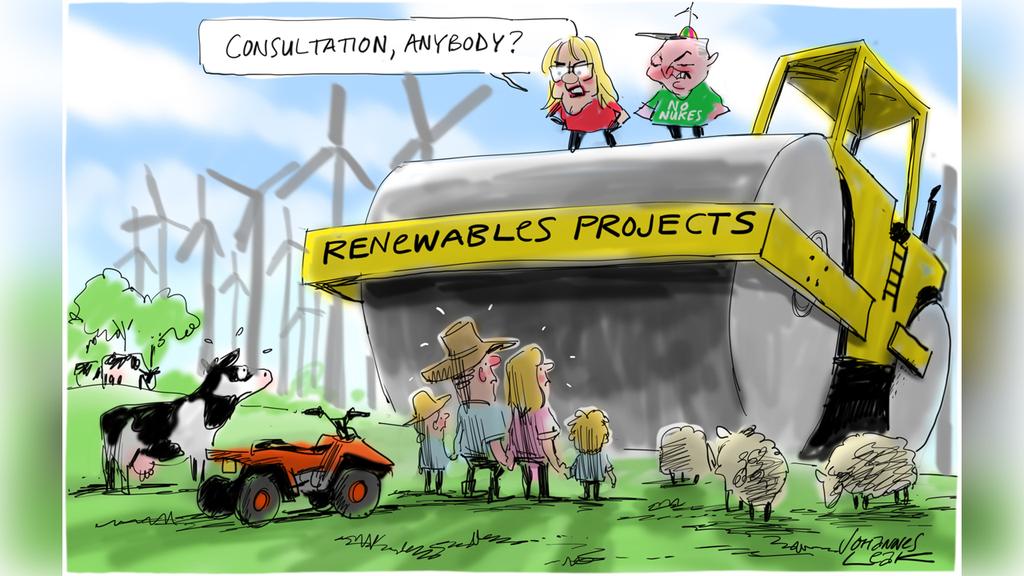
Couple the groundswell of support for nuclear power, with the cumulative rage that is building in rural communities being steamrolled by the wind and solar industries and their political enablers and you have what is known in Australia as a ‘political shit-storm’.
The People’s Republic of Victoria has just ripped up its planning process for wind and solar factories, removing any serious potential for local opponents to protect their communities. By preventing communities from protecting themselves, the PRV’s Politburo believes it can accelerate wind and solar projects and thereby save them from their looming financial collapse, as investors pull their cash and refuse to risk another penny in doomed projects. In every Ponzi scheme, the collapse is sudden, notwithstanding efforts to forestall the inevitable with hopeful talk about stellar returns just over the horizon.
In the piece below, Chris Kenny weaves together several threads that all lead to the same conclusion: the only long-term solution to Australia’s self-inflicted energy crisis is safe, reliable and affordable nuclear power.
Getting to net zero without nuclear power condemns us to poverty
The Australian
Chris Kenny
16 March 2024
Our energy debate, here and globally, is one of the most consequential discussions in human history. That it is distorted by politicking, virtue signalling and delusion can be explained only by widespread ignorance about what is at stake.
It is pointless to contest the proposition that we need to transition away from a heavy reliance on fossil fuels. They are a finite resource and if our civilisation is to continue in anything approximating its current form this transition is unavoidable sometime.
The point of contestability is the urgency – probably overstated by many players. Still, let us put that argument aside and look at the overwhelming scale of the task. If we understand how energy has underpinned the development of our economies and societies, and how we rely on it, we could never be blase about transitioning from fossil fuels. We are talking about the reversal of the whole trajectory and achievement of our development across just a few decades.
We are being urged to up-end the relentless intensification of energy in favour of energy devolution or diffusion. This flips all we know about the core driver of our civilisation and, if it must be done, it needs to be done carefully with all possible technologies on the table.
Our journey from forager to influencer is all about the availability of increasingly intense sources of energy. The hunter-gather relied only on the energy of the human form, fuelled by the vegetable and animal matter of other organisms.
By controlling fire, domesticating animals and harnessing wind and water, we greatly leveraged our energy options. But none of this was enough to sustain cities or deliver widespread wealth.
Fossil fuels changed everything, driving transport and generating electricity. For thousands of years the global population grew very slowly and lived mostly in poverty. Across the past 250 years the population has increased tenfold, we have developed unfathomable wealth and technology, all the while more than doubling life expectancy and reducing poverty.
Energy was the driving force, and the consequences extend way beyond the economic.
In a new short film for Net Zero Watch, John Constable explains the impact: “That exponential increase in wealth from high-quality fuels led to a society that could withstand external shocks that would have been catastrophic for earlier populations. It was the beginnings of modernity.”
Constable is seen as a controversial figure in the climate debate, the sort derided as a denier by alarmists and renewables zealots. But his historical perspective is incontrovertible.
Apart from transport, heating and cooling, industrialisation, appliances, entertainment and communications devices, consider what energy has done for humanity. In How the World Really Works, Vaclav Smil details how even in the early part of the 20th century most of the world faced poverty and food shortages. Rising food production – fuelled largely by fossil fuels and techniques dependent on them – led to a decline in global malnutrition from two in three people in 1950 to less than one in 10 now. And because this occurred while the global population more than tripled from 2.5 billion in 1950 to eight billion in the 2020s, it means we are feeding eight times as many people as we did 70 years ago.
We mess with this formula at our own peril. What has been fuelled by dense forms of energy can continue only if replacement energy is available, otherwise much more will have to change, and likely for the worse.
Constable talks about other knock-on effects, describing how Britain’s population became larger and richer and therefore more secure and innovative: “Wealth creates freedom, which creates more wealth, which creates yet more freedom and more wealth.”
He fails to offer a long-term solution, preferring to warn of potentially dire and chaotic consequences if we shun reliable and affordable energy: “Everything that humans value is in jeopardy.”
Labor, the Greens and their barrackers in public debate have their hands over their eyes, ears and mouths. For them, the world’s only reliable, baseload, zero-emissions fuel source is an evil whose role they refuse to see, hear or consider.
This is confounding when green-left politicians in Europe have long embraced nuclear and 22 leading economies at the COP28 conference in Dubai last December pledged to triple their nuclear energy output.
The green left in Australia shuns modernity for sham reasons; it cites only cost but this cannot be genuine given its lack of interest in the costs of renewables and clear evidence that many nations are reaping price benefits from nuclear. The costs of not developing a domestic nuclear industry need to be confronted. We would consign ourselves to a more sparse and vulnerable electricity grid that damages environments and landscapes. It also would face permanently high transmission and energy storage costs.
We would turn our backs on a hi-tech industry that plays a role in all modern economies and we would do this while attempting to run (and build) nuclear-propelled submarines. Madness. We also would surrender energy security, undermining economic fundamentals. Australia’s strategic rivals would encourage us to eschew nuclear and persist with our renewables plus storage experiment (especially if they buy our coal, gas and iron ore while selling us wind turbines and solar panels).
Former prime minister Malcolm Turnbull posted on X about the nuclear debate, asserting that nuclear could not “firm” renewable energy such as wind and solar. “To firm them we need flexible, dispatchable sources of zero emission energy such as pumped hydro, batteries or green hydrogen,” Turnbull said. “Nuclear reactors cannot turn on and off, ramp up and down like hydro or batteries can. Nuclear reactors generate continuously.”
And he said that like it is a bad thing. Nuclear would stabilise our grid with constant power and at times of low demand there might be little need for renewables. Perhaps that is why renewable investors, including in green hydrogen, are so antagonistic to nuclear. Excess power from a nuclear plant at times of low demand might be used to generate hydrogen or desalinate seawater. Next Turnbull will criticise drip irrigation because it invariably leads to moist soil.
Another film from Britain caught my attention this week. It was an old newsreel-style update on the 1956 commissioning of Britain’s (and the world’s) first commercial nuclear reactor at Calder Hall in Cumbria. Over wonderful black-and-white footage of workers toiling away on gargantuan cement and steel installations, there is a voice-over in well-modulated King’s English that has a hint of derring-do in the delivery.
“Far below, work started on the intricate task of creating the heart of the reactor furnace, to draw heat from the new fuel of the atomic age,” we are told. Yep, they were proud. Here was a damaged and straitened post-war nation justifiably taking pride in its industry and innovation – it built the reactor in less than three years. Compare that to our negativity and self-doubt.
The green left here argues all this technology is beyond us and that we should build wind farms and power lines across the country while we leave the rest of the world to modernise, and just hope for the best. It is a scientific cringe.
In an extraordinary interview on Tuesday Sarah Ferguson on the ABC’s 730 harangued opposition climate change and energy spokesman Ted O’Brien for daring to suggest this nation could deliver a nuclear plant inside 12 years and do it in a costly manner. Apparently, this can happen only overseas.
Yet the same host spoke with Climate Change and Energy Minister Chris Bowen last November and when he claimed to be turning Australia into a “renewable energy superpower” they both managed to keep straight faces.
Facts and science have lost relevance in favour of ideology and sanctimony.
Science tells us, as the International Energy Agency concludes, that current technologies cannot deliver net zero by 2050. Neither can net zero be delivered without nuclear energy. Yet the government’s pretence continues, and the Greens and the media cheer. Just this week Anthony Albanese hailed a company investing $44m in electric trucks – but taxpayers tipped in almost half ($20m) and no one mentioned none of this would be possible without coal-generated power.
Turnbull and Bowen complain about timelines and costs for nuclear while somewhere underneath the Snowy Mountains lies a bedevilled tunnelling machine called Florence that Turnbull set to work on what was supposed to be a $2bn, five-year project but that will cost $20bn across at least 10 years and will provide only some energy storage if we are lucky.
Around the country communities are objecting to renewable projects and the transmission lines to connect them – legal and political battles are enjoined. Little wonder renewable energy investment, despite being favoured by laws, subsidies and market rules, is starting to drop off.
Bowen is set to trump a long list of failed energy ministers. One of the key considerations on election timing will be energy – can Labor risk an election early next year if there is a threat of blackouts from December through to March?
We know what a zero-emissions environment looks like – South Australia lived it for a day during the 2016 statewide blackout that occurred only because of how vulnerable the renewables push had made them. We saw what a low-emissions world looks like too, during the pandemic – people staying home, empty shopping centres, empty CBDs, empty airports, empty streets and empty skies.
The challenge for the world is keeping businesses open and skies busy while getting emissions to zero. It is unclear whether this is even possible. But it is certainly not possible without nuclear energy.
The Australian
 STOP THESE THINGS
Makes you wonder if it’s ideology or plain ol corruption or both. Has to be mostly corruption though. London to a brick the supporters esp in rural regions have skin in the game. Just check out the same letter writers to the mostly fairfax press, straight out of the renewable scammers playbook. Our current ’ energy’ minister ,( like Turnbull) is SO stupid he’s an insult to stupid people. One certainly couldn’t say he’s corrupt , could one?. The fact that govts have to steamroll the regions into submission means they know the end is nigh for this disaster. Perhaps sanity will prevail at the next election.
The Coalition can promised to try to lift the ban on nuclear power but they can’t credibly promise to have a significant amount of nuclear power in the grid in less than a decade or two unless there is a bipartisan move in that direction.
At present the nuclear policy is a figleaf to cover the nakedness of the Coalition energy policy after they rolled over and committed to net zero with no plan and no scientific justification.
Apart from the distant prospect of nuclear power the Opposition has the same suicidal and unachievable net zero energy policy as the Government.
We will have to find a way to keep the coal fires burning until nuclear power is on deck or the economy and household budgets will be wrecked by the cost of power and rolling blackouts.
We are one coal station away from a crisis whenever the wind is low at night. We need some new, state of the art coal power stations to make use of the wonderful resource under our feet. Put coal back into the Coalition, be loud and proud to celebrate the foundation of our prosperity, defender of the balance of payments, the primary source of cheap and reliable power. And it has a minimal environmental footprint compared with the trail of damage wrought by the unreliable energy industry from mining to disposal of mountains of junk and toxic waste.