

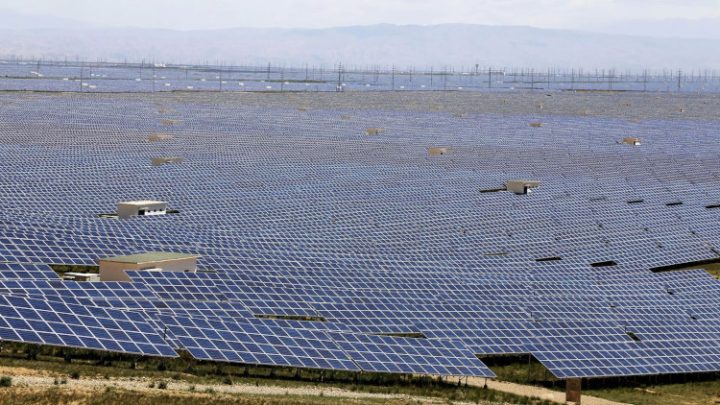
Australia’s prime agricultural land is being carpeted with endless seas of solar panels and thousands of these things are being speared everywhere the panels can’t go.
Dilute and diffuse, wind and solar require a staggering amount of space, and way more than their occasional, weather (and/or sunshine) dependent power generation can ever hope to justify.
Taking up vast tracts of farmland with solar panels means that that land produces nothing else. While the solar panels are lucky to produce power for 5-6 hours every day (ie 20-25% of the time).
Spearing hundreds of 300 tonne, 280m high turbines into productive farmland brings its own range of special ‘challenges’ for primary producers.
Aerial spraying of fertilisers, herbicides and pesticides is out of the question. Pilots will not go anywhere near these things (and the associated MET masts), thanks to the very real risk of a fatal collision. Self-immolating turbines are a deadly bushfire risk. Then there’s the soul-destroying noise they generate.
Followed by the multi-million-dollar cleanup costs when these things finally give up the ghost after 10 or 15 years: a single turbine costs more than $700,000 to demolish and remove.
Those behind the grand wind and solar transition have been rather coy about the amount of land involved. The great bulk of it is privately owned, and in south-eastern Australia, the great bulk of it is highly productive farming land.
Hence the embarrassment that followed the (apparently inadvertent) release of a paper put together by bureaucrats in the People’s Republic of Victoria, which showed that the grand wind and solar push requires more than 70% of the land in the State of Victoria and similar proportions across New South Wales, and large tracts of South Australia.
As the team from Jo Nova outline below, ‘arrogance’ doesn’t quite cover it.
Victorian govt accidentally admits wind and solar could use 70% of all agricultural land in the state
Jo Nova Blog
Jo Nova
16 February 2024
Victoria is just not big enough to fit all the solar and wind industrial plants
It’s no wonder the Victorian government is desperate to begin building offshore wind turbines. Their own targets for the forced transition are so crazy-brave, they would “need” to use as much as two thirds of the state’s agricultural land instead. It sounds delusional but they told us this straight up in their own policy document released in March 2022.
Thanks to Aidan Morrison at the Centre for Independent Studies, who not only reads these boring tomes, but also noticed that they quietly disappeared the Victorian Offshore Wind Policy Directions Paper. He explained in The Australian that he believes they hid it because they’ve realized how embarrassing it looks.
Apparently 227,000 square kilometers is not enough land to power 7 million people in a NetZero world.
Victorian planners had farmland in their sights (as if it was their own). They mapped it out and described it as “available for onshore renewables”.
If farmers were not aware of the totalitarian disregard the NetZero bureaucrats have for farmers, they know now.
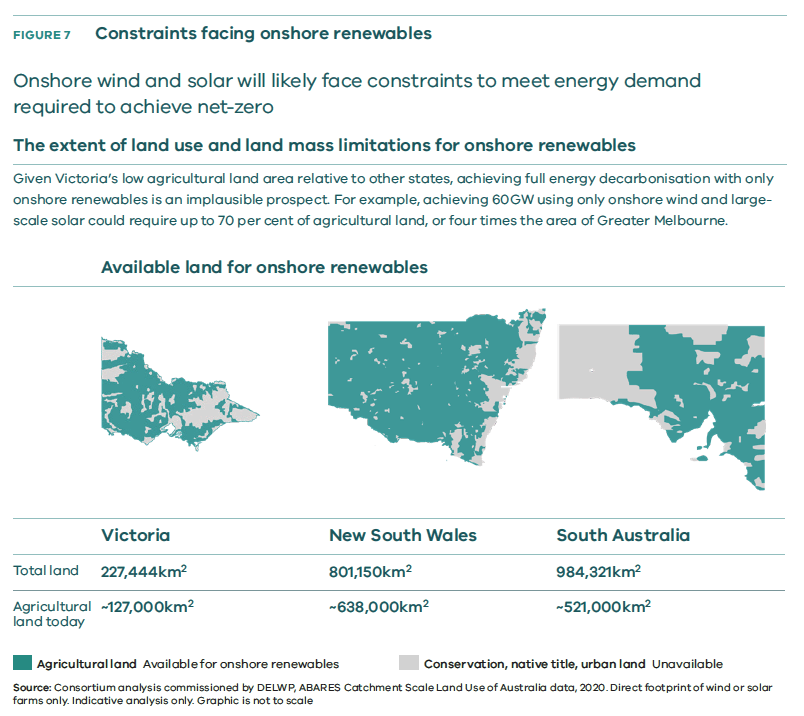
Think about the captive mindset it takes to publish a ludicrous document like this without blinking? These are people who never meet a skeptic. Whoever wrote and approved it didn’t even try to hide the ghastly cost of building wind and solar power onshore. And they certainly didn’t spend a nanosecond imagining what Victorian farmers might think of it. (Or checking their own maths — 70% of agricultural land is not the same as “four times the area of Greater Melbourne”.)
Presumably some bureaucrats were tasked with justifying the big Offshore wind developments and it didn’t even cross their minds that “Net Zero” is an option, a frivolous quest, and that farmers, and everyone (outside the party room) might just say “No”.
Billions of dollars are on the table and no one even reads the policy documents. We live in an era of distilled incompetence.
The Bottom Line:
Victoria is supposedly aiming to be 95% renewable by 2035, and at this point gets about 50% of its electricity from fossil fuels (and even more of its total energy). Even after the mass installation of unreliable energy for the last ten years Victoria needs to build 15 times as much to reach its target.
There are no offshore wind farms in Australia, and the federal government just put a poleaxe through the offshore plans of the Victorian government. But around the world investors are running away, share prices are falling, and insurance firms are balking at the million dollar cost of repairing the cables.
Now would be the perfect time for Australia to get out of offshore wind — right before it gets into it.
Victoria farmers won’t be pleased,
If their lands are confiscated or seized,
For vast solar panel fields,
Decimating food yields,
Nor by wind turbine pipe dreams appeased.
–Ruairi
REFERENCES
The original government source page contains the dead link. Luckily for us the Wayback Machine captured the site and the PDF: Offshore-Wind-Policy-Directions-Paper.
Jo Nova Blog
Ironically, these actions are also violating the Paris Agreement itself.
We are breaking the Paris Agreement
New Catallaxy
Rafe Champion
2 March 2024
Taking over farmland to build facilities to produce intermittent energy is a violation of Article 2(b) of the Paris Agreement.
Article 2 of the 2015 Paris Agreement states:
“This Agreement… aims to strengthen the global response to the threat of climate change, in the context of sustainable development and efforts to eradicate poverty, including by:
“(b) Increasing the ability to adapt to the adverse impacts of climate change and foster climate resilience and low greenhouse gas emissions development, in a manner that does not threaten food production”;
Bill Stinson of the Energy Realists has pointed out the critical final clause in 2(b). In a manner that does not threaten food production!
Clearly every encroachment on farmland violates that clause.
And intermittent energy is not sustainable anyway, so why would we spend billions of dollars to get more expensive and less reliable energy from facilities with a massive environmental footprint?
New Catallaxy
 STOP THESE THINGS
One of the climate clowns pointed out correctly for a change that this 70% number is a low estimate, stating it’s actually around 1000% of Earth needs to be covered in these. This means if we use correct interpretations of math that the clean renewable handicapped space allocated for this disabled energy will consume all open space turning them into dedicated preferred disabled energy parking lots thus we will have to expand outward and place them on the only place they work their best shining light on the need for reliable robust always on energy, by placing them on the Sun. Setbacks should not be to limited to our rising energy bills, setbacks should all be measured by this 80 million mile distance. By doing this we will again have enough open spaces to recharge.
and I wonder WHAT the uhi effect of those massive PV farms are like? gotta be a HUGE heat/thermal effect that affects local areas and rain/winds etc
It doesn’t stop at wind and solar, In parts of Ireland (north and south), there is evidence that land near substations is being bought or rented (obscene offers – don’t know yet about the actual contracts), for lithium ion batteries.
I suppose it’ll take for ever to realise this doesn’t work either. Nonetheless, it shows how poorly unregulated Lithium hexafluorophosphate (+ cathode materials) is worth the risk.
Consider in a breakdown/fire/explosion, the risk and amounts of Hydrogen Fluoride, Phosphoryl fluoride, nickel oxide dust in inhalable form, and the contaminations this can lead to.
I wonder how that risk compares with growing carrots and parsnips, sorry, what’s that?
Oh; you’ve got an electric cooker, boil them up quick during low demand, great with onions; don’t forget the land to grow them on!
Perhaps it’ll be a more efficient means of subsidy harvesting?
I’m sure someone from STT can articulate this much better.
P.S.
What about substations in Australia, is the surrounding land being bought up for batteries and are any of them near people, food producing land or fresh water systems?