

The ‘constraint payments’ paid to wind power outfits are commercial extortion, where the (occasional) producer claims a fee for producing absolutely nothing, at all. The honourable kidnapper at least hands over his victim when he gets the cash and there’s something to show for the exchange.
In this case, the victims are unwitting taxpayers and power consumers and the villains are laughing all the way to the bank.
Up to December 2019, British wind power outfits had collected over £650,000,000 for doing nothing at all; the cost to power consumers was almost £1 billion over the last five years and that figure is expected to soar. By 2030, wind power outfits across the UK (principally in Scotland) are predicted to pocket £3 billion a year for simply doing nothing.
In this little piece, Paul Homewood tackles the wind industry propaganda being run through the BBC, which claims that the ‘problem’ can be solved by building a completely unnecessary power grid to shift occasional power from the north to the south; again, costing taxpayers untold £billions.
Wind Curtailment Costs To Rise To £3 Billion By 2030
Not a Lot of People Know That
Paul Homewood
19 December 2024
It appears that the BBC will print any nonsense it is handed by the renewable/climate lobby:
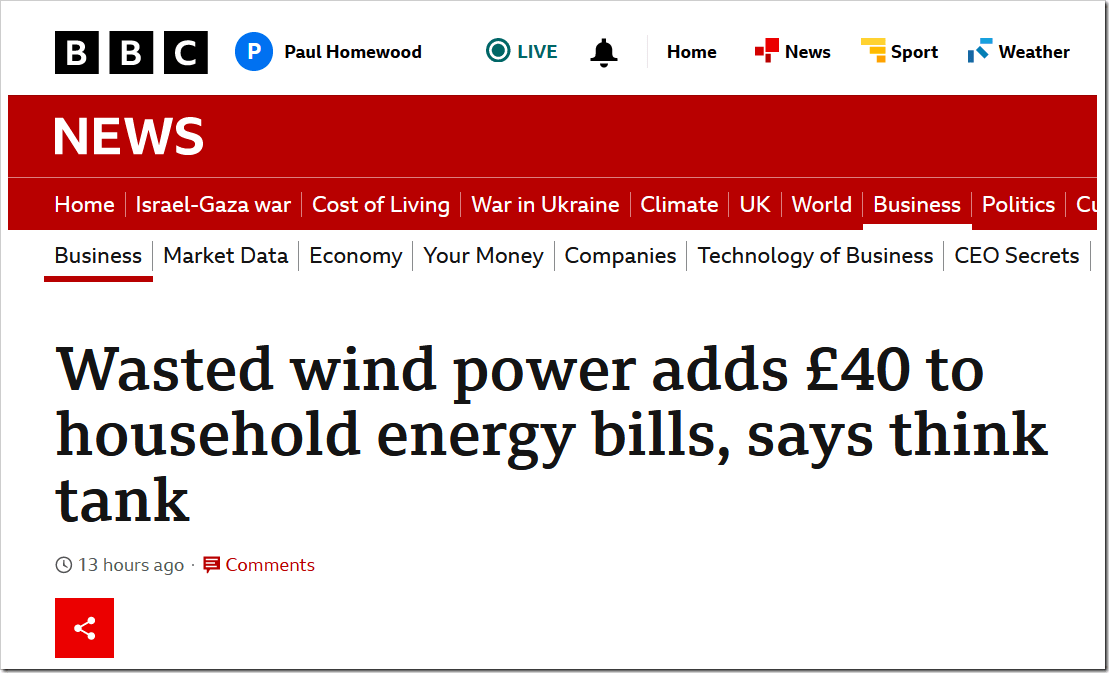
Wasted wind power will add £40 to the average UK household’s electricity bill in 2023, according to a think tank.
That figure could increase to £150 in 2026, Carbon Tracker has estimated.
When it is very windy, the grid cannot handle the extra power generated. Wind farms are paid to switch off and gas-powered stations are paid to fire up. The cost is passed on to consumers.
The government said major reforms will halve the time it takes to build energy networks to cope with extra wind power.
Most of the UK’s offshore wind farms are in England – Dogger Bank off the coast of Yorkshire is the largest in the world. Meanwhile, around half of onshore wind farms are in Scotland but most electricity is used in south-east England.
Carbon Tracker said the main problem in getting electricity to where it is needed is a bottleneck in transmission between Scotland and England.
The practice of switching off wind farms and ramping up power stations is known as “wind curtailment” and the costs are passed on to consumers, it said.
Carbon Tracker researches the impact of climate change on financial markets. It said since the start of 2023, wind curtailment payments cost £590m, adding £40 to the average consumer bill.
It warned those costs were set to increase to add £180 per year to bills by 2030, due to wind farms being built faster than the power cabling needed to transmit the electricity.
https://www.bbc.co.uk/news/business-67494082
For a start, they can’t even get their numbers right.
They say that wind constraint payments cost £590 million this year. Households however only use a third of electricity generated, so they are only directly paying about £196 million towards the bill. This equates to £7 per home, not £40.
They have also got their logic upside down. It is not “wasted wind power”, but the constraint payments that households are paying for. The answer is simple – refuse to pay them.
The problem, of course, is not “lack of infrastructure”, as they claim. It is that we ever built so many wind farms in Scotland, so far away from consumers, who will have to pay for all of this infrastructure as well. Yet we still have not learnt our lesson and are carrying on building even more. According to Carbon Tracker, constraint payments could rocket to over £3 billion by 2030.

https://carbontracker.org/reports/gone-with-the-wind/
It’s like subsidising new factories in the middle of nowhere in the Scottish Highlands, but not building any road links.
As the BBC is suddenly concerned about energy bills, maybe it should remind its readers that they are already paying some £1.2 billion to subsidise Scotland’s onshore wind farms every year.
Not a Lot of People Know That

 STOP THESE THINGS
Great business if you can get it – the great taxpayer & consumer swindle is in fast mode – the sooner net zero is scrapped, the better
So now, in Scotland, and Wales, allegedly to curtail wind curtailment, we are bombarded with plans for grid infrastructure – swathes of super pylons, substations and BESS – again at enormous cost, financially to the consumer; aesthetically to our iconic landscapes; impacting on individual homes and businesses. For what, in reality? So that even more wind farms can be speared in.