
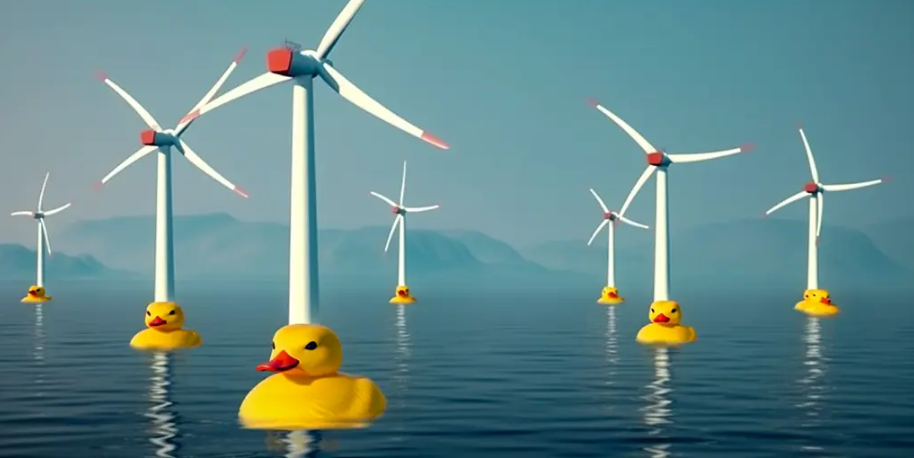
The more desperate rent-seekers become, the sillier they sound. The latest plan to float 800 tonne turbines at sea sounds like parody in motion.
Notwithstanding that the offshore wind industry can’t make a buck in shallow waters where their turbines are firmly connected to the ocean floor – dozens of grand offshore projects have been scrapped in the last twelve months – hopeful crony capitalists on America’s West Coast reckon that they can buck the trend and make squillions by spending two or three times more on the capital required to occasionally generate power with no commercial value.
David Wojick reports on the latest ludicrous plan to squander taxpayer’s money on a scheme that makes absolutely no sense.
CFACT Blasts Fed’s “Floating Wind” Fantasy
Watts Up With That?
David Wojick
9 November 2023
CFACT President Craig Rucker has blown the whistle on Federal plans to put hundreds of floating wind generators off the Oregon coast. Floating wind is the latest green energy fantasy, taking its place along with hydrogen, EVs, battery storage, and net zero.
The idea is that where the water is too deep for conventional offshore wind generators, we will simply put these huge towers and turbines on floats. Pretty much all of the West Coast fits this bill, as does most of Maine.
Responding to a Federal request for comments on a big floating wind proposal for Oregon, Rucker explains clearly that the technology needed to do this does not exist and may never exist in an economically feasible form. The federal agency is the Bureau of Ocean Energy Management (BOEM). The plan is to designate hundreds of thousands of ocean acres as Wind Energy Areas and then start auctioning them off to floating wind developers.
His succinct comments are here: http://www.cfact.org/wp-content/uploads/2023/11/Comments-concerning-BOEMs-Draft-Wind-Energy-Areas.pdf
I want to dive into the technology a bit to show what a boondoggle floating wind really is.
First, let me say that, sure, we can put huge turbine towers on floats. Our fighter jets take off from and land on floats, right, floats called aircraft carriers. But they are really big, hence expensive. The same is true for floating wind, albeit at a somewhat smaller scale.
Look at it this way. Suppose you took a sailboat and put a 600′ tall mast on it. At the top, you put an 800-ton turbine with three 500′ long wind-catching blades. How big would that boat have to be not to blow over when hit by severe wind and waves?
The answer is very big indeed, in fact, huge. Now compare this huge float with the simple monopile that conventional offshore generators sit on. The monopile is a simple steel tube, maybe 30′ in diameter and a few hundred feet long, driven solidly into the ocean floor.
Compared to the huge float, the monopile is small and cheap. But simple monopile base offshore wind facilities are already tremendously expensive. Floating wind is projected to cost much more, from 2.5 to 3 times more, in fact.
In addition to the huge float holding up the turbine tower, there have to be a bunch of monster mooring chains anchored firmly to the ocean floor in all directions to keep the float from rocking too much in heavy seas or from capsizing. Then, too, the power lines taking off the electricity have to somehow get from these bobbing floats to the distant shore.
The highly specialized fabrication facilities and work boats required to make and install all this stuff in deep water do not exist. Given that over 50 vastly different floating wind designs have been proposed, we do not even know what to build.
I say projected because no utility-scale floating wind facility exists in the world today. BOEM is talking about quickly building thousands of Mega Watt (MW) of floating wind. Five leases pegged at 3,600 MW have already been sold off California. But as Rucker points out, the biggest facility in the world today is an experimental 88 MW and that just fired up a few months ago.
Those five California leases are, in effect, experimental. The developers are each going to try to produce an economically viable floating wind facility. As things stand, the odds are very long against them. I can hardly wait to see the Construction and Operations Plans, which are the first required step in the long road toward project approval.
But the ultimate crunch point is selling the juice via a Power Purchase Agreement (PPA). If costs run three times regular offshore wind, which is already extremely expensive, then the required PPAs might simply be unobtainable.
However, California just passed a law allowing the State to directly buy offshore wind energy. Perhaps the plan is for the State to buy horrendously expensive electricity, sell it to the utilities at the much lower going wholesale rate, then let the taxpayers eat the losses. It is, after all, Crazy California.
Mind you, this silly game is being played around the world. Several countries have launched similarly speculative large-scale floating wind projects, and many more are talking about it. Of course, they are also talking about mass-scale hydrogen, EVs, and net zero. It is all part of the same green nonsense.
As for the American floating wind fantasy, stay tuned to CFACT as this engineering comedy unfolds.
Watts Up With That?

 STOP THESE THINGS
Ice is melting oceans are rising but apparently ‘the science’ doesn’t mention water displacement.
Put all the MPs for environmental protection in a full bath & it wouldn’t overflow: no substance.
So much for the laws of physics. Perhaps MPs for science could explain where the carbon comes from to make steel out of iron.
AUs leading xspurts (x the unknown factor & spurt a drip under pressure) on nuclear energy keep saying plants are too big, take too long to build & are too expensive.
Queensland has no upper house so I suggest we are too over-governed by the too over paid.
Keep all kids away from parliaments; it gives them the wrong idea on acceptable behaviour.
I didn’t get STT emails 2, 3, & 4th Dec. & WordPress said site not found.
We’re back online now. You should have received an email notification today. If you don’t get one tomorrow, let us know, thanks.
I have not received your Email.
Have you got mine?
I have noticed the censure and wrote a report on
eike-klima-energie.eu/2023/12/03/die-zensur-unliebsamer-webseiten-geht-weiter-hier-stopthesethings-australien/
And I wrote to wordpress,, automaticc , they respond evasively
All the best to you and the group
Andy
We did, thanks Andeas. We had a technical glitch, back online. All good.
What happened to the Blog. The fascist sods at WordPress have struck again??
cancelled Do you have another platform?
Elizabeth Schiemer Port stephens Australia
Banned!! ???
OMG!!
Where to next??
Sent from my iPhone
In 1930, Claude George, a student of Jacques Arsène d’Arsonval, built a 22 kWe ocean thermal system near Matanzas, Cuba. It was destroyed in a storm. Then he built one in 1935 on a 10,000 ton barge of the coast of Brazil. It was destroyed before it produced any power. Why would floating wind turbines be any different? The 120 kWe plant built by Tokyo Electric Power Company at Nauru, which consumes 90 kWe to run itself and delivers 30 kWe to a village and school, has not yet been destroyed. When it is, will environists (the “mental” part was consciously removed) howl about the ammonia pollution?
As far as transmitting power to shore, somebody has surely proposed microwaves, as they’ve done for orbiting solar panels. Just another way for wind to kill birds.
On important metric that needs to be considered in every scheme is Energy Return on Energy Invested, or EROI, as eloquently described by Daniel Weißbach et al in “Energy intensities, EROIs (energy return on invested), energy payback times of electricity generating plants,” Energy 52, pp 210-221 (April 2013) http://dx.doi.org/10.1016/j.energy.2013.01.029. Solar and wind with storage clock in at 4. Economic viability requires 7. Nuclear power plants operated for eighty years clock in at 250. Rome, powered by slaves and asses, clocked in at 2. Space-based would clock in at less than 1.
The whole idea is a complete joke. Scam!