

The twisted logic of the wind and solar ‘transition’ means the only way of preventing blackouts is to force users to stop using electricity.
Australia’s Federal government is paying energy-hungry businesses (using taxpayer’s money, obviously) to stop producing whatever it is that they produce so they do not use electricity. Because that’s the only way the powers that be can secure the power that isn’t.
Total solar output collapses are thoroughly predictable. It’s called ‘sunset’.
Predicting total wind power output collapses simply means predicting periods of calm weather.
Juggling power demand around the weather is always tricky and a little like a game of musical chairs, where each round results in somebody missing out altogether.
The Brits have come up with their own farcical solution, as Paul Homewood reports below.
Grid asks factories to use less energy next winter under blackout prevention plan
Not A Lot Of People Know That
Paul Homewood
18 June 2023
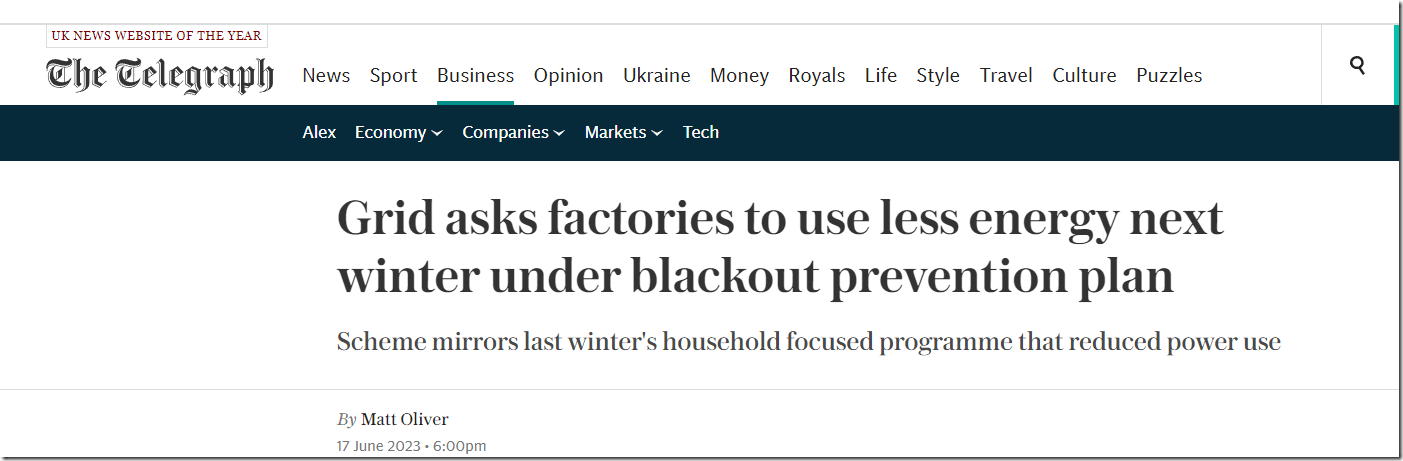
The National Grid will ask factories and businesses to voluntarily cut their electricity usage this winter under an expansion of a service previously pioneered by households.
In a bid to help keep Britain’s lights on, the Grid has confirmed it will urge heavy industry to sign up to the so-called demand flexibility service this coming winter.
Businesses that sign up would be asked to reduce their consumption at times when supplies are expected to be stretched, helping to ease pressure on the system.
While they may use the same amount of energy overall, shifting their usage outside of peak times can help the Grid to manage and prevent blackouts in worst-case scenarios.
Households are also being asked to take part in the demand flexibility service again, which was first introduced last year.
We are rapidly returning to the blackouts and voltage reductions of the 1960s and 70s. (Remember how our old TVs used to lose their horizontal hold, whenever voltage was reduced?)
Back then our steel works, along with many other heavy power users, were handed Maximum Demand periods, usually of an hour, and with maybe a day’s notice at times of peak demand. Any electricity used during that hour was charged at a punitive rate. Consequently everything shut down, the furnaces, rolling mills etc; even the lights went off in the offices, which was quite a fun time when you did not have to work and could chat the girls up instead!. But it was no way to run a factory efficiently, and neither will this latest idea.
This move is, to all intents and purposes, rationing. And the reason is quite clear – the closure of nearly all of our coal power capacity.
If we are having to take such drastic action now, heaven help us when our gas plants start to shut down as well.
The Telegraph finishes with this ridiculous claim:

Given that only 1.6 million homes took up the offer, clearly the amount saved could not have been enough to power 9.9 million homes.
Not A Lot Of People Know That

 STOP THESE THINGS
“Moving to the US for cheaper power.” Not California, where power costs twice the national average.
Firm power from the unreliables in USA would cost up to ten times total GDP every year.
http://vandyke.mynetgear.com/Worse.html
What a way to attract industrial investment to the UK – tell them the electricity needed to make manufacture their products can’t be relied upon to be available when they need it…
And then – if they actually manage to make a profit – the Chancellor will punish them with a “windfall tax”.
“In a bid to help keep Britain’s lights on, the Grid has confirmed it will urge heavy industry to sign up to the so-called demand flexibility service this coming winter. This move is, to all intents and purposes, rationing.”
No. Incorrect!
I don’t care what lable they give it. It is a blackout!
The “demand flexibility service” seems to be the same as the “demand management” that is currently being used in Australia. A better term might be a controlled blackout.
Rather than cutting power to thousands or millions of consumers they target one or two high volume industries.
The thinking behind this is likely that rather than upset millions of consumers they then only upset one or two businesses who are compensated monetarily. Either way you look at it – it is a blackout.
The ever gullible public still believe that they are in capable hands…frightening!
In SE Australia we have the Orwellian “reliability and emergency reserve trader (RERT) scheme ” which sounds like a reserve but it is a rort (Australian for racket) which hides the shortage of power from the public by making selected big energy users power down for a while, with compensation paid by other consumers.
The next step is to black out selected suburbs and districts. There has not been a great deal of that because we have not had much extreme weather since January 2019 when there were blackouts in Victoria.
Also I suspect that we have been losing power-intensive industries by going out of business or moving to the US for cheaper power.
Reblogged this on whatyareckon and commented:
These climate scammers are NUTS!!!
I think the more accurate term is “useful idiots.”