

Backing ideology over sound engineering was never the smartest ploy. Now the ideologues are in a flat panic as the public begins to realise that they’ve been lied to, all along.
The ‘renewables are cheap’ story doesn’t seem to cut it anymore, with Australian households and businesses set for 25-30% increases in their power bills next month. Australians have been hit with double-digit percentage increases in their power bills every year since the Green-Labor Alliance ramped up the Federal government’s Renewable Energy Target back in 2010.
Their ‘more giant batteries will fix it’ meme is struggling, too. There is no grid-scale power storage system using batteries operating anywhere in the world. Australia is no different. The reason batteries offer no solution is all down to physics and economics.
As the grand wind and solar ‘transition’ collapses around them, the zealots and rent-seekers are reduced to accusing Australia’s coal-fired power plants of being ‘unreliable’ and continue to rant about the occasional ‘outage’ at a coal-fired plant as the source of all of the grid’s woes.
Never once do these characters ever confront the daily total collapse in solar output (aka ‘sunset’) and the regular near-total collapses in wind power output (aka ‘calm weather’); never once do they suggest that the chaotic delivery of wind and solar might well be the root cause of the power pricing and supply calamity that’s afoot.
Along with wild talk about giant batteries rescuing the situation, zealots and rent-seekers have turned their attention to building an enormous (and additional) transmission infrastructure – purportedly to capture all that wasted wind and solar power that’s presently being generated beyond the back of beyond.
Labor’s hapless Energy Minister, Chris Bowen reckons a mere $20 billion of taxpayer’s money ought to be enough. But, as we will detail below, no amount of additional wiring (with or without batteries) can compensate for the vagaries of sunset and the weather.
We’ll start with this piece from The Australian.
Power grid precarious as winter looms, warns EnergyAustralia
The Australian
Colin Packham
5 June 2023
Australia’s electricity network is precariously balanced going into a peak demand period, the head of one of the country’s biggest energy companies has warned.
Mark Collette, head of EnergyAustralia, said recent fossil fuel closures, including the shutting of AGL Energy’s Liddell coal-fired power plant, had left the national electricity system exposed, even though generators have fast-tracked maintenance to ensure no repeat of the coal power station outages that plagued Australia in June 2022.
“The dispatchable capacity is actually less than last year after the closure of the Liddell power station at the end of April. If there were outages or supply shocks – we notice them,” Mr Collette told a climate business summit in Sydney.
AGL Energy shut the last unit of the Liddell power station in April.
Australia is still reeling from the market suspension last winter when a spate of coal power stations suffered outages, forcing generators to turn to gas at a time when prices were at record levels to prevent blackouts. That in turn triggered a crisis that has led to higher household power bills from July 1.
Mr Collette is the latest executive to express concern about the capacity of Australia’s electricity network to manage the increased demand during winter and summer amid a rapid transition of the country’s fuel sources.
Coal is the largest source of electricity in Australia, accounting for about two-thirds of all power, but its role has waned significantly in recent years as fossil fuels come under mounting economic and social pressure.
“In preparation for every coal retirement, what I’d like to see is enough capacity to replace the services that coal provided. So far coal has been closing without the replacement being there,” Mr Collette said
The closure of coal power stations will help Australia – one of the world’s highest per capita emitters – meet its carbon emission targets. But industry executives have warned that new zero-emission sources are failing to keep pace with the closures of coal power plants and Australia is risking its energy security.
Unexpected coal outages this winter would put pressure on wholesale electricity prices, which will be key to determining how much prices rise in 2024.
The Australian Energy Regulator last month approved bill increases of about 25 per cent for households and businesses across the east coast from July 1, which it said was predominantly driven by the increased cost of generating electricity in winter 2022.
A global energy crunch – which pushed up the price of coal and gas – was the major driver in soaring generation costs in 2022. The price of coal has fallen significantly in recent months, aiding Australia’s electricity generators, but wholesale costs remain elevated amid a generation squeeze.
Queensland’s fifth-largest coal generator, state-owned Callide C, remains offline, while east coast gas supplies have been impacted by a series of outages at ExxonMobil’s Longford plant.
Federal and state governments have said progress is being made in increasing renewable energy generation capacity, which would decrease the cost of generating electricity during sunny or windy days.
However, industry executives have warned Australia is behind the pace in developing storage such as large-scale batteries and pumped hydro to compensate for so-called renewable energy droughts.
Mr Collette said there had been increased investment in batteries, but noted the systemic differences with coal.
“A coal power station would have a stockpile of a month, maybe two. A battery will have between two and four hours,” Mr Collette said. “In May you had a period when there wasn’t much wind. If you didn’t have coal there, it would have been a very different story.”
Over $120bn of spending is needed to finance new solar, wind, transmission and energy storage projects by 2030, according to the Australian government-backed Clean Energy Finance Corporation.
The Australian
So, just about every lie and myth is employed there to pretend that all is well in the wind and solar ‘transition’ garden. True, there is an implicit acknowledgment of ‘a problem’, but no recognition of the most obvious solution: stop closing coal-fired power plants, right now. Blind faith in the central myth and ignorance of reality are the hallmarks of any great cult.
Then there’s the rapid rise of already crippling power prices, met with ludicrous claims that more chaotically intermittent and heavily subsidised wind and solar is the only solution to that aspect of Australia’s self-inflicted energy crisis.
Power prices to take years to fall and Albanese’s bill cut pledge at risk by lack of green energy
The Australian
Colin Packham and Nick Evans
6 June 2023
Electricity prices will take years to return to pre-pandemic levels and Labor’s pledge to triple the amount of renewable energy in the grid by 2030 is at risk as the nation is failing to build enough green power, top business leaders have warned.
As Anthony Albanese promises both a net-zero economy by 2050 and a reduction in power bills by the next election, leading energy companies say the country is not ready for renewable energy droughts and Energy Minister Chris Bowen concedes he is “not satisfied” with the pace of progress on clean energy projects.
Alinta chief executive Jeff Dimery, head of the country’s fourth largest energy retailer, said he could not see a way of building enough renewable energy sources to compensate for the loss of coal, which still generates about two-thirds of Australia’s electricity.
“We’ve had one battery reach a final investment decision in the last quarter – one battery,” Mr Dimery said.
“Snowy 2.0 is delayed, VNI West is coming in 2031, three years after Yallourn comes out. The whole transition is not lining up. We are so far off track.
“This is not a complaint, it’s fact. We’re not looking to apportion blame. Really it’s the opposite. We have to come together on the solutions quickly.”
Industry executives said they expected wholesale prices to remain high over the next few years.
The warning comes as the cost of producing electricity in NSW hit the fifth highest level for May on record, despite a fall in the cost of coal and gas globally.
An increase in wholesale prices during the month will not immediately flow through to customer bills, but they will be a major contributor in calculations about power bill rises in 2024.
And any failure to build enough replacement energy supplies will threaten Labor’s promise to slash $275 from household electricity bills by 2025.
Mr Bowen said large-scale wind and solar farm investment commitments grew by nearly 50 per cent in 2022 but he added he was not satisfied with the pace of progress to hit clean-energy targets by the end of this decade.
“I’m pleased with what we’ve done in the first 12 months, but I am far from satisfied,” the minister said. “There is so much more to do and we are just getting started.”
Paul Broad, who ran Snowy Hydro until resigning shortly after Labor won office last year, said the challenge of the huge pumped hydro expansion under construction could not be overstated, adding that was just a tiny fraction of new green-energy supplies needed.
“We need a Snowy every year, but it’s extremely difficult,” Mr Broad said. “We are being lied to that this is achievable; the transition will take 80 years.”
Australia already faces a new cost-of-living shock, with electricity prices set to soar by up to 29 per cent in a fresh hit for small business. A steep bill hike will land from July 1, despite the government’s efforts to calm markets through a series of emergency interventions.
Transgrid is building $10bn of transmission projects to deliver renewable energy to households and said that, while they remained on track, challenges were mounting for bringing enough new power supply on board in time.
“It feels like we are on track with the building of renewables,” said Brett Redman, Transgrid’s chief executive and the former boss of AGL Energy. “The second part, however, the building of firming – be it batteries or gas – that is more of a challenge.”
Executives said there had been a wave of small-scale projects but to compensate for the loss of coal Australia would have to deliver upon its offshore wind plan.
States, led by Victoria, have placed offshore wind at the heart of plans to make the transition from coal. Offshore wind will be large-scale projects, often comparable to Australia’s largest coal power stations when operating at full capacity.
But renewable energy droughts – when the sun is not shining or the wind is not blowing – will mean Australia will need a significant expansion in storage capacity to smooth the volatility.
NSW in May was forced to delay its timetable for two critical renewable energy zones, the mainstay of its plan to make the transition to renewable energy. Sources said the delay was driven by failures to consult with landowners for permission to develop, and Mr Redman said Australia would need to be mindful of complexities.
“Generally big complex projects can take a little longer than you expect,” he said.
Australia’s coal power plants are ageing and many are approaching the end of their operational lifespans.
Dylan McConnell, a senior research associate at the University of NSW, said he expected wholesale volatility to continue to plague the market.
“We have so many projects that are delayed and will take longer to be delivered to market, and consequently we are going to have plenty of volatility,” Mr McConnell said. “This could be seen particularly in summer when it is likely we have an El Nino.”
El Nino weather patterns will typically bring hotter, drier conditions across the east coast, increasing demand from households for electricity to cool their homes.
Under mounting environmental and social pressure, Australia is shifting away from its dependency on coal, a transition that will determine whether it can meet its carbon emissions reduction targets but will also reshape the country’s $2 trillion economy.
The transition is broadly supported by voters who elected the federal Labor government year ago on a platform to hasten the move to renewables.
The surge in NSW wholesale prices during April was attributed to the closure of AGL Energy’s last unit at its Liddell coal-power station and scheduled maintenance of other generators ahead of the increased winter demand.
The Australian Energy Market Operator said last week it believed the power grid was well placed to cope with winter demand, as it cited recent maintenance of coal power stations that it said should boost the reliability.
Any further rise in power bills would intensify political pressure on the federal government.
Treasurer Jim Chalmers in his second budget last month said the government would offer energy bill relief to some 5 million homes.
The Coalition has intensified pressure on Labor amid signs of voter anger over the cost-of-living crunch.
Labor insists its legislated target of having 82 per cent of the country’s electricity needs met by renewable energy has seen a wave of developments begin.
Work has accelerated on building transmission lines that authorities believe will allow for zero-emissions energy to move across the country.
Australia has also seen a spate of batteries developed but large-scale storage developments have been hit by a spate of delays.
The Australian

The ‘batteries and extra transmission lines will fix it’ story is just that. A thoroughly baseless set of claims that a nine-year-old would quickly reject, provided she had a moment to consider the graphical data which we will present below.
Power transition requires more than good intentions
The Australian
Editorial
6 June 2023
Failings in the nation’s energy market represent one of the most pressing issues for households, businesses and the economy.
Governments of all persuasions and at all levels have been too slow to recognise the problems being created as hopes for a speedy transition to a lower greenhouse gas emissions network have not been matched by reality. Rising prices for electricity users and a shortage of supply of natural gas on the east coast are the result of market distortions due to government interference.
Against the promise of cheaper electricity bills made by the Albanese team during the election campaign, industry leaders now warn that prices will remain high for at least a decade. Political leaders have been seduced into believing today’s problems will be solved by simply building more renewable power. Environment Minister Tanya Plibersek fell into the trap on Monday when she said: “Renewable energy is cheaper. It’s cheaper as well as being cleaner.”
In the next breath, Ms Plibersek defended the government’s decision to spend $20bn on new transmission infrastructure. These are costs that must be included in the renewables calculation as well as the cost of providing back-up supplies to cover intermittency when the wind doesn’t blow or the sun doesn’t shine. Too little attention has been paid to the difficulty of achieving this task or the cascading failings already taking place in what is being attempted.
As things stand, we are forging ahead with destroying a system that has been reliable for decades and still supplies more than two-thirds of the nation’s electricity. But we are falling well behind in building the assets needed to keep the lights on and the wheels of industry turning.
In a special series of reports, Energy Crisis: How We Power the Future, we bring a focus to the hard truths that must be faced. As we report on Tuesday, two industry veterans have blown the whistle on how badly things have run off course. Alinta chief executive Jeff Dimery says he cannot see a way of building enough renewable energy sources to compensate for the loss of coal. The Snowy 2.0 pumped hydro project that is supposed to back up wind and solar is far behind schedule and billions of dollars over budget. The Victoria-to-NSW interconnector, VNI West, is scheduled to arrive three years after the Yallourn power station has been closed. Mr Dimery says “the whole transition is not lining up”.
This does not begin to take account of the difficulties likely to be encountered securing all the landholder and other agreements necessary to roll out thousands of kilometres of high-voltage power lines and hundreds of large-scale wind and solar farms. For proof, witness the delay in the timetable for two renewable energy zones in NSW, both central to that state’s renewable energy plans. And the view from BHP that the much-hyped hydrogen will be only a marginal player in global energy supplies into the future. Hopes that offshore wind developments will provide a ready solution fail to appreciate the hard lessons from abroad about the costs involved and disruption caused by periods of low wind.
Former Snowy Hydro chief executive Paul Broad says voters are being lied to that the transition is possible in the time frames that are being promised. He says the low-emissions transition is likelier to take 80 years. What is clear is that as coal-fired power stations close, power prices rise.
Following the closure of the Liddell Power Station in April, the cost of producing electricity in NSW hit the fifth-highest level for May on record despite a fall in the cost of coal and gas globally.
It is an undeniable fact that the world’s big greenhouse gas emitters, including China and India, are forging ahead with coal. And that our allies, including the US and Britain, are focused on ushering in a new era of nuclear power.
Governments must take stock of what is going on. Voters deserve more than glib one-liners that renewables are cheaper. They deserve to know there is a plan B to secure supplies at an affordable price when the inevitable delays happen and existing assets have been forced to close.
The Australian
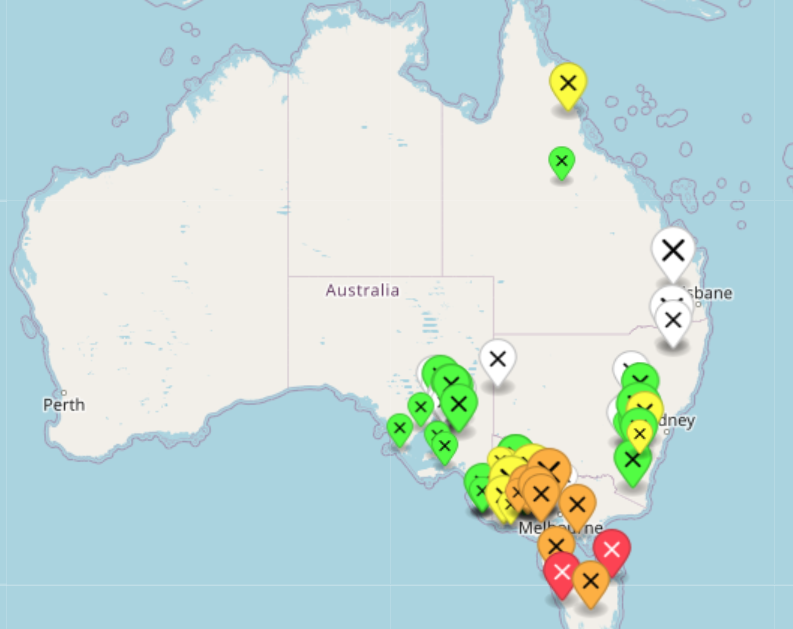
The graphic above shows the location of every wind farm connected to Australia’s Eastern Grid; 79 in all. Turbines – with a combined capacity of 10,277 MW – are located from Far North Queensland, along the Great Dividing Range in southern Queensland and all the way down through New South Wales (across to Broken Hill, in Western NSW), all over Victoria, Northern Tasmania and vast tracts of the Mid-North and South- East of South Australia, as far west as Port Lincoln.
The Eastern Grid connects all of those States: QLD, NSW, VIC, TAS and SA. The Northern Territory and Western Australia are too remote to be connected to the Eastern Grid – the cost of running transmission lines from WA or the NT would never be repaid and will never happen, whatever claims are made.
The first graphic below shows the combined output in MWs of every one of those wind farms during May 2023, the second does so in terms of percentages of their combined notional capacity.
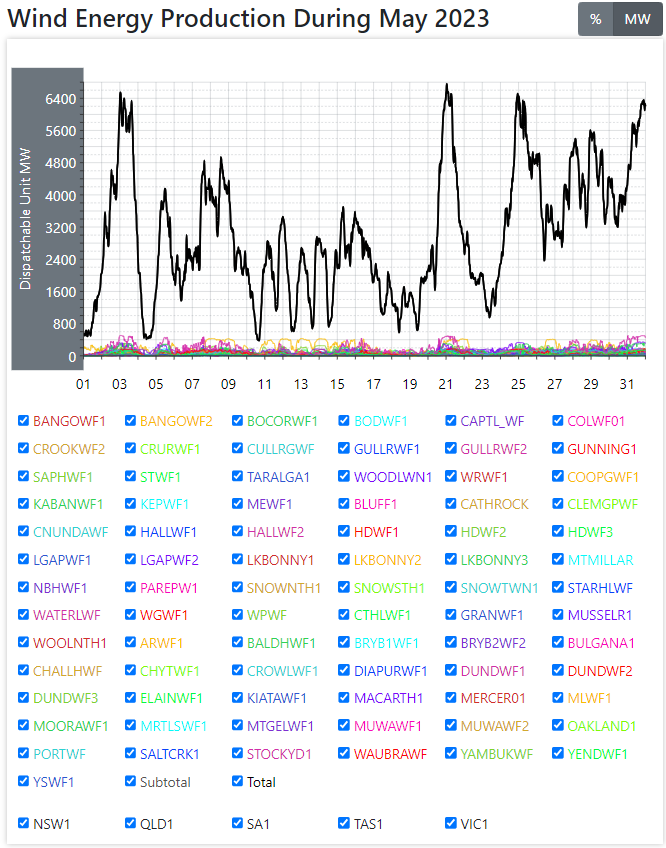

The data above – courtesy of Aneroid Energy – depicts the typically chaotic performance of Australia’s wind farms.
Occasionally, and then only briefly, their combined output tops out at around 60% of their notional capacity. What the rent-seekers and zealots refuse to acknowledge are the routine and random 5-6,000 MW collapses in output that occur over the space of a few hours. Nor is there any acknowledgment given to the lengthy (and frequent) calm spells, when output struggles to top 5% across the entire Eastern Grid. And, likewise, there’s never any mention of those frequent occasions when their best performance amounts to 20-30% of their combined capacity – again, for only brief moments (see above).
Australia could crisscross itself with additional transmission lines and interconnectors between States and it would not make a shred of difference.
It’s simple mathematics: when a system capable of generating 10,277 MW – and spread over an enormous geographical expanse – only ever generates 60% of that capacity (at best) and routinely generates around 5% of that capacity – ie 510 MW – or less, no amount of connection can rectify that system’s inherent and obvious inability to generate power, on demand. With the entire system generating as little as 5% – and often no more than 10-20% – there is nothing, or next nothing, to distribute across the Grid, irrespective of how well connected those 79 wind farms and thousands of turbines might be.
As the data consistently shows, wind power is always and everywhere a weather-dependent proposition. It’s that simple, and that obvious.
The only people suggesting otherwise are those with a financial (or perceived political) stake in profiting from the scam – and the witless ideologues who have absolutely no idea about how electricity is generated and distributed. And, sadly, that appears to be every one of the reporters responsible for The Australian articles above.
The sooner the entire grid collapses, the better. Then, and perhaps only then, will those that pretend to govern us stop lying to us and tell it like it is.

 STOP THESE THINGS
Reblogged this on whatyareckon and commented:
Political WIND bags!!!!!!!
Using eleven years of data for California, I calculated that 1,200 watt hours of storage are needed for every watt of average demand. USA as a whole: 1,450. Texas: 1,200. EU, Germany, Denmark: about 900.
http://vandyke.mynetgear.com/Worse.html
I’d love to repeat the analysis using Australian data, but I can’t find it. Where can I get generation data, categorized by “fuel” type, with hourly resolution, for several years?
Aneroid Energy https://anero.id/energy/wind-energy
FULLY AGREE. WE WROTE ABOUT THE TRUE COST OF RENEWABLES BACK IN 2017:
HAAR, LAURA N., and LAWRENCE HAAR. “An Option Analysis of the European Union Renewable Energy Support Mechanisms.” Economics of Energy & Environmental Policy 6, no. 1 (2017): 131–48. https://www.jstor.org/stable/26189575.
“Over $120bn of spending is needed to finance new solar, wind, transmission and energy storage projects by 2030”
And then, when the Sun sets and the wind stops blowing…
This liberal-driven insanity is a massive waste of resources that could be put to good use!
When reading those articles from The Australian I thought to myself that they could have been written by an ABC journo.
Journalism in Australia and indeed most of the world is is riddled with obvious lies, omissions for a cause and biases that make for a very hard and frustrating read.
Once upon a time, many years ago we would turn on our TVs for the 6pm news. I believe that most of what was broadcast then was pretty factual. Now???? Garbage!
“Over $120bn of spending is needed to finance new solar, wind, transmission and energy storage projects by 2030, according to the Australian government-backed Clean Energy Finance Corporation.”
The RE transition has hit the wall, as we see in Britain and Germany. They are rapidly deindustrializing in a process that started well before the war. They can import power from neighbours or they would be further down the drain, but Australia does not have that luxury and we are at the limit of our dispatchable capacity so any more reduction means we are in deep trouble every time we have a windless night.
Like the legendary farmer who incrementally reduced the rations of his workhorse until it died, we have run down coal power, our workhorse, to the point where we need to have wind power on deck to meet peak demands in the evening. And when a wind drought strikes, we are into blackout territory.
No amount of additional RE capacity makes a scrap of difference on windless nights! How hard is that to understand?
As for storage, pumped and batteries are a joke. If Snowy2.0 is ever completed it will add virtually nothing and the capacity of the biggest batteries is negligible compared with the power required to get through a windless night. How hard is that to understand? Just do the arithmetic:)
Maybe Chris Bowen could ask one of our billionaires to help fund a big fat cable connected to China’s electricity grid.
That’d fix our wind drought fears.
Click to access jrc-report-link-2017.pdf
It would have to be a DC cable. The limit for AC is about 480 km. Look up the St. Clair curve.
“Just do the arithmetic”
AGW hoaxers don’t need no stinkin’ arithmetic!