
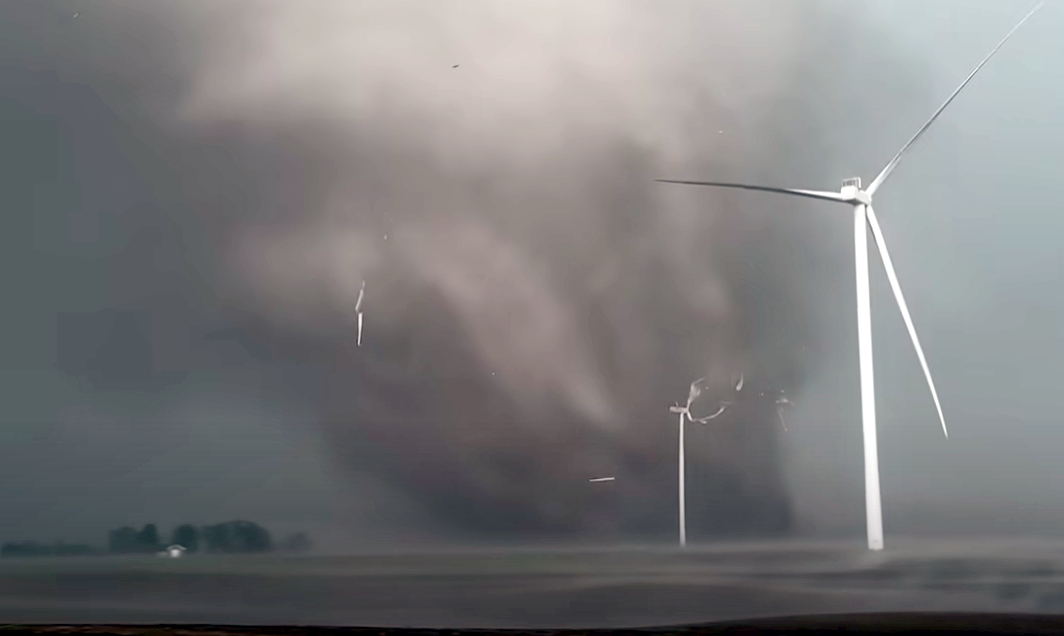
As America goes, so goes the entire industrial wind and solar scam. It’s not just that President Donald J Trump hates rent-seekers – and the wind and solar ‘industries’ they inhabit – with a passion, it’s the fact that, by pulling the US out of the Climate Industrial Complex, the once secure and firmly subsidised future of every wind turbine and solar panel manufacturer is now in tatters.
And that matters. Because of the sheer volume of sales that existed in US before the 47th President took office, the loss of the American market will destroy many of those panel and turbine makers, already in decline thanks to evaporating subsidies around the globe.
Which brings us to this week’s roundup.
Delivering another nail in the coffin for America’s wind industry, US Transportation Secretary, Sean Duffy just pulled the plug on a total of US$679 million that had been earmarked by the Biden administration for a dozen offshore wind operations, killing all of them, stone dead.
US Department of Transportation
Trump’s Transportation Secretary Sean P. Duffy Terminates and Withdraws $679 Million from Doomed Offshore Wind Projects
US Department of Transportation
Press Release
29 August 2025
In this Fox News interview, Junkscience.com publisher Steve Milloy details the depth of the subsidised solar scam and discusses Donald Trump’s move to have the EPA cancel a US$7 billion rooftop solar subsidy rort set up by Sleepy Joe.
Expert exposes solar panel industry as a ‘total scam’
Fox News
Steve Malloy
9 August 2025
Ronald Stein, Oliver Hemmers & Steve Curtis detail how the mandates, targets and subsidies to wind and solar distort the electricity market, with the deliberate aim of preventing nuclear power generation from doing what it does best: delivering safe, reliable and affordable power around-the-clock, whatever the weather.
Nuclear power in a free enterprise environment is the pathway to abundant low-cost electricity
America Out Loud
Ronald Stein P.E., Oliver Hemmers & Steve Curtis
4 August 2025
In this article, Dieter Helm details the colossal pricetag of attempting to run on sunshine and breezes, focusing on the UK – where its suicidal wind and solar obsession is driving retail power prices into the stratosphere.
The price of energy and the system costs of renewables
DHELM
Dieter Helm
26 August 2025
In this paper, Ursula Maria Bellut-Staeck details how the pulsing, low frequency noise and vibration generated by these things delivers unnecessary harm to humans and all manner of other creatures.
A fundamental basis for all living creatures, mechanotransduction, is significantly endangered by periodic exposure to impulsive infrasound and vibration from technical emitters – in particular cardiovascular and embryological functions
SCIREA Journal of Clinical Medicine
Ursula Maria Bellut-Staeck
16 June 2025
Stay tuned, STT will be back next week with more.

 STOP THESE THINGS
National Environmental Protection
Agency Bill 2025 (NEPA Bill)
The Bill establishes the National Environmental Protection Agency (NEPA) as the new federal regulator that will implement and enforce the re-written EPBC framework and related Commonwealth environmental laws. NEPA is promoted as an independent “tough cop on the beat” with powers to enforce compliance, require audits, and issue environmental protection
orders.
In practice, NEPA’s independence and accountability are weakly built in:
So this Bill is not just about creating a regulator; it is about who ultimately controls environmental decision-making and how much is shielded from scrutiny.
RED FLAGS
Instead of a genuinely arm’s-length regulator, NEPA risks becoming a delivery arm for government priorities (housing, renewable corridors, critical minerals) rather than an independent guardian of MNES.
Risk: This is a very unusual power in environmental law, and EDO notes it risks further politicisation and uncertainty rather than the constrained, rules-based system Samuel recommended.
Risk: NEPA’s workload will skew towards facilitating pre-screened development rather than robustly testing whether particular projects should be refused or heavily conditioned.
This is the core Bill of the seven-bill package. It rewrites the Environment Protection and Biodiversity Conservation Act 1999 (EPBC Act) and introduces a new bioregional planning framework. The stated goal is to “modernise” approvals and “streamline” environmental decision-making, but the mechanism effectively shifts control from project-level assessment to
up-front regional zoning.
Under the Bill, the Minister can divide Australia into Development Zones and Conservation Zones, based on perceived “environmental values.” Projects classed as “priority actions” in Development Zones are registered rather than assessed, meaning no Environmental Impact Statement (EIS), no project-specific public comment, and limited review rights.
The Bill also introduces new tools—offset funds, protection statements, and “rulings”—that replace scientific assessment with administrative shortcuts and give the Minister broad discretion to waive or reinterpret protections.
Major dangers / big issues
Effect: Environmental protection becomes a one-time regional map exercise, not a continuing duty to test individual impacts.
Effect: Thousands of hectares of unlisted but ecologically critical native vegetation could be opened to clearing.
Effect: Converts the EPBC’s avoid-mitigate principle into a “pay-to-destroy” scheme.
Effect: Political expediency can trump environmental law.
Effect: Citizens lose practical ability to object to real, on-the-ground proposals.
Effect: Creates a two-tier system—listed sites protected, the rest expendable.