
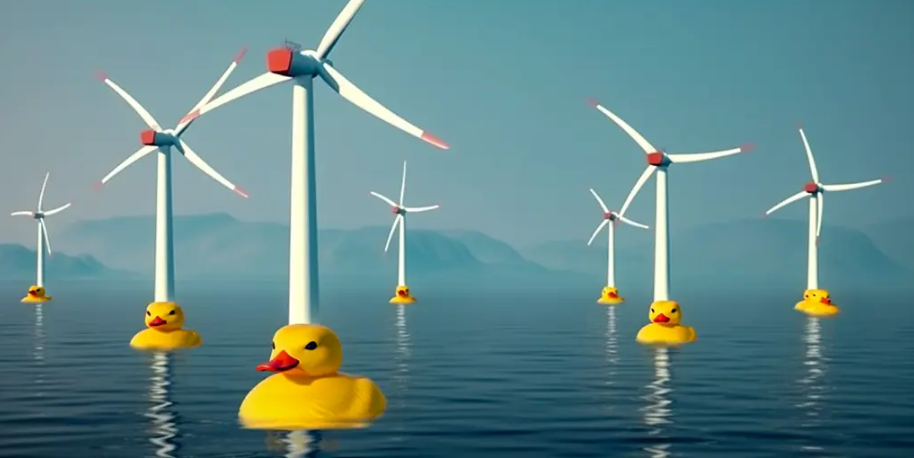
The environmental destruction caused by the offshore wind industry has completely flipped public opinion. The wanton destruction of marine habitats, fishing grounds and the wholesale slaughter of whales, dolphins and other marine mammals has drawn the same kind of attention that attracts people to multicar pileups. In this case, the characters responsible are easily identified and are being rightly pilloried by the general public.
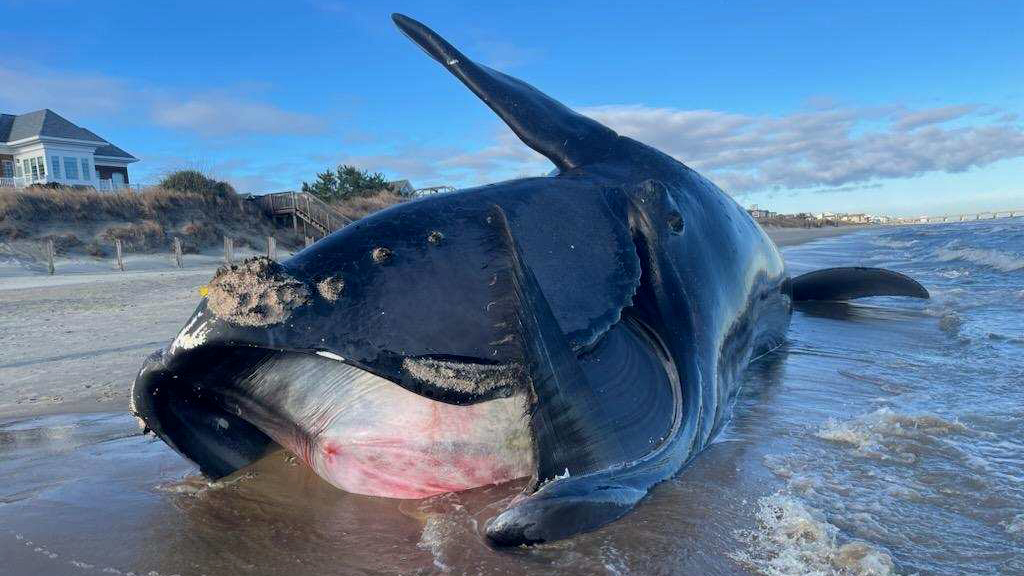
Having the Atlantic coast littered with dead whales, caused by the insane noise levels generated during the pile driving required for the construction of these things, is their spin doctor’s nightmare.
And that’s not the only catastrophe offshore outfits are keen to deflect, avoid and bury.
In the following 2 pieces, Edward Ring provides a rather helpful roundup of everything that’s wrong with the offshore wind industry, targeting the latest lunacy of floating mega-turbines way out to sea.
Floating Offshore Wind – A Financial Catastrophe
Abundance – California Policy Center
Edward Ring
14 August 2024
When it comes to looming financial and environmental catastrophes, nothing can compare to floating offshore wind. It is energy policy at its worst.
In an analysis earlier this year (WC #36), using cost estimates published by a European energy consulting firm, I estimated the total project cost for floating offshore wind off the California coast at, best case, $13.6 million per megawatt of baseload-equivalent capacity. “Capacity” is an often misunderstood word.
The “nameplate capacity” of a wind turbine might be 10 megawatts, but that amount of electricity is only going to be generated when the wind is blowing and the system isn’t down for maintenance. With intermittent sources of electricity generating technologies such as wind turbines, the “yield” is what matters, and that is unlikely to ever exceed 40 percent, even offshore.
Taking into account intermittency, the U.S. Energy Information Administration estimates a construction cost of $10 million per megawatt. But that estimate is for the less expensive “fixed bottom offshore wind with monopile foundations,” and not for floating platforms.
As economist Jonathan Lesser, author of “The False Promises of Offshore Wind,” shared with me via email last week, “the technology for the cabling needed to secure the turbines to the floor and the cables to carry the electricity are in their infancy. I conclude that the EIA estimate for floating turbines is, in my view, pure fantasy.” Which is to say, more than $10 million per megawatt.
Another expert I was fortunate enough to reach is Gordon Hughes, a professor of economics at the University of Edinburgh. For the last several years he has been analyzing the performance of offshore wind in the North Sea and throughout the world. Here’s what he wrote to me in a recent email:
“I don’t believe the figures given by EIA – they have no basis in actual costs and performance, they are little more than optimistic guesses generated by lobbyists. No-one knows how to build floating wind turbines with a tip height of 220 or 250 meters. The rotational forces in high winds are huge and the only way to stabilize them are to build huge concrete/steel platforms. I have no idea where they would be built on the West Coast and I doubt that towing them across the Pacific from East Asia is viable. Could they transit the Panama Canal?
The point is all talk of floating wind farms off California or Oregon seems to me to be ungrounded speculation. You could build ones with a tip height of 150 meters but that would significantly reduce both the nominal capacity and capacity factor for such turbines.”
At that height, still nearly 500 feet, nameplate capacity is only 2.5 megawatts per turbine. We would have to float 10,000 of these monstrosities in order to achieve the currently planned 25 gigawatt capacity off our coast.
As acknowledged in a Cal Matters report from July 2024, “The offshore wind industry must be created almost from scratch: a new manufacturing base for the still-evolving technology; a robust and reliable supply chain; transportation networks on land and sea; specially configured ports to make, assemble and maintain the gargantuan seagoing platforms; finding and training a highly specialized workforce; building a large transmission network where none exists and beefing up those that operate now.”
Compare that to the EIA’s estimates to construct other types of electricity generating plants. A natural gas fueled electricity generating plant with 95 percent carbon capture will only cost $2.4 million per megawatt. Advanced nuclear: $7.8 million per megawatt. Small modular nuclear: $8.9 million per megawatt. Geothermal: $3.9 million per megawatt.
Imagine the scene if this abominable scheme ever comes to full fruition. To produce 25 gigawatts of capacity would require at least 2,500 wind turbines floating approximately 20 miles offshore.
To have a capacity per turbine of 10 megawatts, each of them would be approximately 1,000 feet high, and each of them would have at least three tethering cables hooked to the sea floor over 4,000 feet underwater. Each of them would also need an underwater high voltage cable that would somehow connect to the onshore grid.
Offshore wind is a terrible idea. There are plenty of alternatives, including the only slightly less unpalatable option of onshore wind. But the California Energy Commission pushes forward.
The rhetorical bludgeon used to silence critics and empower the special interests poised to make a killing is predictable enough. From Cal Matters, here’s a quote from one of the CEC’s five commissioners. “‘I feel the urgency to move forward swiftly,’ said energy commissioner Patty Monahan. ‘The climate crisis is upon us. Offshore wind is a real opportunity for us to move forward with clean energy.’”
Clean energy does not have to require hundreds of billions in taxpayer subsidies and utility rate increases. Clean energy should not rely on technology that isn’t ready and components that can’t be sourced. And clean energy shouldn’t destroy the environment. Invoking the “urgency” of climate change without addressing the issues of cost, technology, materials, and environmental impact is a vapid and irresponsible but all too common tactic.
Let’s assume that we industrialize some of the most pristine stretches of the California coast and foul our offshore waters with between 2,500 and 10,000 floating wind turbines.
We will have 25 gigawatts of new capacity, yielding 10 gigawatts of steady power once sufficient land-based storage assets are available. That equates to 87,600 gigawatt-hours. Even at $10 million per megawatt, which is a best case estimate, the total project cost will be $100 billion.
To generate the same amount of power capacity by constructing new, advanced combined cycle natural gas generating plants with sequestration of CO2 emissions would cost $25 billion. That’s four times less expensive.
Next week we will review the environmental impact of floating offshore wind.
Abundance – California Policy Center

Floating Offshore Wind – An Environmental Catastrophe
Abundance – California Policy Center
Edward Ring
21 August 2024
Last week we examined California’s plans to install between 2,500 and 10,000 floating offshore wind turbines approximately 20 miles off the coast of San Luis Obispo and Humboldt counties.
The estimated cost to install 25 gigawatts of capacity, which equates to 10 gigawatts of steady power if adequate storage assets are available, is at least $100 billion. Those costs don’t include the necessary investments in storage assets or additional high voltage transmission lines. Nor do they include the costs to maintain these floating turbines in a hazardous environment.
No other significant energy option costs this much. Even nuclear, at its falsely inflated construction costs, is less expensive. Natural gas electricity generation with CO2 sequestration included is four-times less expensive.
Every imaginable “renewable” – solar, geothermal, and onshore wind – is far less expensive. We should not be doing this. It is special interest driven dysfunction at the highest levels of California politics, and it will squander hundreds of billions of dollars.
But beyond its eye-watering costs, offshore wind is an environmental catastrophe.
It doesn’t require scientific expertise to recognize that California’s treasured marine ecosystem will be disrupted by the presence of somewhere between 2,500 (at 10 megawatts each) and 10,000 (at 2.5 megawatts each) floating wind turbines.
That will require between 7,500 and 30,000 tethering cables descending 4,000 feet to the sea floor, along with 2,500 to 10,000 high voltage cables. These power cables will either be individually descending 4,000 feet, or they’ll be connecting at shallow depths from one turbine to another, bundled in order to reduce the number of lines that have to traverse the 20 miles from wind farm to shore.
Imagine the impact on aquatic wildlife. Entanglements. Collisions. Broken cables. Electromagnetic fields. Low frequency noise. Sedimentation from anchor use. And so much more, all of it poorly understood.
When it comes to evaluating the environmental impact of offshore wind on whale populations, one would think environmental groups like Greenpeace would offer some criticisms.
After all, the heroic original mission of Greenpeace was to save the whales. But today, instead of sending a reincarnation of the Rainbow Warrior to challenge offshore wind installers, the organization issues proclamations such as this: “Protecting whales means busting fossil-fueled myths about wind energy.”
The evidence that underwater sonar used to survey sites causes permanent damage to the ability of marine mammals to navigate and communicate is nearly indisputable. Inexplicable deaths of pilot whales off the coast of Scotland. Hundreds of deaths of minke, humpback and right whales off the coast of New England.
Off the east coast of the U.S., the areas selected for offshore wind farms have to be outside of heavily trafficked shipping routes. That is precisely where whales and other aquatic wildlife have congregated.
Into these remaining sanctuaries comes noise from construction vessels, high frequency sonar mapping, and pile driving, releasing sound impacts up to 240 decibels. This is enough to permanently destroy hearing in marine mammals, which is fatal.
An August 2023 report released by a New England fishermen association summarizes research they completed on offshore wind projects. Their findings are stunning. Just the geographic extent of these proposed offshore wind projects is unprecedented.
According to the report, “Federal regulators at the Bureau of Ocean Energy Management (BOEM) have designated almost 10 million acres for wind farm surveys and development.” That is over 15,000 square miles.
Not included in that allocation are the corridors where high voltage lines will have to cross the ocean floor to transfer electricity from the turbines to land-based power grids. The report found that “electromagnetic fields (EMFs) emanating from subsea cables appear to produce birth deformities in juvenile lobster.”
The report also found that wind farms “increase sea surface temperatures and alter upper-ocean hydrodynamics in ways scientists do not yet understand,” and “whip up sea sediment and generate highly turbid wakes that are 30-150 meters wide and several kilometers in length, having a major impact on primary production by phytoplankton which are the base of marine food chains.” There’s more.
Offshore wind turbines, after the high decibel disruption caused during surveying and installation, “generate operational noise in a low frequency range (less than 700 Hz) with most energy concentrated between 2 and 200 Hz.
This frequency range overlaps with that used by fish for communication, mating, spawning, and spatial movement,” and “high voltage direct current undersea cables produce magnetic fields that negatively affect the drifting trajectory of haddock larvae by interfering with their magnetic orientation abilities.” Haddock are “a significant portion of U.S. commercial fish landings and are an important component of the marine food chain.”
Direct destruction of our offshore marine environment are not the only environmental impacts of offshore wind. The interior of the massive blades are typically made of balsa wood, which thanks to the surge in demand has led to Amazon rainforest being replaced with balsa plantations.
By now it ought to be common knowledge that the quantity of minerals used to deploy green energy technologies is far greater than what is necessary for conventional energy. Using data from the International Energy Agency, geopolitical writer Peter Ziehan calculated the mineral requirements for offshore wind to be nearly 16,000 kilograms per megawatt, compared to less than 2,000 kg/MW for natural gas. The destructive impact of this mad rush to source minerals around the world so Americans can “go green” cannot be overstated.
Should this be of concern, there’s also the heavy carbon footprint of offshore wind. You have to take into account the carbon footprint of the mining, refining, manufacturing, shipping and installation. Then add to that the ongoing maintenance, sourcing, shipping and installing replacement parts.
After no more than 20 years, the turbine and the blades will have to be replaced, with the old parts either disposed (you can’t recycle the massive blades) or recycled. And then there’s the additive impact of quick start backup natural gas power which when turned on and off abruptly to fill in for intermittent wind operates at a far lower efficiency, i.e., about twice as much CO2 emissions per megawatt-hour than when allowed to run as continuous baseload power. In fact, a September 2022 analysis by the US Bureau of Energy Management claimed that offshore wind would have “no measurable impact” on reducing so-called greenhouse gas.
In a must-watch video posted in February 2024, Lisa Knight, an M.D. and PhD and resident of Maine, delivers a 30 minute lecture to concerned local residents that surveys additional environmental harm that accompanies offshore wind farms. It is not possible in a few words to describe every detail of this dense, scrupulously researched presentation. All of it is relevant.
Suggesting that we need offshore wind because of the “urgency” of the climate crisis is an insult to the common sense of anyone who has studied these projects and compared them to every imaginable alternative. California needs to prioritize energy solutions that will do more good than harm.
Abundance – California Policy Center
 STOP THESE THINGS
Two excellent articles.
The USA Bureau of Ocean Energy Management explicitly violates regulations of the National Oceanic and Atmospheric Administration, but nobody seems to care.