
The offshore wind industry is facing the fury of fishermen determined to protect their fisheries, their livelihoods and the environment they live and work in.
Along America’s Atlantic coast, fishermen of all shapes and sizes have turned on the offshore wind industry with an industrial scale fury.
Right alongside them are those with a passionate concern for whales, porpoises and dolphins. Another group of critters that the wind industry treats as ‘roadkill’, and why wouldn’t, they? – having helpfully obtained government licenses to kill as many as they please.
Then there’s the effect on the creatures that provide fishermen with income and their customers with dining pleasure. Those effects now include hundreds of tonnes of toxic plastics and fibreglass gunk being spread across the ocean every time one of the blades of these things decides to disintegrate and spew its entrails over America’s coastal waters.
Leslie Eastman reports on the latest insurrection by America’s fishermen.
New England Fishermen Stage Floating Protest at Vineyard Wind Site
Legal Insurrection
Leslie Eastman
30 August 2024
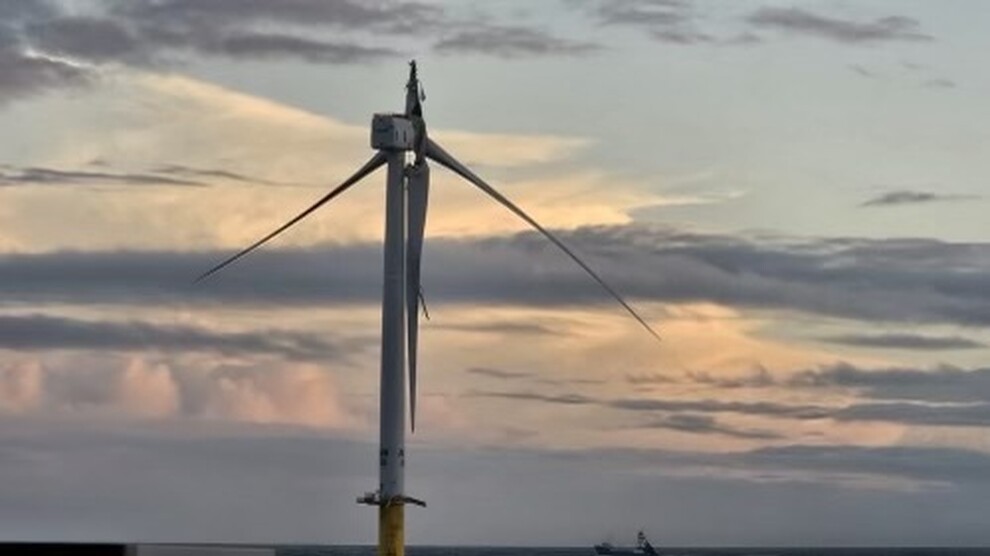
I am continuing to keep an eye on the Vineyard Farms offshore blade failure near Nantucket. A few weeks ago the facility was closed because of the failure of Vineyard Wind’s newly installed wind turbines, and the city was poised to sue.
After one blade failed and ended up in the water, the beaches were cluttered with sharp fiberglass shards, which is a sub-optimum condition at the height of the summer tourist season. Continuing investigation into the cause of this environmental contamination incident determined that a manufacturing flaw in the blade was responsible for the failure.
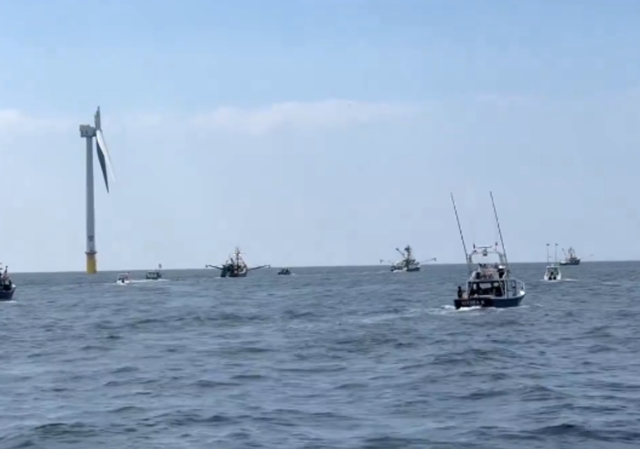
Now this weekend, a “flotilla” of about two dozen commercial and recreational fishing vessels steamed to the wind farm on Sunday to protest offshore wind development.
The vessels, hoisting anti-offshore wind flags and blasting air horns, departed early Sunday morning from ports in New Bedford, Nantucket, Martha’s Vineyard, Rhode Island and along the Cape, converging at about noon on the site of the crippled Vineyard Wind turbine.
“The blade collapse was an eye-opener to a lot of people who before didn’t know that offshore wind is a disaster for the ocean,” said Shawn Machie, 54, who is captain of the New Bedford scalloper F/V Capt. John.
…The “flotilla” protest was organized by the New England Fisherman’s Stewardship Association (NEFSA). Plans kicked into gear when Dan Pronk, captain of lobster boat F/V Black Earl, was collecting turbine debris that had washed up on the shores of Nantucket. He called Machie and other New England fishermen who said they felt they had to “do something before it’s too late,” Machie said.
“We feel like our jobs are just accepted as collateral damage,” Machie said. “We are regulated for sustainability. And that makes sense. We need regulation. But offshore wind is allowed to kill fish and wreck nurseries without any manageable stopping point.”
The protesters indicate the impact on their industry will be more significant than many appreciate…because they can’t trawl on former fishing grounds.
Otto Osmers, a commercial fisherman from Martha’s Vineyard, made the journey from Menemsha at 7 am on Sunday, arriving at the Vineyard Wind site around 10:30 am. Osmers conceded that offshore wind projects like Vineyard Wind can block trawling and crab trap routes, but had other concerns about the project. “The ocean is one of the last undeveloped places on earth,” he remarked about the sight of so many large turbines peppering the horizon. “We put cables down there but it’s largely undeveloped. It’s sad to see that go away.”
Others were more passionate in their displeasure. Sue Zarba, who along with her husband John who fish recreationally, said seeing the scale of the turbines was emotional. “That was the first time I was up close to the turbines, and I was sobbing,” she said in an interview after the protest. “After you’ve seen this offshore wind farm, you cannot unsee it. Soon over one thousand acres just off the coast will be filled with turbines. We will never be able to undo this man-made environmental disaster.”
“This cannot continue because that’s where we fish,” said Zarba. “They’re developing on a tuna fishing ground. You can’t fish around turbines, you can’t trawl.” She added that her son, who attended the protest, was initially skeptical of her protesting but changed his mind once he saw the turbines.
However, their protests are being met with a deaf ear. The National Marine Fisheries Service issued a new biological opinion for flagship offshore wind project Vineyard that finds no adverse effects to endangered whales and other marine wildlife stemming from driving the array’s last 15 monopiles.
“It will have no effect on any designated critical habitat,” National Oceanic and Atmospheric Administration Fisheries said in a statement. “NOAA Fisheries does not anticipate serious injuries to or mortalities of any ESA-listed whale including the North Atlantic right whale.” The agency said that with mitigation measures, “all effects to North Atlantic right whales will be limited to temporary behavioral disturbance.”
In conclusion, the fishermen are doing the work that environmentalists used to do.
 STOP THESE THINGS
Turbine blades are covered by fiberglass bonded by epoxy. Polyester resin isn’t used because solar UV destroys it. Epoxy is about 40% Bisphenol-A, which is banned in food packaging in many countries because it’s carcinogenic. The average turbine sheds 65 kilograms of microplastic particles per year, mostly epoxy. Plastic straws do not contain epoxy, but environists (no mental in the middle) are concerned about them instead of wind turbine epoxy.
There are additional problems. The magnetic fields from underground power cables are apparently addictive to crabs. They don’t to migrate to mate or find new feeding areas. Lobsters get birth defects that make it difficult for them to swim.
Details in my book “Where Will We Get Our Energy?” Everything quantified. No vague handwaving. 350 bibliographic citations so you can verify that I didn’t just make up stuff.
Wind Turbine
The show could not work out what caused the crash. I used to fly, and I had a class 1 IFR rating, so I know what flying in cloud is. If an interment failed, you used a combination of other interments. So if the helmet was giving him trouble, he would have gotten rid of it. You are not trained to just kill yourself; you are trained to use other things, so if the helmet was at fault, he would have gotten rid of it. There was another helicopter there that called out to the in-trouble Taipan helicopter to “pull up” three times, so if the pilot was alive, he would have pulled up or dune something. But if he was dead, he could not do anything. Birds and bats that fly through blade-tip vortices, the large pressure change causes their lungs to bust and fall to the ground dead. I would think that birds would be able to cope with air pressure changes better than humans can.
bottom to the top only at the wing tip. That is why large aircraft have bits on the wing tips going up and may be down to help stop the wing tip vortices. Wing tip vortices are extra-rough turbulence.
are like an aircraft wing, except the outer part is travelling at a higher speed than the inner part, so the blade is twisted, but it still acts like an aircraft wing.
going around in a circle, so you have two circles, one big one, and there could be as many as three smaller ones. Whatever it is, there is a big pressure change, and this pressure change kills anything with lungs.
and are told by this Government (labor) not to say anything about it. Wind turbine will put a stop to all manufacturing. That is Treason
turbines are bad news and should not be used. How much is the UN paying the Labor politicians?
atmosphere, running from wind turbines, but there is nothing to hold it in one place. Then I saw an article about 3,000 dead whales, dolphins, and porpoises in just 3 years. I then realised that blade-tip vortices were bending down to the ocean. This means you do not know just where the blade-tip vortices are. On the ocean, it is only a matter of time before a big ship goes through blade-tip vortices and a lot of people are killed. The short answer is that if wind turbines are where you are going, then do not go.
downwind side of the wind turbine would be killed. They knew this back in 2004 and did not do
anything about it. That is why the wind turbines are so high. It is the pressure change–not the
blades–that wipes out thousands of bats and birds annually at wind farms.