

In a theatre of the absurd, wind and solar generators get paid (with your taxes) to generate nothing at all (except subsidised profits for their shareholders).
Producing no power when consumers really need it, and mountains of power when consumers don’t, is the very definition of chaos. And all that wanton waste comes with a punishing price tag.
Even so-called ‘bargains’ are a complete waste of money where the product has absolutely no inherent value.
Power consumers – be it businesses or households – only care about the power they need and are only willing to pay for the power they consume. No one cares about the rest, which is why wind and solar are worthless, always and everywhere.
In wind and solar obsessed places like Australia, huge volumes of electricity are dumped into the marketplace when the sun is up and the wind is blowing. So much so, vast amounts of wind and solar capacity is curtailed with wind and solar outfits knocked out of the game. It won’t be long before they start getting paid handsomely to produce, nothing at all. Just like their European counterparts.
Wind and solar have never made any sense, particularly in terms of base economics. Hence the massive subsidies, punitive mandates and ridiculous targets that favour the unreliables.
In the piece below, the team from Jo Nova report on what’s become a cannibals picnic, where wind power outfits and large-scale, commercial solar generators are being devoured by the ‘domestics’ – the millions of households covered in their very own panels.
The end result is that power consumers will end up paying for billions of dollars of idle wind and solar generation capacity. Welcome to your wind and sun powered future!
Random power glut means 80% of solar plant output was thrown away on Sunday
Jo Nova Blog
Jo Nova
5 September 2024
It’s just another day of profligate waste in Renewable World
It’s barely spring in Australia and already we’re reaching the point where there’s too much solar. There’s such an excess of useless energy, prices are negative, meaning the hapless generators have to pay people to take the poison power away. And on Sunday, at a time when investors ought be making their peak profit for the day, they were rushing to turn 80% of their panels off.
Feel the pain — the stunted curve of the solar plants (below) is supposed to be the same shape as the rooftop PV.
In reality, this is how we make the parabolic curve of orbital solar physics fit a rectangular box — by building five times as much as we need and wasting most of it.
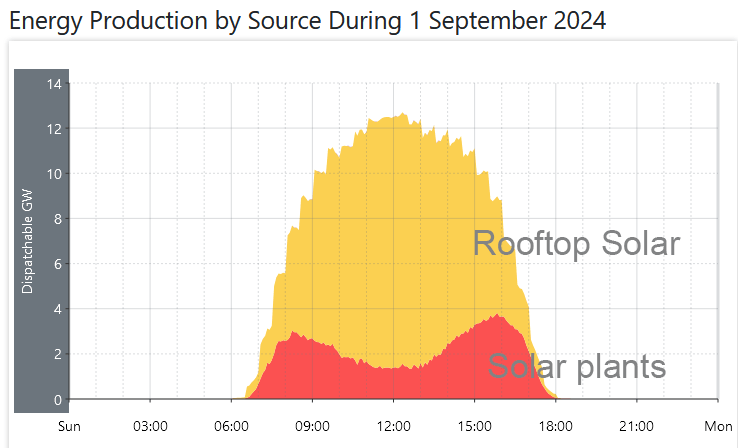
Bear in mind, this is just the start of a the lumpy road to nowhere. Even though we already have more solar panels than we can use, we’re supposed to be installing 22,000 more panels every day in Australia to reach our mystical NetZero target.
Paul McArdle of WattClarity noticed the dire situation. As he says “rooftop PV is killing it’s big brother!”
He has calculated the curtailment levels were often around 40 to 50% for large solar plants in the last week of August.
Who would want to invest in a solar plant?
And at the moment, there’s a bite out of the daily peak, every day.
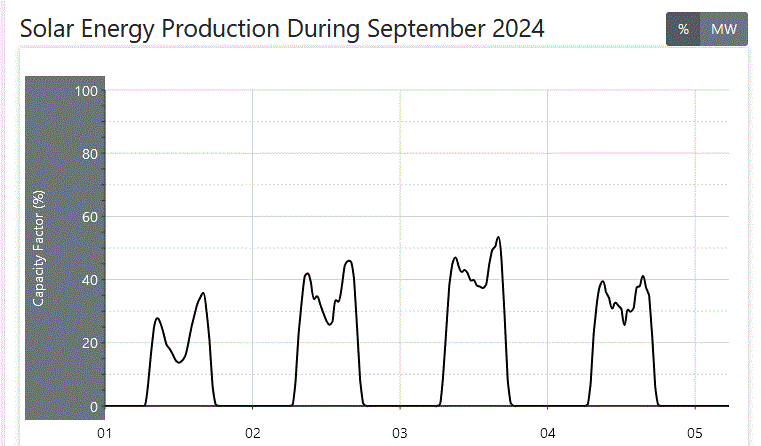
Call it “spillage”
We’ve reached this surreal point because there is more wind power than usual and it’s spring. The weather is mild, so householders don’t need as much electricity — thus the minimum demand on the grid is falling dangerously low. That’s a problem because the giant coal plants and other reliable generators need to keep running, to supply the frequency stabilization and so they can ramp up to fill the gaps.
Wild winds blow up solar farm profits
Angela Macdonald-Smith, Australian Financial Review
[Josh Stabler, managing director at adviser Energy Edge] …said the available wind and solar resource almost exceeded total demand, but noted that renewable “spillage” – where renewable output is not made use of – was also at a record high.
“Spillage and abundance will be continuous features of the electricity market into the future and will become more common, especially during spring,” Mr Stabler said.
It’s mayhem on the market:
The 24-hour average wholesale price was negative for Victoria, South Australia and Tasmania, according to National Electricity Market data, with NSW only just in positive territory at $16.81 a megawatt-hour for the 24 hours to 3am on Monday. That compares with the four-week average price in NSW of $206.23/MWh.
So wholesale electricity prices are six times higher than they used to be, and we have an overdesigned grid with twice as much infrastructure as we need and most of the time, a lot of the capital assets are sitting around doing nothing.
And people think if we just do more it will “be cheaper”.
Jo Nova Blog
 STOP THESE THINGS