

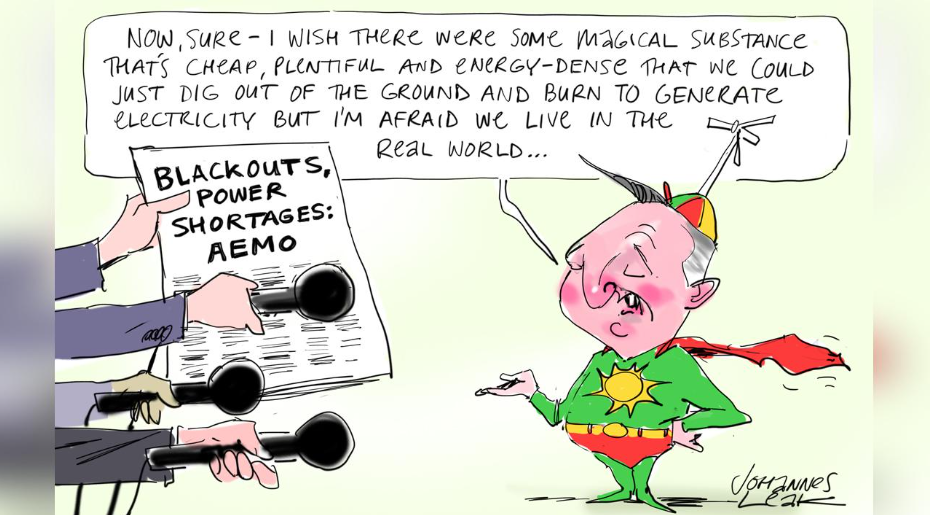
Once upon a time, those charged with delivering affordable power, as and when we needed it, were responsible, stoic and serious. These days, the energy domain has been overrun by a group of delusional zealots, who act as the spearhead for a band of cynical, billionaire rent-seekers.
Politicos love them, and are always keen to shower them with other people’s money.
In Australia, billions of taxpayers’ money is being squandered on the falsehood that, in the not-too-distant future, every single watt of power will be generated by nothing other than sunshine and breezes.
There is no better example of the level of idiocy that has overtaken energy policy, than the ‘plan’ (childish pipe dream?) by a billionaire software developer, Mike Cannon-Brookes to carpet the Australian outback with millions of solar panels and then send the power generated (for about 6-7 hours a day – cloud and cyclones permitting) 4,200 km along an undersea cable to Singapore, of all places.
As Nick Cater outlines below, Australia is neck-and-neck in the race to peak energy stupidity.
The sun is setting on our renewables ‘superpower’ fantasy
The Australian
Nick Cater
26 August 2024
Renewable energy superpower status is supposedly in Australia’s grasp now the government has given Mike Cannon-Brookes the green light to export solar power to Singapore.
Tanya Plibersek announced environmental approval for the tech billionaire’s eccentric proposal last week, taking a swipe at Peter Dutton’s “expensive nuclear fantasy that may never happen”.
By contrast, the Environment Minister would have us believe Cannon-Brookes’s plan to siliconise the NT Outback is a done deal. All that’s left to do is raise $35bn in capital, install 120 square kilometres of solar panels, build a modest 788km transmission line to Darwin, and lay a 4200km high-voltage cable on the seabed, and we’re good to go.
The Sun Cable AAPowerLink project feels like it was stolen from a Heath Robinson cartoon: a convoluted, unnecessarily elaborate, and impractical contraption designed to accomplish a mundane task. It may mark the beginning of the end of the renewable romance, the point at which the transition to wind, solar and hydropower collapses under the weight of its own absurdity.
There is increasing evidence the US has reached the point of peak renewables, as the pool of private investors shrinks and winning community approval becomes harder. Research by the Lawrence Berkley National Laboratory showed roughly one-third of utility-scale wind and solar applications submitted over the past five years were cancelled, while about half of wind and solar projects experienced significant delays.
The US Department of Energy says the national electricity network needs to grow by 57 per cent by 2035, the equivalent of approximately 21,000 km a year. Last year’s total was around 200 km, down from just over 1000 in 2022.
Meanwhile, the challenges of grid synchronisation and storage remain unresolved, and the technical problems for offshore wind turbines, in particular, are mounting. Last week, turbine manufacturer GE Vernova announced an investigation into a blade failure in the 3.6GW Dogger Bank project in the North Sea off the coast of the UK. It is the third blade failure this year.
In July, a newly installed blade crumbled at the Vineyard Wind offshore plant, creating debris that washed up on Nantucket Island, Massachusetts. At 107 metres long and weighing 55 tonnes, they are the most enormous blades deployed commercially. The failure of three in quick succession suggests the quest to increase output by installing ever-larger blades has reached its natural limits.
Yet the imperative of expanding generating capacity is hardening. The principal driving force is not electric vehicles but the rapid growth of artificial intelligence. AI requires at least 10 times the power of conventional computing programs.
In the US, data centres account for about 2.5 per cent of power and demand could rise to 7.5 per cent by 2030, according to Boston Consulting Group. In Ireland, data processing and storage use 12 per cent of electricity produced, forcing the authorities to limit the number of connections to the grid.
Silicon Valley has long abandoned the notion it can be powered by silicon photovoltaic panels while burying stray emissions in the Amazon forests.
In April, the tech giant Amazon paid the best part of $1bn ($US650m) for a sizeable block of land next to Pennsylvania’s Susquehanna nuclear power station. It will be the site for a data centre powered by up to 480MW of carbon-free electricity delivered reliably around the clocky.
Shares in US nuclear power companies such as Consolidated Energy, Talem and Vistra have soared by between 80 per cent and 180 per cent in the past year. So-called green energy stocks, on the other hand, are static or falling, while coal is making an unexpected comeback.
In May, the Financial Times reported that the retirement dates for coal-fired power stations are being pushed back as operators become concerned about grid security. Allianz Energy has delayed the conversion of its Wisconsin plant from coal to gas for three years to 2028. Ohio-based FirstEnergy announced in February that it was scrapping its 2030 target to phase out coal, citing “resource adequacy concerns”.
The effect of AI on electricity demand was largely unanticipated at the beginning of the decade. AI chips will undoubtedly become more efficient, but there is no telling how much further the demand for AI will grow since the technology is in its infancy. Nor can we begin to guess what other power-hungry forms of technology might be developed by 2050.
What we do know, however, is that if Australia’s demand for electricity exceeds 313 TWH a year in a 2050, we’re in trouble. That’s the target the Australian Energy Market Operator has set in its updated blueprint for the great electricity transition.
As Chris Bowen points out, that’s going to take a lot solar panels and wind turbines. The Energy Minister says we need 22,000 new solar panels a day and a new 7MW wind turbine every 18 hour s just to meet our 2030 target of a mere 202 TWH. For the record, the speed of the rollout in the first two years of Labor government is less than a tenth of that.
One of the hallmarks of the anointed is an unwavering conviction in the integrity of their analysis and the effectiveness of their proposed solutions. They feel no need to hedge their bets by factoring in contingency arrangements should their predictions turn out to be wrong. Nothing in AEMO’s Integrated System Plan indicates its experts have given any thought to scaling up electricity production in line with actual demand, which may well be considerably higher than they’ve anticipated.
If they had, they would have to acknowledge that there are limits to the renewable energy frontier determined by energy density, the demand for land and the requirement for firming. The silicification of northern Australia cannot continue forever, nor can we expect to rely on China for most of the hardware and pretend there are no geopolitical consequences.
As for our nuclear-phobic Prime Minister’s dream of turning Australia into the Saudi Arabia of green hydrogen, while simultaneously sitting at the cutting edge of quantum computing, forget it. In 2006, as the shadow minister for the environment, Anthony Albanese gave a speech at the Swansea RSL on avoiding dangerous climate change.
“Why on Earth would we want to take the big health and economic risk of nuclear energy when we have a ready-made power source hovering peacefully in the sky every day?” he asked.
If Albanese doesn’t know the answer to that question 18 years later, he probably never will.
The Australian
 STOP THESE THINGS
There are two perspectives on the transition to unreliable energy, depending on which of the two universes you are living in. In one universe it is going well, we are up to 42% average penetration of unreliable energy and sometimes in SA it is 100%.
In the other universe the transition has hit the wall because we have reached the tipping point where the capacity of coal has run down to approach the base load (the minimum required day and night.) One more coal station closure will will take us into a red zone where the lights will flicker every night when the wind is low. The Victorian government has been supporting two coal stations with confidential arrangements for years and the same thing is planned in NSW to avert the closure of Eraring coal station.
Britain, Germany and South Australia are past the tipping point and they keep the lights on precariously by sourcing power from other grids and deindustrializing to reduce demand.
The logic of the situation is graphically depicted in this piece
https://newcatallaxy.blog/2023/07/11/approaching-the-tipping-point/
Wind droughts are the nemesis of the transition and it is weird to see little or no mention of wind droughts in commentaries on the travails of the energy system, even those that are bitterly hostile like Nick Cater’s contribution above. It is not enough to mention the VARIABILITY and the low average capacity factor (30%) because the killer problem is the phenomenon of severe wind droughts when there is next to no wind power generated across the whole of the NEM for periods up to three days.
Thanks to the criminal negligence of the meteorologists who issued no wind drought warnings and the equally criminal incompetence of the responsible authorities who didn’t check the wind supply, we have blundered into one of the most damaging public policy blunders of our short history.
There was no excuse to persist with this folly after independent local wind watchers clearly documented severe wind droughts over ten years ago. That was the work of Anton Lang and the Paul Miskelly team, which has been ignored despite the efforts of Jo Nova and the Energy Realists of Australia.
The time has come to change the energy narrative and start planning an orderly exit from the suicidal quest for net zero. Time is short. Have a look at the rising tide of concern about the grids of North America and the grim examples of Britain and Germany.
https://www.flickerpower.com/images/Looking_for_the_Net_Zero_exit_sign___The_Spectator_Australia.pdf
.