
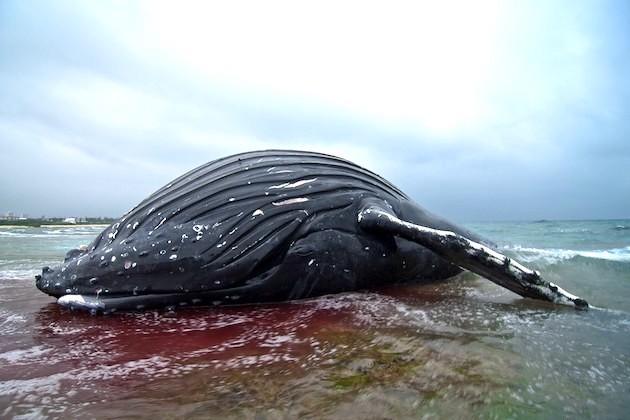
The offshore wind industry is taking a pounding for its pointless slaughter of whales, dolphins and more. And rightly so. While the US Federal government has provided wind power outfits with a license to kill, the general public are not so forgiving. And they’re growing hostility represent a whale-sized political problem for offshore wind.
Once upon a time, environmentalists were known for hugging trees and saving whales. These days, modern eco-fascists couldn’t care less about either.
Thankfully, the unhinged zealots that back wind and solar as the only true method of ‘saving the planet’ – like the sociopath seen in the video above – represent a shrinking and tiny (albeit vocal) minority.
Slowly but surely, they are being replaced by people with a true and genuine concern about the world they live in; a world in which charismatic mega-fauna might be left unmolested to go about their business on the high seas.
In the articles below, David Wojick draws focus on the mounting whale carcass count that the offshore wind industry can no longer avoid, and which their government enablers can no longer excuse.
Offshore wind whale deaths indicated by statistical analysis
CFACT
David Wojick
22 July 2024
Systematic statistical analysis indicates that offshore wind development has likely been killing lots of whales since it began around 2016. This long-standing conjecture that wind kills whales may be confirmed.
Call it forensic statistical epidemiology. The epidemic is the huge number of Northwest Atlantic whale deaths that were first officially observed by NOAA in 2016-17, and that continued to this day. It is forensic because killing whales can be highly illegal.
This math feat was performed by Apostolos Gerasoulis, a Rutgers professor emeritus of computer science. This is a computer math problem, not a biological one, so he is exceptionally qualified. See https://www.cs.rutgers.edu/people/professors/details/gerasoulis-apostolos
Professor Gerasoulis has confirmed with profound statistical evidence the widespread conjecture that offshore wind sonar surveys have been killing whales. There is now no reasonable doubt that the extensive sonar harassment authorized by NOAA since 2016 has caused the massive increase in whale deaths that NOAA first flagged in 2016-17.
Here is a lengthy article that provides some of that compelling evidence:
Given that I and others have been yelling at NOAA about this for two years, it is not a stunning discovery to us, just tragic proof that we were right. For example:
https://www.cfact.org/2022/09/27/how-to-kill-whales-with-offshore-wind/
And https://www.cfact.org/2023/01/23/evidence-says-offshore-wind-development-is-killing-lots-of-whales/
I have repeatedly pointed out that the overall Humpback Whale death rate doubled when sonar blasting began. Gerasoulis finds that in the region where the surveying was most active, the death rate jumped to an astonishing five times greater.
It took a computer guru to do this pioneering work because it is a complex computation problem. He geographically logged all of the deaths and all of the sonar blasting routes over time, then looked at the correlations, which are profound. It is statistically impossible that these correlations between sonar blasting and dead whales are just a coincidence.
Note that the sonar blasting does not kill the whales outright. It is predicted by NOAA to change the whale’s behavior, so all it has to do is change it in deadly ways, such as causing a ship strike. It is actually expected by NOAA that some whales will be deafened.
Here is a telling analogy. A firecracker thrown at a dog causes it to run into the street and be struck by a car. The car killed the dog, but the firecracker caused the death. In science, this is called the first cause (firecracker) versus the final cause (car strike) of the dog’s death. Sonar blasting is like an endless string of firecrackers going off, lasting for hours or even days.
The press has consistently ignored the warnings, never reporting the potentially adverse effects of “harassment”, as it is officially called. That widespread acoustic harassment is actually predicted and authorized by NOAA is never even mentioned. Even worse, NOAA never mentions it in their online material on the whale death crisis despite it being pointed out to them repeatedly.
Unfortunately, the incredibly loud pile driving that is now starting at the offshore wind construction sites is even worse than the sonar blasting. The NOAA harassment authorization numbers are much higher, ten times higher in some cases. We, therefore, expect the deaths to increase unless decisive action is taken.
Now that the numbers indicate that authorized harassment is likely the cause of widespread whale death, something must be done to stop the carnage. If NOAA continues to authorize potentially deadly harassment without first studying the data, and if wind developers continue unabated, each whale death is a reckless violation of the Marine Mammal Protection Act. Gerasoulis‘s statistical model may even tell us when this happens.
Given this compelling new evidence, if NOAA still refuses to act, then either the President or Congress should do so. Acoustic harassment is ongoing, and whales may be dying from it. This reckless killing of whales must stop.
CFACT

Feds must rethink authorizing harassment of whales by offshore wind
CFACT
David Wojick
14 August 2024
We now know offshore wind sonar surveys are a likely cause of whale deaths. For details, see my prior article.
Simply put, a significant fraction of authorized harassments likely causes whales to be killed.
The question is how should the Federal approval process for offshore wind surveys be restructured to incorporate this new whale-death knowledge? One obvious possibility is to simply ban the practice. That works for me, but may be too extreme to pull off.
If a certain number of whale deaths is deemed allowable, here is the outline of a death allocation procedure. Included are the other protected marine species for which sonar-induced deaths might be established, as well as harassment from other offshore wind activities. This is basically a death budget for the offshore wind program.
There are three offshore zones for which the following six steps should be done — Atlantic, Pacific and Gulf of Mexico.
- The federal Bureau of Ocean Energy Management (BOEM) identifies the existing leases and leases in process or likely to become so. For each lease, they estimate the potential generating capacity of each as well as the likely technologies and life cycles thereof.
- The National Marine Fisheries Service (NMFS) determines the harassment potential over time for each lease, for each exposed endangered and protected species. All relevant forms of harassment are considered, including noise, wake effects, and physical presence.
- NMFS determines the mortality impact of the combined harassment for all leases on each species. The new statistical procedure pioneered by Professor Gerasoulis likely plays a major role here.
- NMFS determines the allowable amount of harassment that will have no adverse effect on the population of each species.
- NMFS and BOEM jointly develop an administrative procedure for allocating the allowable harassment authorization to the leases. If Step 4 cannot be done, I suggest the allowable amount for all leases combined be limited to ten percent or less of the exposed population for each species. We need a default limit on allowable deaths.
- NMFS allocates harassment authorizations in accordance with the established procedure. These allocations may be adjusted over time as knowledge and technology changes.
No development that creates harassment can occur without authorization. Note that the numerous planned and in development offshore wind projects are at very different stages of federal development:
- Operational
- Under construction
- Approved for construction
- In the process of approval
- Leased but not yet applied for approval
- Not yet leased
Projects in different stages might get different allocation treatment, especially the advanced projects that already have big authorizations that now have to be restricted.
Of course lots of death research is now needed. This includes for other critters besides whales, especially dolphins, whose harassment numbers are huge. It also includes the other stages of development besides sonar surveys. For example, construction harassment allocation numbers run ten times or more greater than survey numbers. Then, there is operations harassment, which NMFS has yet to recognize.
The Marine Mammal Protection Act (MMPA) needs to be rethought as well. It clearly was never designed to handle the hundreds of thousands of harassment authorizations that are being doled out to the offshore wind developers. This is painfully true now that we know numerous whales are being killed because of harassment.
The big question is whether unavoidable yet deadly offshore wind harassment is even legal under the MMPA and the Endangered Species Act.
CFACT
 STOP THESE THINGS
Has anyone ever done a ‘death count’ on humans from the siting of onshore turbines too close to their rural homes? Have coroners connected the dots and reported the rise once turbines are turned on? Have doctors and nurses connected the dots when they’ve seen the rise in emergency room visits for sudden cardiac symptoms, requests for lab work, prescriptions for medications to stop the symptoms caused by proximity to unrelenting noise- both audible and sub audible/infrasound?
Won’t the wind industry force itself on rural communities even more if they can’t get contracts for offshore?
>