

The wind industry’s financial misery is spreading like the toxic junk from disintegrating turbine blades that’s covering vast tracts of the Atlantic coastline.
Once bullish forecasts for giant offshore wind turbine projects these days sound like suicide pacts involving other people’s money.
Loose talk about mega-offshore projects has been replaced by massive and mounting losses being suffered by operators and hopeful proponents. Those losses are the reason dozens of these mega-projects have been scrapped, and the remainder are under serious threat.
Denmark’s Ørsted is among offshore wind’s big players, which is why its shares are taking a serious pounding.
The offshore wind industry’s (cynical) attempt to garner sympathy is unlikely to attract much, except ridicule and derision. Particularly from those who’ve been pushing for a sensible energy policy that doesn’t result in the wholesale destruction of marine environments and the coastal communities that depend on them, as these reports from the Daily Caller and Master Resource explain.
Biden-Subsidized Offshore Wind Developer Reports Massive Losses In Latest Blow To Industry
Daily Caller
Owen Klinsky
16 August 2024
A Danish renewable energy group booked huge impairment losses Thursday after it pushed back the launch of one of its U.S. offshore wind projects, according to its first-half 2024 earnings report.
Orsted estimated the value of its assets declined $472 million in the first half of 2024, largely due to delays at the onshore substation for its 704 megawatt (MW) “Revolution Wind” project off the coast of Rhode Island and Connecticut, the report showed. The company also reported a variety of other problems, including losses related to its cancellation of its Ocean Wind projects in New Jersey and its abandoned effort to produce eco-friendly methanol in Sweden.
“Despite encouraging progress on our US offshore wind project Revolution Wind, the construction of the onshore substation for the project has been delayed,” Orsted’s CEO Mads Nipper said in reference to the delay. “This is, of course, unsatisfactory, and we continue our dedicated efforts to de-risk our portfolio.”
The delay at Revolution Wind was driven by soil contamination at an onshore transformer station, and resulted in an asset markdown of $310 million, or roughly 65% of the total impairment amount.
Orsted’s stock fell as much as 9% following the earnings announcement, according to Reuters.
The U.S. offshore wind industry has had a wave of project delays, missed production targets and public backlash in the past year.
New York State scrapped three offshore wind projects in April after failing to finalize power purchase agreements with developers. The failed efforts contributed to Democratic New York Gov. Kathy Hochul issuing an official review in July admitting the state was going to miss its goal of 70% renewable electricity by 2030.
A July report from the American Clean Power Association found there will only be 14 gigawatts of offshore wind production capacity deployed by 2030, less than half the Biden administration’s target.
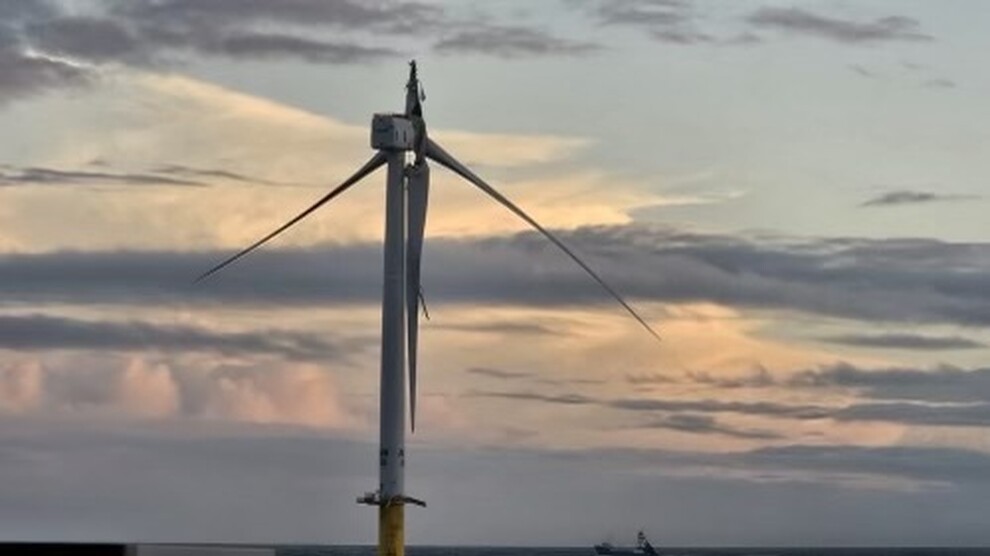
The industry also came under fire in July after a broken wind turbine off the coast of Nantucket scattered debris into the ocean, resulting in multiple beach closures.
The Biden administration has provided billions of dollars in subsidies to the offshore wind industry, including to Orsted.
“We maintain a strong focus on de-risking project execution and prioritizing growth options with the highest potential for value creation,” Nipper said of Orsted’s first-half earnings results.
Orsted and the White House did not immediately respond to requests for comment.
Daily Caller

U.S. Offshore Wind: The Struggle Continues
Master Resource
Kennedy Maize
21 August 2024
This post updates the financial troubles of Denmark’s Ørsted, recent BOEM auctions, and pushback against Maryland governor Wes Moore. Today, operational offshore wind capacity is less than 50 megawatts versus the Biden-Harris Administration goal of 30,000 MW by 2030.
Ørsted
Denmark’s Ørsted, the worldwide leading offshore wind developer, recorded a $575 million loss in the second quarter. In part, the loss is the result of disappointing developments in the U.S.
The company has delayed commercial operation of its 704-MW Revolution Wind project off the coast of Rhode Island and Connecticut from 2025 to 2026. Ørsted’s ambitious U.S. offshore wind program has been lagging, despite solid support (subsidies, permits) from the Biden administration.
A year after an Interior Department’s Bureau of Ocean Energy Management (BOEM) auction for Gulf of Mexico leases failed to attract significant interest, BOEM continues to delay another attempt to find adequate bidders off the east coast.
Reuter’s summarized Ørsted’s issues:
Ørsted’s impairment losses also related to its Ocean Wind project in the United States whose development it halted last year, an increase in U.S. interest rates, and its decision to cease development of its green e-methanol FlagshipOne project, which was due to open in Sweden next year. Shares in Ørsted, once a green investor favourite, ended down 7.2%, having fallen as much as 9.3% earlier. They remain at less than one-third of their value since peaking in early 2021.
BOEM Auctions
In March, BOEM solicited interest in another Gulf of Mexico auction, which resulted in industry yawns. The agency stated on July 26th that it
received 25 comments in response to the March 2024 [Proposed Sale Notice], with one company expressing interest in participating. As a result, BOEM is cancelling this sale due to a lack of competitive interest. BOEM may decide to move forward with a lease sale at a future time, based on industry interest.
—————
BOEM last week (Aug. 14) held a lease sale for the Mid-Atlantic region, off Delaware, Maryland, and Virginia with takers.
Norway’s Equinor Wind won a provisional lease for 101,443 acres some 26 nautical miles off Delaware for $75 million. Dominion Energy’s Virginia Electric and Power subsidiary won a provisional lease for 176,505 acres 35 miles off the entrance to the Chesapeake Bay for $18 million. Six companies participated in the auction.
The Equinor lease is not far from where Baltimore-based US Wind has a federal lease for a proposed two-phase, 2-GW project off Maryland’s Ocean City. BOEM last month (July 29) issued a final Environmental Impact Statement for the Maryland project. Maryland has also issued renewable energy certificates for the US Wind project.
US Wind, reports BOEM,
proposes to install up to 114 turbines, up to four offshore substation platforms, one meteorological tower, and up to four corridors for offshore export cables, which would make landfall in Delaware Seashore State Park. The lease area is approximately 8.7 nautical miles offshore Maryland and approximately 9 nautical miles offshore Sussex County, Delaware, at its closest points to shore.
US Wind, in partnership with Spain’s Haizea Windgroup, is also developing a plant to make monopile foundations for wind projects at Baltimore’s Sparrows Point, once the home of Bethlehem Steel when it was the world’s largest steel mill. According to the company
“Sparrows Point Steel is poised to become the best offshore wind heavy logistics and fabrication yard on the East Coast. Haizea’s depth of knowledge and expertise will cement Maryland’s role as a hub of offshore wind manufacturing in the U.S.”
MD Gov. Wes Moore vs. Critics
Maryland Democratic Gov. Wes Moore last week (Aug. 16) faced opponents of his aggressive push for offshore wind in Ocean City. Local TV station WBOC spoke to Moore about growing local opposition on the eastern shore of Maryland, Delaware, and Virginia. Earlier in the month, Moore signed a memorandum of understanding with BOEM to open up more offshore federal land to wind development. Last year, Maryland passed a new law expanding the state’s goal for offshore wind development to 8.5 GW.
Moore told WBOC, “You’re talking about being able to power three million homes in the state of Maryland and turn us into a net exporter of clean energy. That’s exciting, it’s new jobs, it’s new opportunities.”
Many people on the Eastern Shore, particularly those who depend on the Chesapeake Bay for a living, see burgeoning wind farms as a potential disruption to their ways of life. Jimmy Hahn, an Ocean City area commercial fisherman, told the TV station, “They’re trying to steal our grounds, they’ve stolen our bottom, they’ve stolen the area that we fish in, their last resort is to buy the place where we sell our fish at and once they accomplish that we have nowhere else to work.”
Moore responded, “All those conversations have to happen with local leaders, it has to happen with local communities. There has to be measures of both transparency and accountability as to what we’re hoping for and what we’re going to achieve.”
Vineyard Wind: Yellow Flag
The Interior Department’s Bureau of Safety and Environmental Enforcement (BSEE) has given Avangrid a yellow flag to continue limited work on its Vineyard Wind project off the Massachusetts coast.
BSEE shut down the 804-MW project last month following the failure of a 351-foot blade on one of its turbines, spreading debris widely to beaches on nearby Nantucket Island and as far as mainland beaches on Cape Cod. Reuters reported that the Interior Department agency last week (Aug. 13) confirmed the updated shutdown order, while Avangrid and blade maker G Vernova continue to investigate the cause of the massive blade failure.
“The updated suspension order still does not allow further blade installation or power production at this time, the companies said,” according to Reuters. Vineyard Wind and GE Vernova said they are removing portions of the damaged blade that remained on the wind turbine to remove risks of further ocean debris.
Master Resource
 STOP THESE THINGS
Hello everyone.
Attached I think is an interesting PDF document.
Mit freundlichem Glück Auf Günter Bartsch
ELEKTRO-CAD & MONTAGEDIENST GmbH Kelserweg 5 45277 Essen
Tel.: 0201/59807190 Fax.: Dokumente bitte per E-Mail Mobil.: 01718643736 E-Mail: Guenter-Bartsch@gmx.de Guenter-Bartsch@gmx.de Web: http://www.cad-elektro.de/