
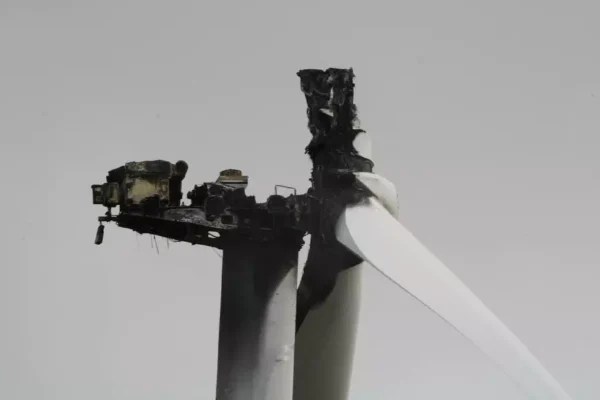
Subsidised wind and solar are the principal reason for rocketing power prices, and rocketing power prices are the principal reason for rocketing inflation.
Branded as “cost of living pressures” the rapid doubling and tripling of retail power costs are always and everywhere about the market destruction caused by massive subsidies to intermittent and unreliable wind and solar.
The punishment being dished out to consumers in their ever-increasing power bills was as perfectly predictable as it was perfectly avoidable.
Now that the Proles are making the obvious connection, rent-seekers, their propagandists and political enablers are working overtime to convince them otherwise.
In Australia, the disaster is compounded by the anti-useful-hydrocarbons squad who rail against coal, oil and gas – because they emit “dangerous carbon pollution” – aka carbon dioxide gas, a naturally occurring trace gas essential for all life on earth – ask the tree in your backyard or the pumpkins in your pumpkin patch.
In the first piece, The Australian outlines the suicidal anti-gas policies that have led to a critical shortage (and insane prices) for the gas that’s meant to be used in fast-start gas turbines, critical to keep the grid from collapsing when the sun sets and/or calm weather sets in – and wind and solar output hit the floor. Think every calm night.
The balance of the post is given over to a group of independent engineers, scientists and other professionals, who attack the nonsense pitched up about wind and solar being “cheap and reliable”, with a careful and detailed analysis that concludes the inevitable: if you want blackouts and off the charts power prices, then simply keep pushing for subsidised wind and solar.
AEMO report shows just how out of touch the green extremists are
The Australian
Editorial
24 July 2024
The challenges posed by intermittent wind and solar for electricity generation have been reconfirmed by the Australian Energy Market Operator, but climate extremists still seem unable to grasp the message. In a welcome statement, AEMO said what has always been obvious: flexible gas-powered generation is “the ultimate backstop for the national electricity market during periods of reduced renewable generation”.
Despite years of investment and overblown claims about the penetration of wind power being equal to total demand at some times, generation from wind was down 20 per cent in the June quarter, with wind availability down to its lowest levels since the second quarter of 2017. Hydro generation also was down 18 per cent to its lowest output for a second quarter since 2017. The drop in generation coincided with cold weather that drove increased demand for energy. As a result, gas use was up 16 per cent and black coal up 7 per cent.
The squeeze on gas supplies as a result of mismanagement by state governments driven by ideological demands has produced a shortfall of gas availability when it was most needed. According to AEMO’s Quarterly Energy Dynamics report, gas markets remain vulnerable to price shocks and supply shortfalls over winter, despite record gas supply flowing south from Queensland as supplies have run short in Victoria. Domestic gas prices increased by $13.76 across the quarter, influenced by cold weather driving up demand in southern states and lower gas production from Longford, Victoria.
The Albanese government has belatedly acknowledged the important role that gas must inevitably play. On Tuesday, Resources Minister Madeleine King announced new offshore gas exploration permits to support the domestic east coast market and west coast producers. Permits will be finalised for Esso and Beach Energy in the Otway and Sorrell basins as well as Chevron, INPEX, Melbana and Woodside Energy on Australia’s west coast.
The exploration push is welcome but more must be done to combat the destructive role being played by the Australian Greens and other climate agitators. Greens leader Adam Bandt has called for a halt to new fossil fuel developments, for liquefied natural gas exports to be restricted and for the provision of greater government support to transition industry and households off gas. Ms King has rightly said the Greens’ plan to cancel our longstanding LNG contracts with regional trading partners would trash our reputation as a stable investment destination and turn the lights off in countries that depend on Australian gas for their energy security.
The Greens in Queensland have said they will demand a ban on new coalmines and gas projects and an earlier shutdown of coal-fired power if they secure a balance of power in a hung parliament after the state election in October. The Climate Council has called for an immediate halt to gas exploration because “Australia, and the world, is increasingly being powered by clean renewable energy”.
The latest AEMO report shows just how out of touch the green extremists are. Electricity prices are rising and will continue to do so until order is restored to the supply and demand balance in the national energy market. Without gas, uncertain and intermittent supplies of renewable energy have shown themselves to be an unstable foundation on which to build the nation’s future energy security and affordability.
The Australian
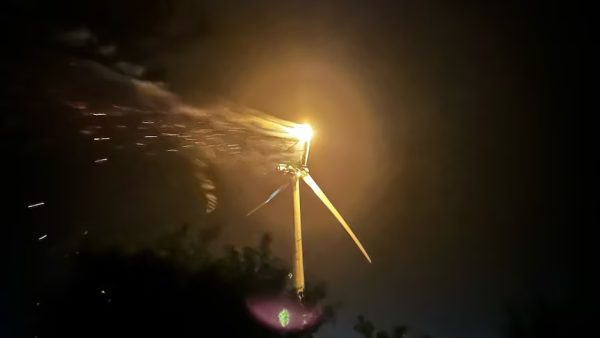
The AEMO 2024 ISP Will Not Deliver Reliable Power: AEMO’s numbers just do not add up
A Report by Independent Engineers, Scientists and Professionals
31 July 2024
Introduction
Our 9 February 2024 submission to AEMO and CSIRO concerning the draft ISP identified serious potential reliability problems resulting from AEMO’s electricity grid design. Our inputs were largely ignored.
The final version of the ISP, released on 26 June 2024, essentially reveals the same deeply flawed model of the NEM electricity grid.
Failure to Address Clearly Stated Reliability Issues
AEMO’s ISP suffers from severe deficiencies in capacities of both energy storage and baseload back up power, starting in the next few years and lasting throughout the entire period to 2050. It shows no evidence of rigorous system design engineering required for high reliability systems based on worst case conditions and healthy reserve margins.
By 2030, the dispatchable reserve margin falls from historic levels in excess of plus 20% to minus 19% and in subsequent years it is substantially worse. It cannot deliver adequate power when NEM-wide grid demand is maximum and when overnight solar is zero and wind output is close to nothing.
Furthermore, the negative reserve margin provides no allowance for facility outages for maintenance and repairs. The grid design also suffers from insufficient power capacity to quickly recharge the energy storages to prepare for the next set of worst case conditions.
AEMO’s own historical NEM data demonstrates periods of very low renewable energy production lasting 3 or more consecutive days and dramatic falls occur many times in a month. Periods of several months, when wind and solar outputs are well below long term averages, are evident in both Australian and overseas data. May 2024 witnessed several major droughts.
The energy storage capacity in the ISP is too low by at least a factor of ten. Adding more batteries and additional renewable generation to recharge them is completely unaffordable.
Deceptive Data Concerning Dispatchable Power
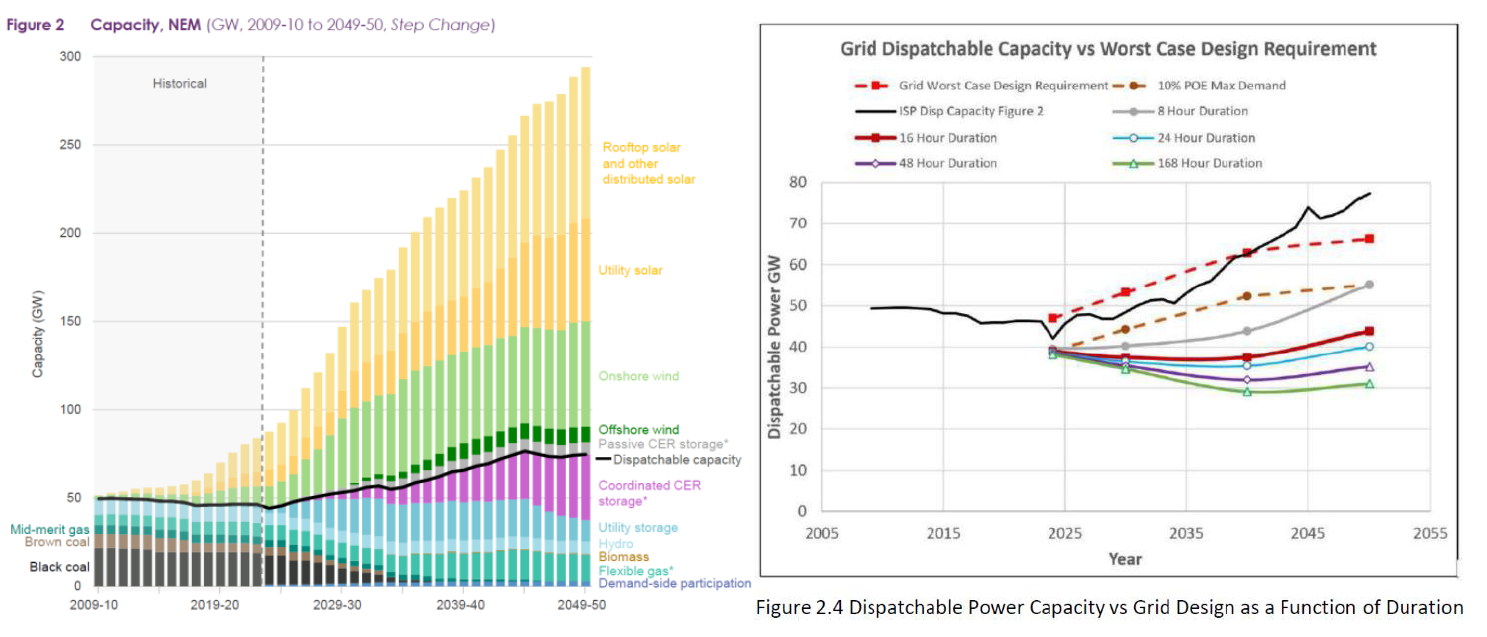
Figure 2 in the ISP is a graphical chart showing power from various generation sources and storages by year until 2050 (see below).
It shows impressive growth to 2050 but almost all growth is in renewables which have very low capacity factors (25-32%). Similarly, energy storage outputs show remarkable growth but most of these provide power for just a few hours. Much it is from coordinated home resources which may be uncertain.
The dispatchable black line climbs to above 75 GW by 2050 but in truth, it is meaningless because much of it cannot be used to back up the grid when solar and wind power are largely absent for periods of multiple days and significantly below average for periods of months.
This deceptive portrayal is merely a summation of maximum power outputs from all sources. A truthful depiction would, as a minimum include warnings to the effect that renewables provide less than one third of maximum power on average and not all dispatchable power provides practical levels for grid back up.
Figure 2.4 in our submission (see below) provided an alternative version of this chart showing the true dispatchable power over various periods based on ISP data for energy storages (ISP Figure 20). By 2040, the dispatchable power of AEMO’s ISP design falls to just 30 GW for backup durations of one week but at the same time it indicates that for 16 hours overnight, it is only 37 GW. However, a proper engineering design with a 20% dispatchable reserve margin will require over 60 GW by 2040.
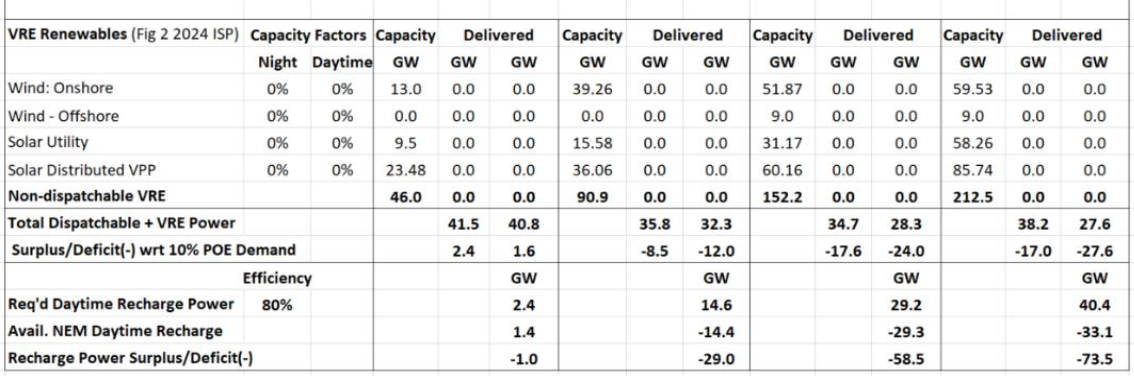
A Whole-of-System Power Budget Shows Failure of Reliable Power at Night
A whole-of-system power budget is fundamental to understanding the viability of the AEMO ISP and making a counterpoint to the CSIRO GenCost report, however, the ISP provides no system level power budget data. In fact, the ISP does not contain any data on maximum demand. Instead it forecasts average annual energy production figures. This is no way to design a high reliability system.
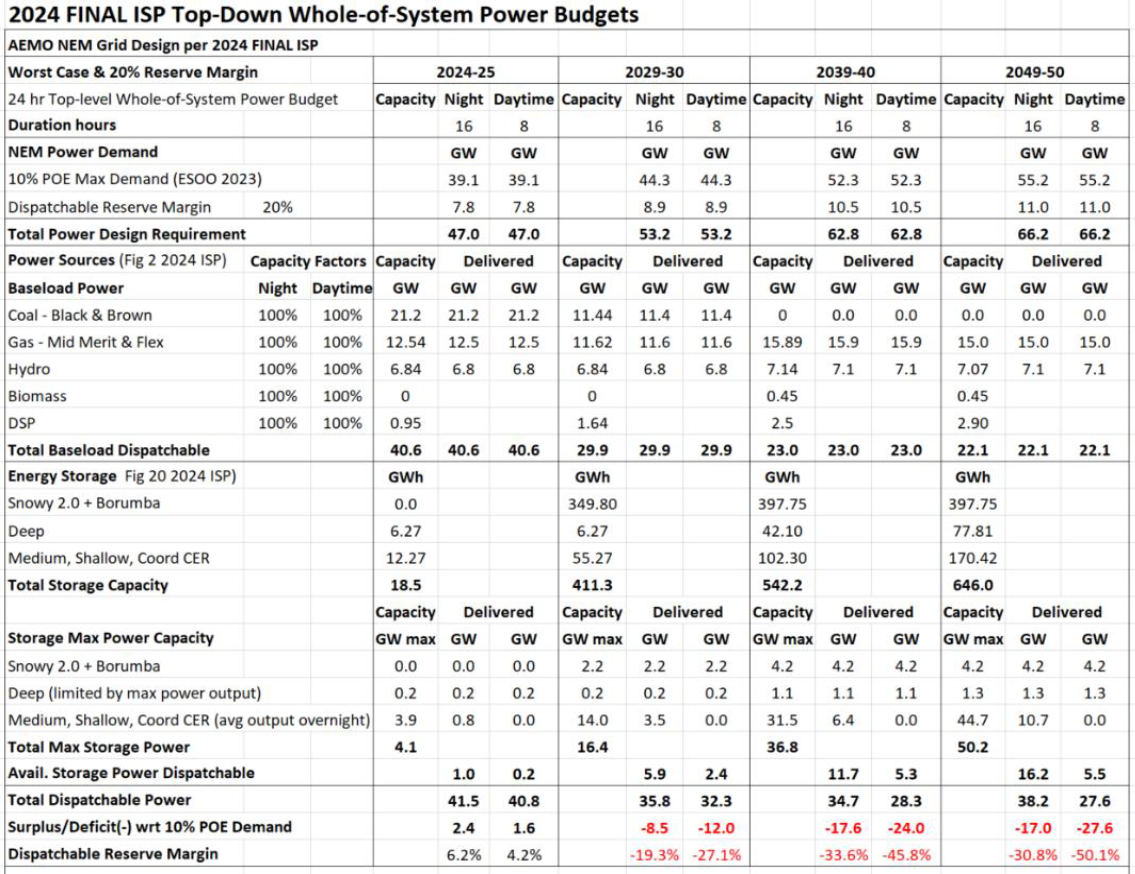
Proper high reliability engineering design requires use of worst case conditions plus a margin for facility outages for maintenance and repairs. A whole-of-system power budget table (on the next page) is based entirely on AEMO’s ISP data.
Our power budget uses maximum grid demand data from the August 2023 AEMO ESOO report because the ESOO update of March 2024 did not contain this data.
We show that by 2030, the dispatchable reserve margin falls to minus 19% on a single 16 hour overnight period when solar is zero and wind falls very close to zero. Any facility outages for maintenance or repairs will make this figure worse. There is simply not enough baseload power nor energy storage capacity.
To restore the dispatchable reserve margin to at least plus 20% would require an additional 17.4 GW of baseload or stored energy outputs in 2030, rising to 28.1 GW in 2040 and 2050.
In the event of multiple day wind and solar drought conditions, there is not sufficient surplus power during daytime to completely recharge expanded energy storages sufficient to handle another overnight period under worst case conditions.
Blackouts are inevitable. The AEMO ISP cannot deliver reliable power under worst case conditions. This is not a matter requiring fine tuning of the grid design. It is a massive failure.
AEMO’s Attempt to Demonstrate System Reliability is Misleading
In Section 6.5 “Reliability and security in a system dominated by renewables”, the ISP acknowledges the challenge as renewables approach 100% of generation. But it claims: “Consumers should be confident that the NEM’s mix of technologies will keep electricity supply secure and reliable during normal operation, extreme peak demand and renewable droughts.”
In the ISP, Figure 24 (p72) attempts to illustrate operability through an eight-day renewable drought for the “NEM except Queensland”. ISP Appendix 4 (Figure 15 p 26) reveals that this simulation test involved an “extended VRE drought event running from 21 June 2040 to 28 June 2040 (reflective of conditions observed historically in June 2019).”
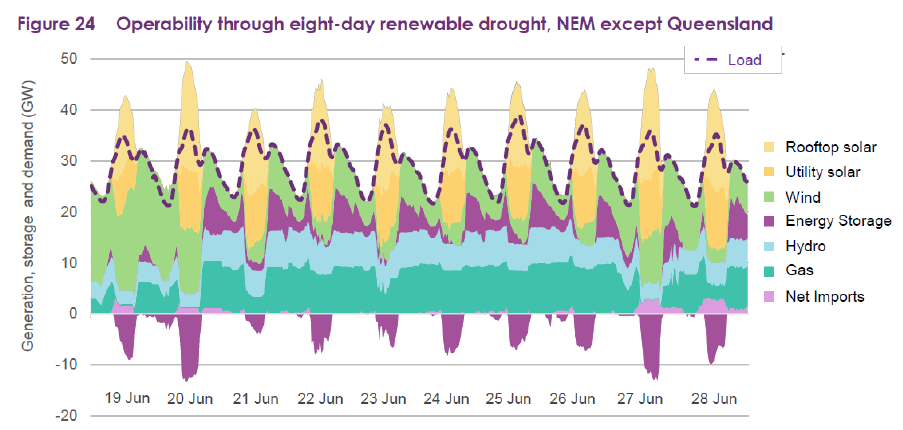
This one-off test looks impressive but is merely an illustration far short of what a proper statistical engineering analysis would require. A detailed examination of the data behind this test revealed the following:
- It assumes imports of power from QLD yet represents a partial system.
- It assumes maximum power continuously from all dispatchable resources.
- It assumes extreme VRE drought conditions were for 6 days not 8.
- It assumes wind capacity factor was 10% in daytime; 13% overnight – not worst case.
- It assumes solar capacity factor was 13-15% – not worst case.
- Non-daytime grid demand in early evening was 32 GW decreasing by 31% after midnight to 22 GW; this profile is speculative in the face of increasing EV demand for overnight charging; worst case is a flat maximum demand.
- The ISP admits that “reliability risk would be elevated, particularly if major generator or transmission outages occur” i.e. no facility outages were taken into account.
These are certainly NOT rigorous worst-case conditions. Instead of illustrating the reliability of the NEM grid design, this test indicates the extent to which the AEMO ISP misrepresents its viability.
Conclusions
Despite its impressive appearance, the ISP contains fundamental technical drawbacks. From an engineering perspective, the AEMO ISP is seriously flawed and fails to provide assurance that the NEM grid design has been developed in accordance with modern system engineering principles for high reliability systems.
We therefore conclude the AEMO ISP, which underpins the entire national economy, will not serve Australian consumers and businesses with reliable electrical power. It is clear this plan has been driven by changes to National Electricity Rules by non-technical politicians and bureaucrats to set artificial goals for renewables divorced from engineering realities.
It is critically important and urgent that an ongoing review process be implemented with advice and input by independent experts to oversee AEMO and CSIRO work on the future NEM.
Download the full report 240731 – The 2024 AEMO ISP will not deliver reliable power 31July2024
The Missing Whole-of-System Cost Model in the AEMO 2024 ISP: The Real Cost of the NEM Transition
A Report by Independent Engineers, Scientists and Professionals
31 July 2024
Summary
The government has not provided a true estimate of cost for AEMO’s plan to transition the NEM to intermittent wind & solar, yet it claims adding reliable nuclear and gas power generation is too costly.
AEMO published its 2024 Integrated System Plan (ISP) in June. It contains only one paragraph [1] to indicate annualised capital costs as either $122 billion present value or $142 billion upfront present value, not including “commissioned, committed or anticipated projects, consumer energy resources, or distribution network upgrades”. This unrealistic, poorly defined estimate needs much clarification.
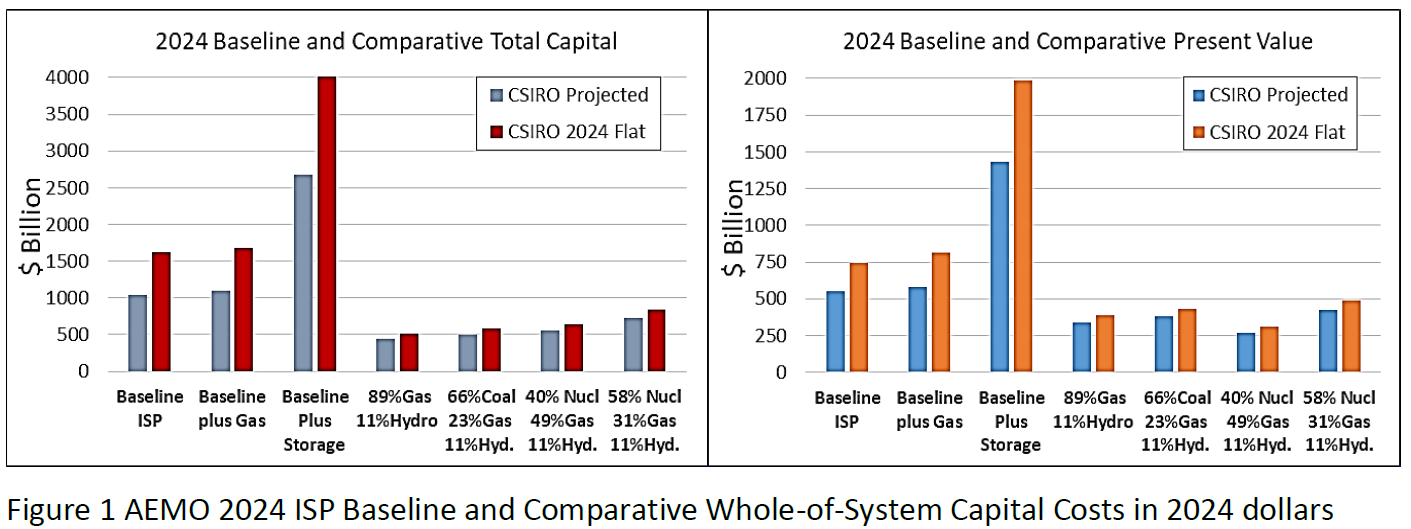
The whole-of-system analysis in this report, draws on 2024 ISP capacities for generation and storages and CSIRO 2024 GenCost cost factors [2], and shows total capital costs for the 2024 ISP over one trillion dollars for a system unable to deliver reliable power [3]. This is about twice the capital costs of four alternative grid designs using gas, coal and nuclear. When fuel costs for gas and coal are considered, nuclear plus gas designs are likely to be the least costly of all options.
A More Comprehensive Capital Cost Analysis
The whole-of-system cost charts in Figure 1 below provide both total capital and present value for a more comprehensive model of the planned NEM grid transition, showing a present value more than four times higher than the 2024 ISP figures. Estimates include both CSIRO’s somewhat optimistic declining future capital cost factors and its flat 2024 cost factors to reflect uncertainties in forecasting. The Baseline 2024 ISP estimates include all generation and storage costs including consumer energy resources, transmission lines, distribution network upgrades and other support costs to reflect the total costs to the economy.
Extending the Baseline ISP with additional gas or storage to overcome the major unreliability of the ISP’s design incurs extra costs and makes clear that ‘firmed renewables with batteries’ is unaffordable. Four alternative designs using gas, coal and nuclear provide comparisons. The results, based on AEMO and CSIRO data, show that the present transition plan is the most costly approach by a large margin.
Conclusions
- Our analysis uses a proper high reliability systems engineering approach to assess a 24-hour cycle under worst-case conditions of maximum demand, wind and solar droughts and the need for a minimum 20% dispatchable reserve margin (DRM) [4] to guard against facility outages. A whole-of-system ‘Baseline’ power budget using 2024 ISP capacities shows the DRM at minus 19% by 2030 and falling much lower by 2040. Widespread and frequent blackouts are certain.
- Adding battery storages and extra wind & solar to recharge them (‘firmed renewables’) to achieve 20% DRM overnight results in completely unaffordable total capital costs of several trillion dollars and provides storage for just one 16-hour overnight period. And it still leaves daytime DRM massively negative. Battery storage capacity for one week requires $5-7 trillion. Replacements every decade would cost upwards of $3.5 trillion. This is simply not a viable path.
- Alternatively, adding gas to existing hydro to essentially duplicate the grid when wind and solar are in drought requires a not-insignificant additional capital cost of $30-60 billion. It would provide continuous backup capability, day and night, but its low utilisation rates would make its economics unattractive for investors.
- The four alternative grid designs, 89% gas plus hydro, 66% coal plus gas & hydro, 40% nuclear plus gas & hydro, and 58% nuclear plus gas & hydro, provide reliable 24/7 power with less than about half the capital costs. The nuclear options, with lifetimes up to 80 years lasting far beyond 2050 compared with wind and solar, minimise costs for gas and probably reduce emissions to less than the Baseline ISP, once whole-of-life emissions for mining, processing and manufacturing of almost 900 times more material is taken into account. All four alternatives impose a tiny environmental footprint compared to the 1.6 million hectares for Baseline ISP wind & solar.
- It is clear that contrary to continual claims that wind & solar are the cheapest form of electricity generation, it is in fact the most expensive when proper whole-of-system estimates are made. The present plan for transition of the NEM is disastrous in terms of reliability, cost to the economy and in particular to the environment, without being a path to the lowest emissions.
- The alternative cost models assume wind & solar installations taper off after 2030. At additional cost, a small level of wind & solar (15-20%) can be maintained in the long term grid design.
Recommendations
- A thorough investigation by independent authorities and immediate implementation of effective accountability mechanisms must be implemented to counter the complete failure of public energy policy regarding reliability and energy costs based on misleading information from public institutions.
- The AEMO ISP and CSIRO GenCost documents must be subjected to higher genuine standards for truthfulness, completeness and professional engineering processes in place of slavishly following flawed existing policies.
- Embedding wind & solar targets into the National Electricity Rules must be halted to end the replacement of power systems engineers by politicians and government bureaucrats selecting technological design solutions without proper engineering qualifications.
- Independent expertise for frequent technical and financial review must be employed in new accountability processes at multiple levels and points in time with a mandate to examine and openly examine a wide range of technological approaches.
- The AEMO 2024 ISP must be discarded and an immediate start be made on a new energy NEM plan considering all power system technologies.
References
[1] AEMO 2024 Integrated System Plan Page 74
[2] ISP Figures 2 and 20; GenCost Section 4.3;
[3] The 2024 AEMO ISP Will Not Deliver Reliable Power, Independent Engineers, Scientists and Professionals, 19 July 2024
[4] DRM is the sum of baseload power over maximum demand. In 2019 the DRM was plus 20% (AER)
Download the full report 240731 – The Missing Whole of System Cost Model in AEMO 2024 ISP
Independent Engineers, Scientists and Professionals
This report has been prepared and supported by independent engineers, scientists and professionals who have many decades of relevant experience and requisite qualifications without any monetary conditions, employment or conflicting interests.
William Bourke, BSc, BEng (Aero), MEng Sc.
Ben Beattie, BE(Elec), CPEng RPEQ
Michael Bowden IEng (Electronics-UK); CPL; CQP
Rafe Champion, M.Sc (History and Philosophy of Science), B.Ag.Sc. (Hons)
Paul R C Goard, B.Sc, Physicist, M.A.I.P., M.I.of P., M.A.I.E., M.A.M.O.S.
Peter J F Harris, BEng, Dipl. Prod Eng.
Professor Emeritus Aynsley Kellow, BA(Hons) PhD
John McBratney, B. Tech (Electronic Engineering), formerly MIE Aust, MIEEE
Paul McFadyen, BSc, MSc, PhD
Emeritus Professor Cliff Ollier, DSc
John McLean, PhD
James R (Jim) Simpson, (Ret., former business unit manager, OTC & Telstra)
Walter Starck PhD (Marine Science)
James Taylor, PhD, MSc, BEng Elect (Hon), PEng, FCASI
Lawrence A P Wilson, D.App.Chem, D.Chem.Eng, B.Comm (Economics)
Corresponding Author: james.taylor861@gmail.com

 STOP THESE THINGS
Thanks for emphasizing the necessity for a comprehensive quantitative life-cycle system engineering analysis. This is a precursor to an isolated demonstration pilot such as Francis Menton has been advocating. Read his “Manhattan Contrarian” columns. Of course, the system engineering study’s conclusions would be “don’t bother with the pilot project; the scam can’t work.”
When I’m confronted by somebody who insists on the cheapness and cites his rooftop solar panels or the generator’s price at a windmill, I recommend he buy a $500 used motor from a junk yard, dump it in his driveway, and pretend he has a complete car.
But… there is a pilot project called Gorona del Viento on El Hierro Island in the Canary Islands, complete with windmills and a giant (for El Hierro) pumped storage system that (unlike Snowy 2.0) actually works. In their best year, they got 35% of their electricity (not total energy) from “renewables” and 65% from Diesel generators. They can’t cheat and import coal (or lignite) fired power from Poland or export their emissions to New Mexico.
I had asked my California assemblywoman, a cipher named Laura Friedmann, my California State Senator, another cipher named Anthony Portantino, my Congresscritter Adam Schifferbrains, and the Secretary of the US Department of Energy, Jennifer Granholm for such a report. Nobody even replied “Sorry, we have no such report.”
So I collected information in “Where Will We Get Our Energy?” I’m sure it’s not complete, but everything there is quantified. There is no vague handwaving. There are 350 bibliographic citations so you check that I didn’t just make up stuff.