
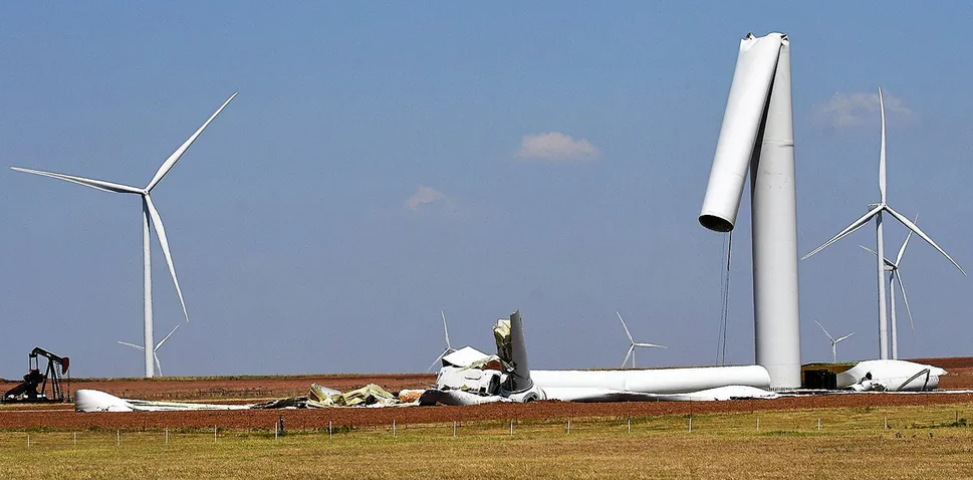
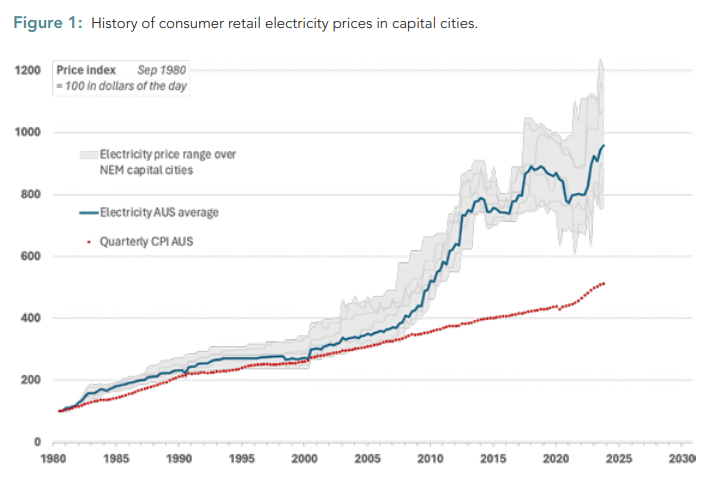
20 years of subsidised wind and solar has caused retail power prices to double or even triple over that period. Attempting to duplicate a perfectly working power generation and distribution system with one that ‘works’, at best, 30% of the time (on average) and never works on calm nights – was always going to end in tears – namely, the tears shed by households and businesses being crushed by power bills that an increasing number of them will never afford. In Australia, businesses and whole industries are being wiped out and the Green/Labor Alliance couldn’t care less.
Whenever wind and solar output entirely collapse (on a regular basis – think Sunset – and for days on end – think bursts of calm and cloudy weather) the gaps are increasingly filled using fast-start up open cycle gas turbines and diesel generators – which are cheap to set up but inefficient and therefore insanely expensive to run.
In Australia, thanks to suicidal anti-gas policies run by State governments, gas is in short supply, notwithstanding an abundance of reserves in New South Wales, Victoria and South Australia. Accordingly, gas is both scarce and predictably expensive. All of which is returned in retail power prices, as The Australian’s Chris Uhlmann reports below.
Real cost of renewables is in your power bills
The Australian
Chris Uhlmann
29 June 2024
There is a moment of profound irony in the New Testament when Jesus tells Pontius Pilate he has come to bear witness to the truth.
“The truth,” Pilate replies. “What is that?”
Consider what the author had in mind. Pilot has Christ, aka The Truth, standing right in front of him and he cannot see it.
If you prefer the movies to scripture then truth is also on trial in A Few Good Men when Colonel Nathan Jessup cracks under cross-examination by Lieutenant Daniel Kaffee.
Jessup: You want answers?!
Kaffee: I want the truth!
Jessup: You can’t handle the truth!
Confronted with uncomfortable truths, many prefer their own version of reality.
And so it was when the Energy Institute delivered its annual Statistical Review of World Energy. For over 70 years this report has done the world a great service by simply recording the energy it is consuming.
For some, the truth of this year’s report was confirmation of the extraordinary progress being made by weather-dependent generation.
The Energy Institute declared “New wind and solar installations outpaced all other additions to the global energy mix in 2023”. Carbon Brief agreed that, “In 2023, wind and solar combined added more new energy to the global mix than any other source, for the first time in history.”
This is true. Renewable energy is rising in the world’s primary energy mix, hitting 14.6 per cent, and the share of fossil fuels is falling.
But look closely and the two reports committed what was once seen as the cardinal sin of journalism, burying the lede.
The big story wasn’t hard to spot; it was in the first line of the Energy Institute’s media release.
“Record global energy consumption, with coal and oil pushing fossil fuels and their emissions to record levels,” it said.
Fossil fuel consumption in the world’s primary energy mix did fall, by 0.4 per cent, but it still accounts for 81.5 per cent of the stuff that makes the world work. Oil production increased by 1.8 million barrels a day to reach a new high of 96 million barrels a day in 2023.
Let’s stick with the zeitgeist and put the good news on coal first. In Europe and North America coal consumption “has been in constant decline over the past 10 years”. But then, this: “Global coal production reached its highest-ever level, beating the previous high set the year before.”
“Whilst China is by far the largest consumer of coal (it beat its own record set in 2022 and now accounts for 56 per cent of the world’s total consumption), in 2023 India exceeded the combined consumption of Europe and North America for the first time ever,” the report says.
The only thing that is changing with coal is where it is burnt, and not much of anything has changed with the world’s consumption of oil. It all nets out to an increase in carbon emissions, exactly the opposite of what the world says it wants to do.
In Australia this week the search for a needle of truth in the energy haystack focused on the alleged ruinous cost of nuclear energy.
Having a debate about energy costs is vital because if they continue to rise it will cripple industry and further beggar the poor. The starting point should be serious scrutiny of the cost of the renewables-dominant system the government favours and what it will do to the retail price of power.
Recall Labor’s pledge to cut power bills rested on the dubious claim that wholesale electricity prices would fall because when wind and solar generate it, the fuel is free.
This thesis was neatly summed up in the beginnings of an energy haiku penned by Climate Change and Energy Minister Chris Bowen.
“The sun and wind don’t send a bill.”
Alas, the retailer does, and prices keep going up.
Stephen Wilson, an Adjunct Professor in the School of Mechanical and Mining Engineering at the University of Queensland, has tackled this myth in a new report for the Institute of Public Affairs titled “The Ruinous Cost of Free Energy”.
He points out what all energy ministers ignore: that the cost of wholesale electricity is not set by the lowest cost of generation on the National Electricity Market. It is set by the highest. And the size of the bill for consumers and taxpayers does not rest on the wholesale price alone. Australians will pay for the total system cost.
But even the wholesale electricity price won’t fall across a year under the government’s plan, because the frequent troughs of weather-dependent generation must be covered by something and whatever that something is will be expensive.
Wilson notes the cheapest system is the one we inherit, engineered in the 20th century on a foundation of low-cost mine-mouth coal.
“It can provide bulk electricity at a wholesale cost level in round numbers of about $50 per megawatt-hour (MWh) or in other words 5c per kilowatt-hour (kWh).”
With the retirement of coal, and the rise of wind and solar, the balance has shifted to an era where gas dominates price setting, as it fires up to cover renewable generation troughs. Even if gas only “meets the last megawatt of demand, it sets the spot price for all generators operating at that moment across the entire market”.
“(If) an extra unit of gas for the marginal generator is about $10 per gigajoule (GJ), then the wholesale electricity price at that moment will be about $100/MWh, which is 10c/kWh.” So, double what we once paid and entirely a function of covering the limitations of variable renewable energy.
The truth of Wilson’s thesis played out in what happened to the wholesale price during the recent cold, still nights, but this is just a halfway house on the road to ever more expensive power. The next phase will be worse.
“If the system is to be operated only on wind, solar and hydro power, with energy shuffled in and out of large and small storage assets and devices, the generation cost averaged across the energy for the total interconnected system will approach $200/MWh (20c/kWh) or more,” the report says.
“The further the system moves away from the inherited generation system in the coal-based ‘$50 cost zone’ through the gas-based ‘$100 cost zone’ and towards the wind- and solar-based ‘$200 cost zone’, the more the actual outcomes for final consumers are likely to escalate to even higher price levels.”
Wilson concludes that the lowest cost system is the one we have, and the next-lowest cost system is one built on new baseload power plants, whether they be coal or nuclear. And the focus of this entire debate should be: How do you generate zero-emissions energy without a catastrophic fall in living standards?
No doubt Wilson’s thesis will be furiously contested. But time will out. The truth will be written in your electricity bill.
The Australian
Stephen Wilson Discussing IPA Research On System Cost Energy Research Credlin Sky News Australia
Institute of Public Affairs
Stephen Wilson
2 July 2024
Transcript
Peta Credlin: Despite repeated claims by the Albanese government that they would bring down your power prices, analysts at UBS now expect prices to peak at $1.4 cents per megawatt hour by 2029. Now that’s a 20% increase on this year’s forecast, and almost 50% on 2023. A new report by the Institute of Public Affairs says, while Australia’s previously benefited from some of the lowest consumer power prices in the industrialised world, it now has some of the highest. It also points out that a renewables only power system is likely to be five or six times as expensive as what we have now, which is our existing coal-fired power base load. The author of that report is adjunct professor at the University of Queensland, Stephen Wilson, and I’m delighted to say he joins me now. Stephen, I just about tear my hair out when I listened to Chris Bowen saying that renewables are the cheapest form of energy because he’s playing with the numbers, isn’t he?
Stephen Wilson: Yeah, so the problem is that they’re not including all the costs when they present the cost numbers. We’ve heard this number thrown around recently of 121 billion or $122 billion of capital investment. But when you look at what’s included, it turns out that the things that are not included are actually larger than the things that are included.
Peta Credlin: So how do they get away with it?
Stephen Wilson: Well, I think the issue is, Peta, that if you use a simple metric like the levelized cost of energy, which you’ll find in places, you’ll find this reported in the CSIRO GenCost report, and you’ll find it reported by Lazard and other people like that. The levelized cost of energy, it’s very simple calculation, but it’s far too simplistic. And it doesn’t take account of what does it really cost to run the whole system and to deliver the service to the customers, which means balancing the demand of the customers every second of every day, and that’s a non-negotiable technical requirement of any power system.
Peta Credlin: To give me a practical example, are you saying that when they compare apples and oranges, when they comparing, say, coal-fired power with the solar farm or renewable energy outfit, wind turbines or something, they’re not calculating the cost it is to get the energy from the wind turbines in country New South Wales to consumers in Sydney. They’re not factoring in the transmission lines required, and they’re not factoring in the firming power when the wind’s not blowing. Is that what you’re talking about?
Stephen Wilson: So they’re not factoring in the cost of balancing that whole system. So you can’t run the whole system just on those resources alone. You need other resources in the system to balance. So for example, simple example is have they included all the cost of all the storage? And it appears that they’re not… They’re assuming that there’ll be very, very large quantities of batteries owned by you and me and all the other private customers on the system, and they won’t count the cost of those in their calculation. But then they’ll assume that all of the customers will make those resources available to the system and put them under the control of the system operator to make sure that the generation and the load, the supply and the demand can be balanced at all times.
Peta Credlin: What I find extraordinary, and I listened to the minister and the prime minister today in the parliament, and they talk about their green hydro. None of this is available at great scale. We might have household batteries available and they’ll develop over time, but we still don’t even have suburb wide battery storage. We don’t have citywide battery storage. And the examples we’ve had in the past that keep a place like Adelaide going for under half an hour, how can they put together a price on energy and make this huge transformation in six years time? It’s all going to happen by 2030, if we really don’t know what we’re buying and we really don’t know what it costs.
Stephen Wilson: Yeah, well, that’s the issue. It’s been mis-sold, I think. The amount of storage that you would need just to solve the problem on paper is enormous. And when you start to cost that in, you see these very, very high costs. And then beyond that, the question in my mind is, will this system even work on a technical level? Will it have the stability and the resilience and the robustness to maintain power at all times? Will the frequency remain stable? Will the voltages remain stable, or will the system be very vulnerable and subject to collapse, which is what I and many other engineers think will be a problem?
Peta Credlin: Well, well on the report, I think it’s incredibly comprehensive. My audience are really interested in the energy issue and I encourage them to head to the IPA website and read your report. Stephen Wilson, thank you for your time.
Institute of Public Affairs
The Ruinous Cost of Free Energy: Why an electricity system built on renewables is the most expensive of all options
Institute of Public Affairs
Stephen Wilson
1 July 2024
- Australia previously benefited from some of the lowest consumer electricity prices in the industrialised world, but it now has some of the highest.
- This paper shows that an electricity supply system built on a foundation of baseload generation – that which provides power 24/7 to the grid to meet base energy needs – results in the lowest Total System Cost.
- This invalidates claims that renewable energy is the cheapest form of energy. That may be true in particular locations at particular points in time, but at the system level a system built on renewable energy would be the most expensive – by far – of available options.
- Customers pay for what they use, but far more of what we pay is required to cover the costs of the physical infrastructure, from generation to our meter, than for generating the electricity itself. To expose the full costs of providing electricity, we need to focus on Total System Cost.
- For example, when a consumer installs rooftop solar panel they draw less electricity from the system, and daytime load on the system is reduced. The excess is exported into the distribution network further reducing load on the system, which forces large-scale generators to reduce output. But the large-scale generators, transmission and distribution networks, retailers and environmental costs still exist. Less energy drawn from the main system does not mean less fixed cost: in this case it means more fixed costs overall.
- The main power system that Australians inherited – engineered in the 20th century on a foundation of low-cost mine-mouth coal – can provide bulk electricity at a wholesale cost level in round numbers of about $50 per megawatt-hour (MWh) or in other words 5c per kilowatt-hour (kWh).
- When a flexible, fast-response open cycle gas turbine meets the last megawatt of demand it sets the spot price for all generators operating at that moment across the entire market. Such units are increasingly called upon to balance not only the relatively predictable and smoothly changing variability of aggregate customer demand, but at the same time the far steeper and more volatile fluctuations in wind and solar power output. Also in round numbers, if the price of an extra unit of gas for the marginal generator is about $10 per gigajoule (GJ), then the wholesale electricity price at that moment will be about $100/MWh, which is 10c/kWh. Each $1/GJ change in the gas price will change the corresponding electricity number by $10/MWh (1c/kWh).
- Continuing with round numbers, if the system is to be operated only on wind, solar and hydro power, with energy shuffled in and out of large and small storage assets and devices, the generation cost averaged across the energy for the total interconnected system will approach $200/MWh (20c/kWh) or more. The additional costs in the transmission and distribution systems will be far higher than for the historical coal-based and the current increasingly gas-price exposed system.
- In other words, the further the system moves away from the inherited generation system in the coal-based ‘$50 cost zone’ through the gas-based ‘$100 cost zone’ and towards the wind- and solar-based ‘$200 cost zone,’ the more the actual outcomes for final consumers are likely to escalate to even higher price levels. The underlying economic problem remains even if cost of living price relief shifts costs from electricity bills to the tax-and-welfare system.
- This paper is summarised in the following short statements:
- The system with the lowest Total System Cost is the one we have.
- The levelised cost of energy (LCOE) of any generation type does not reflect Total System Cost.
- There is a modest role for renewable technology before it increases Total System Cost.
- Contrary to popular belief, coal-fired power plants do not have a predetermined life. They can be refurbished periodically and remain in service for an indefinite period. The benchmark for comparing costs is not a hypothetical fleet of new coal plants: it is the fleet of already existing coal plants.
- Thus the lowest cost system is the one we have, and the next lowest cost system is one built on new baseload power plants, whether they be coal or nuclear.
- Official plans assume, encourage, or require the elimination of coal-fired generation, not on cost, but on emissions grounds.
- Notionally wind and solar provide “free energy” because there is no fuel cost. LCOE acknowledges the up-front investment required to generate electricity from the wind or the sun, and ‘levelises’ that cost across the output from the turbines or the panels over their life. However, LCOE (which is used by AEMO – relying in turn upon the CSIRO’s GenCost model – to develop the ISP) is a simplified calculation applied at the generation level that is not able to provide insight into the Total System Cost with various types of generation technology needed to serve customer demand at all times.
- These conclusion are summarised in Figure 5, below, which appears in the body of the report on page 20.
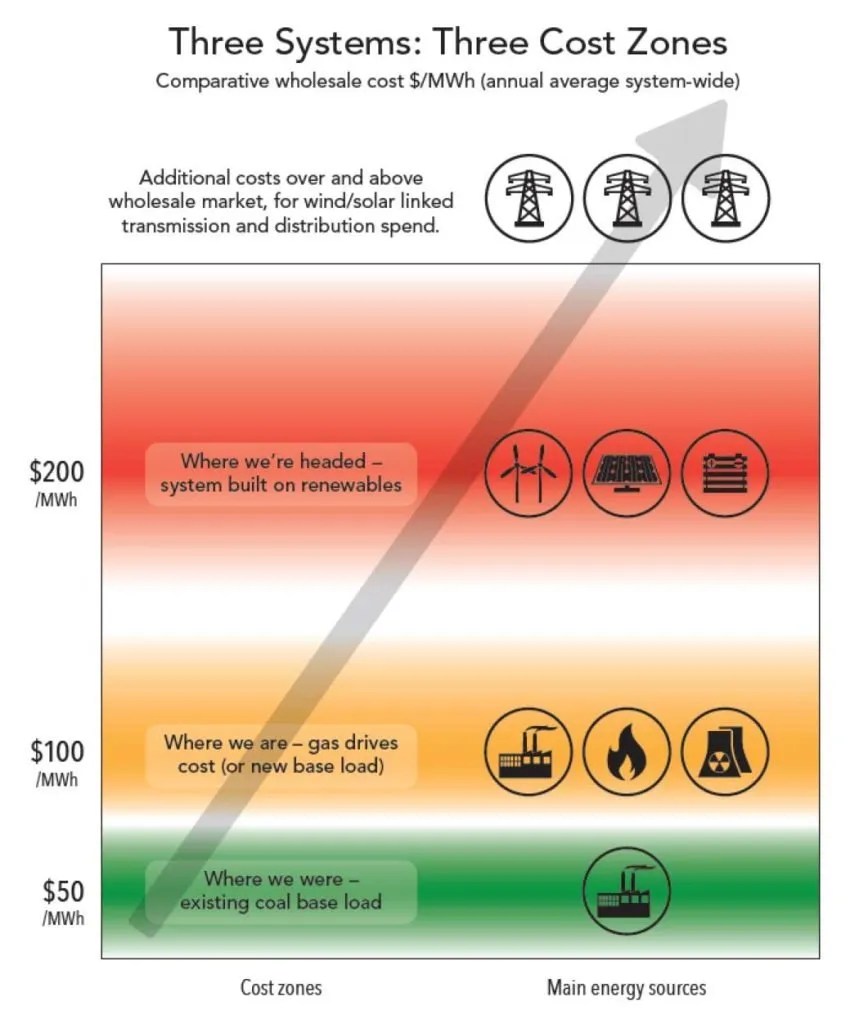
- Beyond the $200/MWh wholesale cost zone indicated in the Figure above, there is the additional cost of the poles and wires required to deliver the electricity as the system hypothetically transitions to one built on renewables.
- Storage via batteries and pumped hydro is often raised as a means of shifting excess wind and solar generation to periods of high demand, but each has significant limitations with respect to duration and cost.
- The total system cost of a renewables-based system (>80% share) may be two or three times as expensive as one premised on baseload (whether current or with new build nuclear), and a ‘renewables only’ system is likely to be five or six times as expensive. All such costs must ultimately be recouped from the consumers, if not the taxpayer.
- It is true that it takes time to plan, prepare, finance, and build nuclear power plants. Avoiding increasingly high cost electricity while also pursuing environmental goals would require prudent management for a number of years of the existing system, including the existing coal plants and gas plants, while replacement baseload assets capable of playing the same role without incurring far higher costs are planned, prepared, financed and deployed.
Download the research report (PDF)
From the concluding observations in the report, Wilson writes:
That said, I agree with the observation that wind and solar power is a cheap way to provide expensive electricity, whereas nuclear power is an expensive way to provide low-cost (but high value) electricity. The saying is not only witty, but true.

 STOP THESE THINGS