

The grand ‘wind and solar transition’ sounds great until you’re left freezing or boiling in the dark – the only inevitable outcome of attempting to run on nothing but sunshine and breezes.
Solar output collapses on a regular, daily basis (a phenomenon that’s been referred to as ‘Sunset’ for some time now). Even when the sun is up, rainy weather and heavy overcast conditions will kill solar output just as readily.
Wind output is all determined by when, where and how the wind is blowing: anything over 25m/s (90kph) and turbines automatically shut down; anything less than 6m/s and these things produce nothing of value at all.
When you’re struggling to explain the relationship between the weather and wind and solar output, just get them to focus on what happens on a calm night?
Even a complete dunce is capable of making the connection between zero wind and solar output and zero wind and sunshine.
Rafe Champion has been trying to educate the Australian masses on that subject for some time now. As he does in the second piece below.
In the first piece, the team from Jo Nova go further and demonstrate that – on those occasions when wind output collapses (often completely and frequently for days on end) – the only thing keeping the lights on is gas being burnt in fast-start-up open cycle gas turbines – aka ‘peakers’. With a successive string of calm nights over the last few months, gas consumption to run those peakers is at an all-time high and gas reserves are at an all-time low.
Cold, windless Victoria may run out of gas before the end of winter
Jo Nova Blog
Jo Nova
24 June 2024
It wasn’t supposed to be this cold and windless in Australia.
For some reason that no climate model can explain, Australia has run out of wind power three months in a row, which means we had to use more gas than expected. It’s also been colder than climate models predicted, despite global emissions being higher than ever in history. For some other reason that no rational adult can explain, the State of Victoria banned gas drilling for most of the last decade (to reduce the beachy-weather days in eighty years) and thus, as night follows day, the state is running out of gas. Ergo, predictably, it is also facing blackouts, cost blowouts and manufacturers dependent on gas are warning they may have to close down, or move to the US, where gas is still cheap.
If only the climate models could predict temperatures and wind even a month in advance?
The AEMO (our electricity grid manager) says Victoria will run out of gas before winter runs out of bite. Apparently Victorians are pulling twice as much gas out of their main storage as they can afford to at the moment. Not only does Victoria need the gas for electricity, but 80% of Victorian homes have gas for cooking or heating. And then there is manufacturing, not just in Victoria but most of Australia as gas prices rise all over the East Coast.
Who needs explosives and fertilizer, anyway?
Orica — one of the largest gas users in the country warned it may have to cut production and jobs in Newcastle due to the gas shortage. Since they supply explosives to the mining industry, and Australia is a big quarry, the repercussions would spread quickly.
Victoria’s main gas facility to run out by end of winter as wind farm output slumps to five-year low
By Perry Williams, and Rhiannon Down, The Australian
The nation is facing a deepening energy crisis on two fronts, with gas shortages so acute that Victoria’s main storage plant is set to run out by the end of winter and one of Australia’s biggest manufacturers warning it will slash jobs and close factories if supplies remain short.
German Morales, Orica’s president for Australia Pacific and sustainability, told The Australian that “there is not enough gas and there is not affordable gas”.
“Clearly if we fail to secure long-term gas at a reasonable market price, we may be put in a position of rethinking what is the manufacturing strategy for ammonia in Australia,” he said. “The Australian gas price is significantly more expensive than that you can buy in other jurisdictions, such as the US. That’s making it very difficult to justify manufacturing in Australia.”
And we thought wind generation was bad in April and May but June may be worse.
The awfulness of the fickle wind is upon us and reaching into our wallets. This was the total contribution of 11.5GW of wind generation to our national grid this month. Paul McArdle from WattClarity said the capacity factor for wind is as low as 21%.
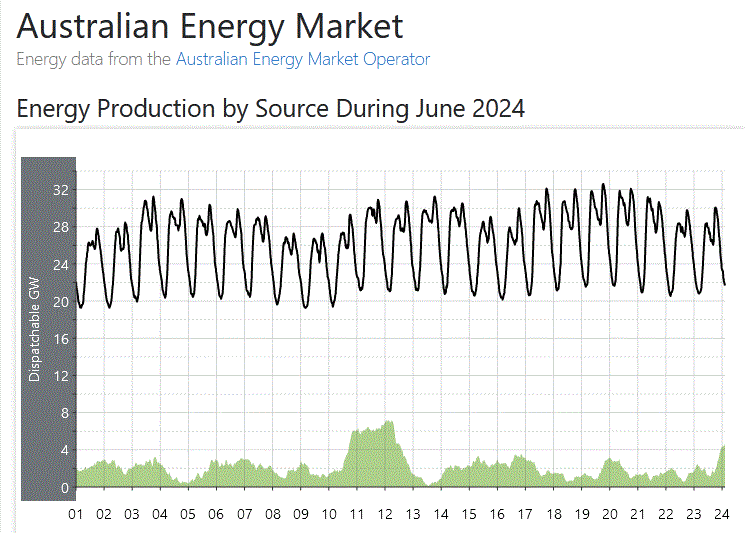
Not-so-coincidentally on June 4th and June 13th when wind generation was exceptionally low, average prices in the whole system doubled (See below).
And this is a major problem with an electricity market that isn’t designed to find the cheapest solution for consumers. Cheerleaders like the CSIRO will still be saying “wind is cheap” when it’s obvious the lack of wind in a wind-dependent-system is very expensive. But these price spikes that were caused by wind turbines will be slapped on coal, gas or hydro, whatever rescued the grid, not on the wind industry. The more wind fails, the “higher” the prices are for its competitors. Neat eh? If only the “experts” at the CSIRO understood how unreliable wind drives up the cost of everything else on the grid.
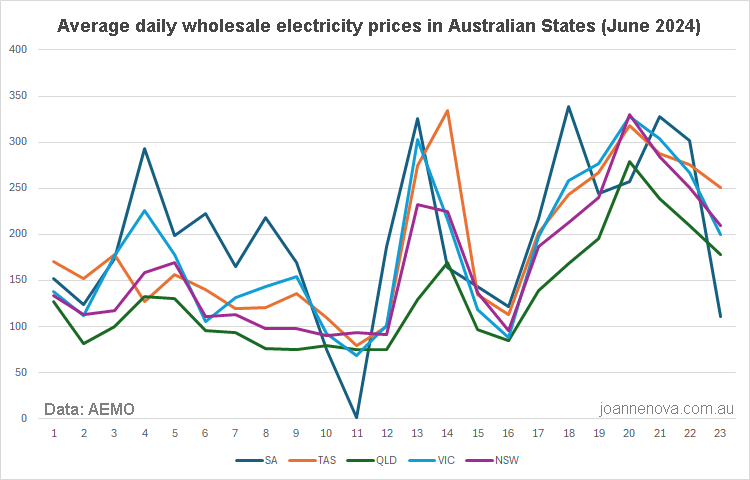
Bad days for wind were June 4th and June 13th, then most other days too.
Those prices are awful and often obscenely high across all five states… On June 13th wind generation fell to just 88MW at lunchtime, and was low all day. The spike this produced is obvious.
Some of the lows like June 20th caused mayhem because they were hitting at dinner time when solar power has gone to bed. Back before the subsidized renewables gold rush, prices would average $30/MWh across the whole grid — not just all day, but all month. This month so far, average prices respectively are SA $197, Tas, $287, Qld $132, Vic $182, NSW $165.
It takes some skill to run out of gas when we are also one of the Big Three LNG exporters in the world, but the Australian government has achieved this. Incompetence knows no bounds:

But hey, winter might be warm from now, who knows?
Not to belabour the point, but if we had decent climate models, we would know.
Gas price cap train wreck on the way
by Saul Kavonic, The Australian
The gas industry is scrambling to try to squeeze out any incremental supply, going as far as blending extra LPGs into the gas stream to eke out an extra per cent or two of production. Every lever to lift supply has now been pulled.
Australia’s energy market is one hiccup away from a major crisis, again. The gas market train wreck – long visible on the horizon – is now in front of us. Set in motion by Labor’s hostile gas policies since 2022, there are no easy levers left to pull to keep the lights on, while also keeping us warm in winter, and manufacturing jobs going. And it is only going to get worse in the years ahead.
If we run out of gas, we’ll just have to burn diesel, or sit in the dark, banging our heads on a cold wall.
Jo Nova Blog

Things That Go Slump in the Night
Quadrant Online
Rafe Champion
25 June 2024
Severe wind droughts are prolonged spells with next to no wind across continental areas. They also exist offshore as any sailor who has been becalmed knows full well. Wind droughts will kill the green-power fantasy, and they have the potential to deal a massive blow to our lifestyle, depending as we do on abundant, reliable and affordable power. While meteorologists don’t mention them, independent Australian observers discovered wind droughts over a decade ago but nobody took any notice. We may pay a bitter price for this neglect.
Serious questions have to be asked about the silence of meteorologists on wind droughts. At the same time the responsible authorities should be called to account for their failure to check the wind supply before connecting intermittent energy to the grid.
Why wind won’t work
Wind and solar cannot provide reliable power at grid-scale and the reason is as simple as ABC: Input to the grid must continuously match the demand, and the continuity of wind and solar input fails on nights with little or no wind.
The amount of storage required to bridge the gaps is not feasible or affordable.
Supporters of the transition to intermittent energy invoke a “holy trinity” of strategies to ride through wind drought. These are (1) long-distance transmission lines to shift power from areas of plenty to drought zones, (2) pumped hydro storage, and (3) battery storage.
Long distance transmission lines will not help because wind droughts can extend across the whole of SE Australia. On the other side of the world they have been known to extend across all of western Europe.
Pumped hydro at the scale required appears to be out of the question. There is no substantial pumped hydro scheme in the world that runs on wind and solar power alone.
As for batteries, we read practically every day that more “big batteries” are coming but “big” is an abuse of language in this context because the capacity of even the biggest batteries, like the 1.4GWh Waratah Super Battery in NSW, is negligible compared with the power required in a single night in the grid. That is in the order of 300GWh, while the total capacity of all the battery projects in the pipeline amount to some 60GWh and the batteries at work in the system at present can deliver only 3GWh.
The plan devised by the market operator (AEMO) calls for a ninefold increase in the amount of installed wind and solar capacity, but all that capacity will deliver a pitifully small amount of power on nights with little or no wind. Such nights are the limiting factor for the whole system like the slowest ship in a convoy or weakest link in a chain.
The threat of wind droughts
Subsidised and mandated intermittent energy providers drive out conventional power plants because they can make money when the market price is too low for conventional providers to run profitably. The unreliables can displace conventional power but they can’t replace it! Eventually there will not be enough reliable (dispatchable) power to meet 100 per cent of the demand. At that point, the power supply will be compromised whenever the wind is low overnight.
The day of reckoning has been delayed by the modest increase in demand in recent years due to creeping deindustrialization — directly caused by the increasing cost of power. As the coal generating capacity runs down, the pinch will first occur for a few hours at the dinnertime peak of demand. That can be met using the deceptively named Reliability and Emergency Reserve Trader Scheme (RETS). This sounds like a reserve supply, but it functions by diverting power from major users (with compensation) to protect the integrity of the grid and avoid inconvenience for the community at large. In other words, industrial production stops so he the community’s lights stay on!
If the RETS diversions of supply is not enough, rolling blackouts can be organized to handle the shortfall. As the process goes on, there will eventually not be enough conventional power to service the base load, the minimum that is required day and night. At that point, whenever the wind is low overnight there will be blackouts, and we will officially achieve the status of a Third World country.
Since 2012, 12 coal power stations have closed in South-Eastern Australia, taking out some 8GW of capacity, which in total is down to 22GW. We are now only one coal station closure away from a power crisis whenever the wind is low overnight. The problem surfaced in June 2022 when outages in some coal stations created a crisis that was met by using gas, which spiked the price of gas, and hence the wholesale price of power.
This was seen as a problem with the price of gas, to be solved by government intervention and a price cap. It should have been seen as an early warning of what was coming if the capacity of coal power continued to run down. Gas is too expensive to be used outside peak periods. In addition, there are serious concerns about the availability of gas going forward.
Energy realists know that we will have to burn coal for many years, yet the state of Victoria has ambitious plans to get rid of coal while they also have confidential deals with two power stations to maintain supply. Similarly the biggest coal plant in the country, Eraring in NSW, will continue with publicly funded life support beyond the scheduled closing date next year.
A worldwide menace
It is not entirely facetious to suggest that wind droughts could undermine Western civilization, or at least the way of life that depends on a continuous supply of affordable electric power. As noted above, as wind and solar power displace reliable, conventional coal-fired power, a time will come when there is not enough conventional power to meet the demand. ie., when the sun and wind are off duty. Germany and Great Britain have reached that point, and they survive with the help of imported power, while they shed power-intensive industries. In short, they bet the farm on wind power and lost.
The same problem is looming wherever net zero strategies are in place. Texas had a critical situation in Feb 2021 although in that instance the wind and solar enthusiasts could point out that the gas system was also disrupted by the cold conditions. Subsequently the gas supply has been winterized to the standard of the colder northern states so it will perform in future. In contrast, there is nothing people can do to prevent windless nights.
The power authorities in some 19 US states have signalled there will be grave problems with reliability in the power supply in as little as three or four years if EPA regulations and the incentives to deliver unreliable wind and solar power continue to drive out fossil fuel.
To meteorologists, silence is golden
Questions have to be asked about the failure of the meteorologist to issue wind drought warnings which could and should have averted the connection of subsidised intermittent energy to the grid.
Meteorologists are the official custodians of weather records around the world but the customary metric for wind resources is the average wind velocity which of course hides both the low and the high points, each of which are unsuitable for power generation from wind turbines. Official meteorological records are still not reporting low wind periods in the way that they report every other kind of extreme weather.
Wind droughts had a low profile after the doldrums in sub-tropical latitudes ceased to be a concern when steamers replaced ships under sail. Even the prolonged European Dunkelflautes (still and dark periods) did not arouse attention until they precipitated the crisis in the power supply in 2021, when the cost of power in Britain and Germany surged, even before the war in Ukraine further aggravated the situation. An entry for Dunkelflautes only appeared in Wikipedia in October 2020 although mariners at sea must have known them from time immemorial and millers on land must have experienced them for centuries. H G Wells wrote in 1901 that windmills were not suitable for pumping water from coal mines because “a gang might sit at a pithead for a month, whistling for a gale.”
Apparently some people were aware of wind droughts a hundred years ago and it remains to be seen how the meteorologists explain their silence on the matter. As for offshore wind developments, perhaps those who approve such projects should read Coleridge’s “The Rime of the Ancient Mariner”.
Australians led the world in wind-watching. Over a decade ago, Anton Lang and the Paul Miskelly clearly identified the danger of wind droughts in Australia, but their work escaped the attention of the responsible authorities and is still virtually unknown. They used the AEMO records of continuous wind power generation to decisively refute the view that Australia has superb wind resources, which had been accepted in official circles, based on the average wind speeds reported by the local Bureau of Meteorology and the conclusions of numerous academic studies. The landmark paper appeared here in 2012.
During calendar year 2010 the total wind output across the grid fell rapidly to zero or near zero on 109 occasions in the year. These low wind periods (not yet called wind droughts) occurred when high-pressure systems fell over most of the continent, moving from west to east as shown on the weather maps displayed in the newspaper and TV weather reports.
In 2010 there were only 23 wind farms and less than 2GW of installed capacity. Hopes were high that the supply would become more reliable as sites became more numerous and widespread. This is not happening, with over 11GW installed, and the records show that prolonged wind droughts still occur across SE Australia, most recently for three days in August 2023.
Lang was an RAAF electrician in 2008, when he first started to report his observations on a private blog. His posts are still appearing regularly and there are now several thousand posts on various aspects of the performance of the wind fleet and the other sources of power as well. This is a remarkable achievement and it must be one of the most sustained, singlehanded, unfunded research projects on record.
Its all over for wind and solar on the grid
Wind droughts happen all over the world and they are a fatal impediment to the net zero program.
Given the failure of the official meteorologists to issue warnings, there is a need for two high-level inquires. One should aim to discover why the officials never warned the public or the responsible authorities about the fatal threat to the power supply. Was it incompetence, negligence or something else? That inquiry should be replicated in all the countries with official meteorological offices and its should extend to the World Meteorological Organizer that was a foundation member of the climate alarmists club. The other inquiry in Australia would aim to identify the agencies that failed to conduct due diligence on the wind supply before wind and solar power were allowed to connect to the grid. Imagine building the infrastructure for a massive irrigation project without an exhaustive study of the water supply, including all the available rainfall records.
In the absence of due diligence, tens of billions of dollars have been added to the national debt to allow subsidised and mandated intermittent energy to enfeeble the grid in one of the most costly policy blunders in peacetime. In return for the expense we have got less reliable and more expensive energy, causing domestic hardship and a great deal of unrecorded deindustrialisation. At the same time there has been massive environmental damage and division in regional communities. In short, there has been a colossal negative return with an enormous threat to the nation’s security and prosperity.
Quadrant Online

 STOP THESE THINGS
Matt Shaner et al used 36 years of wind and solar data for all of North America with one hour resolution to calculate that 400-800 hours of storage would be necessary, depending upon location and the mix of solar and wind.
When unreliable electric generators are attached to the grid and the use of their occasional output is mandated, the effect is to drive the capacity factors of the reliable ones down to the same average as the unreliable ones. The reliable generator owners still have to pay their mortgage and staff, so their prices must change in inverse proportion to their capacity factors.