
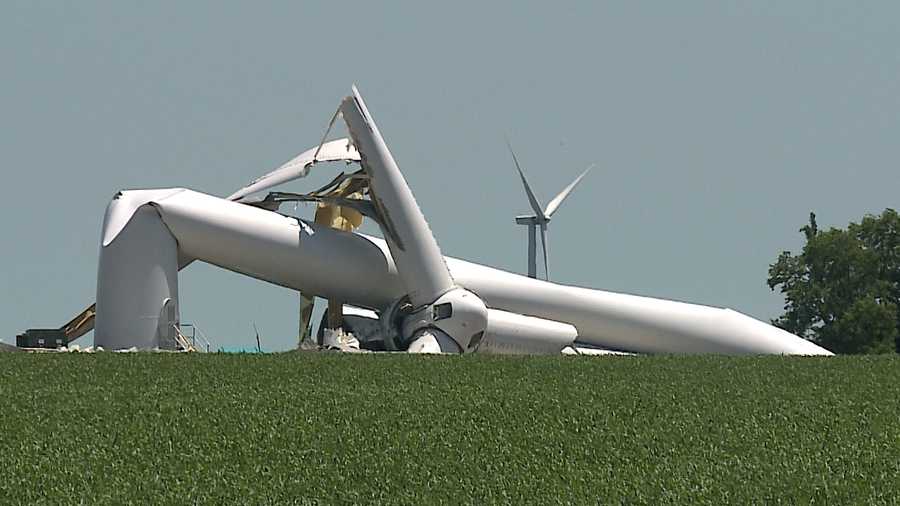
When the wind blows hard enough, the turbines will not only rock, they’ll hit the deck with quite a thud – all 250 tonnes or so. And what a gale can do to 280m high turbines, a hail storm can do to seas of solar panels in a matter of minutes (see Charles Rotter’s piece below).
So if – as we’re constantly berated – the weather can only become more extreme, chaotic and unpredictable in future, then why, oh why, are we pinning our hopes on ‘systems’ that can’t stand up to the weather they rely on? Eric Worrall takes up the point in the first piece below.
If Climate Change is Knocking Down Power Pylons, Why Build More Renewables?
Watts Up With That?
Eric Worrall
28 February 2024
If storms are getting worse, how can fragile renewable energy infrastructure survive the superstorms of the future?
After a weird summer of floods and heatwaves, scientists explain why weather extremes are ‘on steroids’
By climate reporter Jess Davis
When winds as high as 260 kilometres per hour tore down transmission towers in South Australia in 2016 and plunged the state into an electricity void, it took people by surprise.
The sight of high-voltage transmission lines, crumpled on the ground was almost surreal.
Eight years later, as fierce storms broke over Victoria, images of wilted towers were again causing consternation.
…
Storms get more intense
What climate scientists do know is that with more energy in the atmosphere, storms are becoming more intense.
“When you have events like squall lines or cyclones, tornadoes, thunderstorms, they have more energy available to them,” director of the Monash Energy Institute Roger Dargaville said.
Dr Dargaville said he was surprised wind could knock over transmission towers back in 2016, but that’s no longer the case.
“It’s now a very real possibility and will probably occur many times in the future,” he said.
…
Read more: https://www.abc.net.au/news/2024-02-28/global-warming-effect-on-extreme-weather-events/103471564
Professor Dargaville also recently argued for more renewables;
Monash expert: Wild weather aftermath – the security of Victoria’s energy grid and the need for renewables
Monash University
14/02/2024
Associate Professor Roger Dargaville, Director Monash Energy Institute, Resources Engineering, Faculty of Engineering
Monash University experts are available to comment on the power blackout and related aftermath as a result of wild weather in Victoria yesterday, and how our energy grids could be made more resilient in the future.
…
The following can be attributed to Associate Professor Dargaville:
“On Tuesday afternoon, a severe storm belt with wind gusts over 100km/h, extreme lightning and torrential rain caused havoc across Melbourne. Amongst lots of localised power outages due to low voltage power lines being damaged was the destruction of several towers supporting the parallel 500kV lines between Melbourne and Geelong. The effect of losing that vital infrastructure was to ‘trip off’ the Loy Yang A power station.
…
“Distributed renewable energy systems offer both more vulnerability due to more infrastructure spread over wider areas, but also additional resilience as losses of individual power lines don’t have the same impact of losing large centralised power stations.
…
Even if we assume for a moment this super storm claim is true, Professor Dargaville’s position does not make sense.
Consider these alternatives propositions for future energy generation:
- Build an energy system which depends on vast acreages of fragile sheets of glass and machines designed to catch the wind, along with vastly enlarged power grids to capture this dispersed energy, which you know will be massively vulnerable to the raging superstorms of the future.
- Build a set of compact nuclear reactors encased in thick steel and concrete armour, located at a sufficient elevation to eliminate the risk of flooding, utterly invulnerable to any possible storm, located as close as possible to energy end users, to minimise the risk of supply disruption caused by storm damage to distribution networks.
Why is Professor Dargaville advocating for the option which he admits is will increase vulnerability to storm damage, and not even mentioning the nuclear option, which offers near total climate resilience and a steady supply of reliable and dispatchable zero carbon energy?
Fragile, weather dependent renewable energy systems are not fit for purpose, and will never be fit for purpose. They don’t make sense today, and they would make even less sense in a future filled with climate superstorms.
Don’t think for a moment I take the claim of future superstorms seriously, why should the current crop of alarmist climate predictions be any different to the previous 30 years+ of failed climate predictions? But Professor Dargaville’s advocacy of renewable energy does not make sense, even in the context of his own claimed position on future climate disruption.
Watts Up With That?
Meanwhile in Texas….
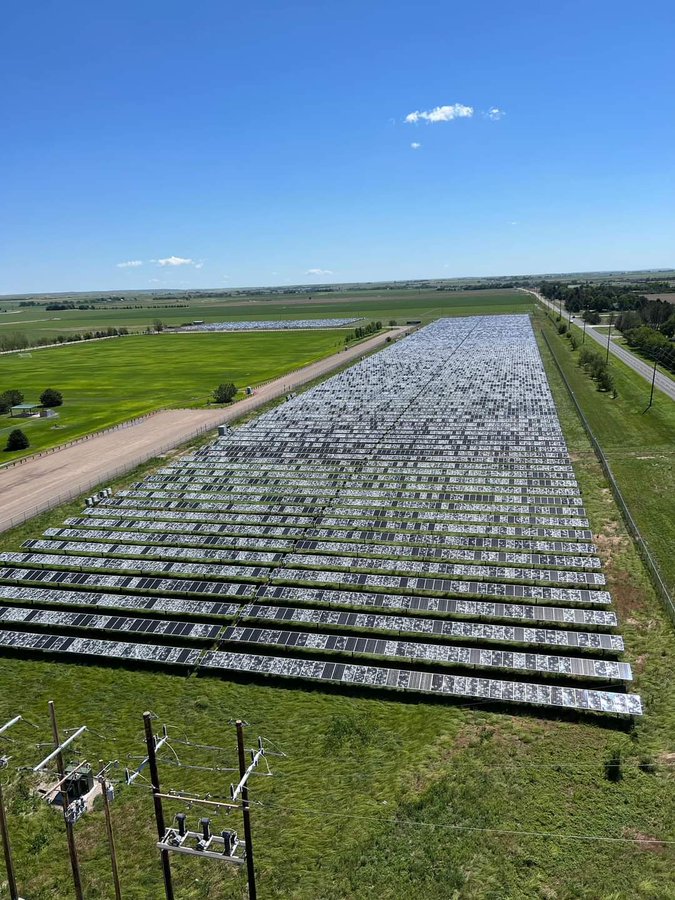
Hailstorm in Texas destroys thousands of acres of solar farms
Watts Up With That
Charles Rotter
26 March 2024
Close up of the destruction from ABC 13 Houston, still from video. Full video link.
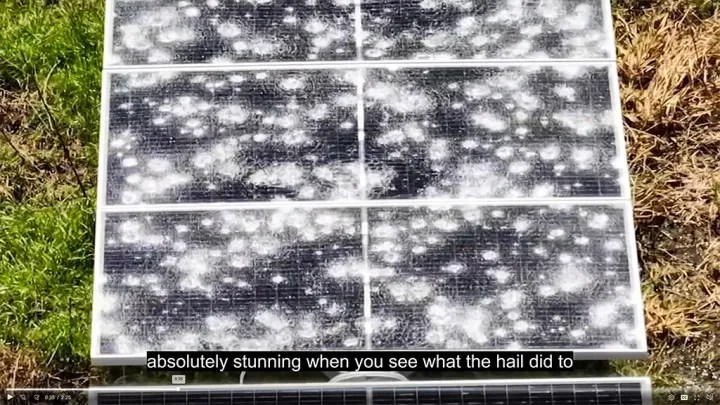
Locals are very worried about water contamination reports MSN.
Experts said that most of the time, large solar farm panels are made of compound cadmium telluride.
This is something Kaminski is worried about because he uses well water.
“That’s what we take a shower with, we drink with,” Kaminski explained. “It could be in our water now.”
 STOP THESE THINGS
seriously, Texans should be smart enough not to waste their money, time and precious land on solar power