
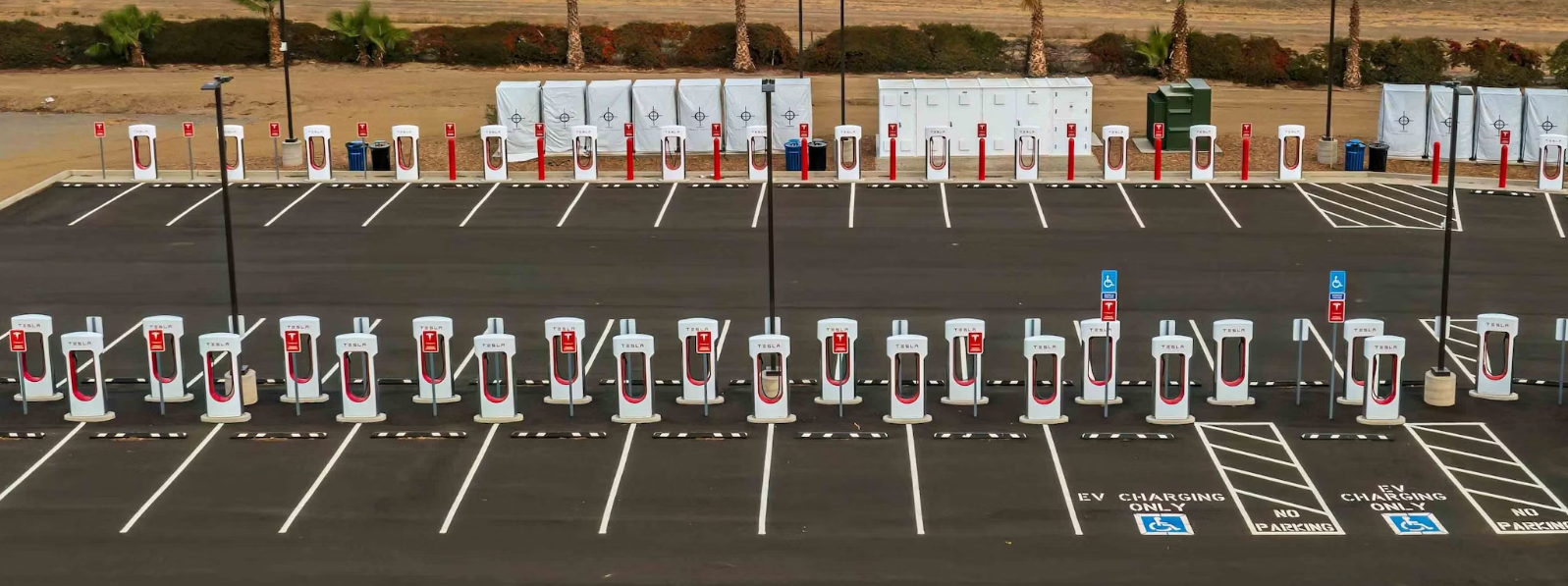
There’s nothing wrong in theory about all-Electric Vehicles. But, if they really were a sensible substitute for petrol or diesel-powered vehicles, they’d already be jumping off the shelves. Except, for some strange reason, they aren’t.
There’s plenty of irony attached to the all-EV cult: the world’s largest EV charging station is run entirely using diesel generators (see above).
Then there’s the hypocrisy that sits at the heart of every EV: a lithium-ion battery.
The lithium-ion battery, whether it’s used to power an all-EV or as a standalone store for electrons lovingly harvested from mother nature, is a wealth of rare earths and scarce minerals, the provenance of which can only be described as troublesome.
Moreover, as Craig Rucker explains below, in places like California, where the all-EV cult reigns supreme, they are having a hard time explaining away the environmental impacts of their exceedingly pious and pompous choice of vehicle.
Why California’s climate disclosure law should doom green energy
Orange County Register
Craig Rucker
19 February 2024
California prides itself for being a leader with respect to tackling climate change. This is because they believe, albeit on shaky scientific grounds, that their citizens “already” face devastating consequences inflicted on them by manmade global warming – including wildfires, sea level rise, drought, climate refugees, and other impacts that “threaten their health and safety”.
Thus, to lower their state’s carbon footprint, the legislature recently passed a law requiring all companies doing over $1 billion in business within California to “publicly disclose” (by 2026) all their “direct” greenhouse gas (GHG) emissions stemming from fuel combustion they utilize, as well as all “indirect” GHG emissions derived from the electricity, heating and cooling they consume.
By 2027, they must also disclose “indirect upstream and downstream” GHGs emitted by sources that they do not own or directly control, but from which they purchase goods and services, including GHG emissions associated with the “processing and use of sold products.”
This certainly appears to cover almost every mega-scale entity doing business in the once-Golden State. And it might help those who fret about climate change sleep better at night. But will it actually lower the planet’s greenhouse gas emissions?
The simple answer is “no”. Let me explain.
Since only “zero-emission” vehicles can be sold in California by 2035, and the state must have 100% “clean” electricity by 2045, the new disclosure mandates should (at least in theory) cover GHG emissions associated with “upstream” operations required for processing raw materials, manufacturing new energy generation and use technologies, and transporting “clean energy” equipment sold to or used in California.
The new mandates should also cover wind turbines, solar panels, electric vehicle batteries, grid-scale backup batteries, transformers, expanded and enhanced transmission lines, and other equipment associated with California’s emerging “clean, green, renewable, sustainable” economy.
And they absolutely should also cover the extraction, processing, refining and other activities required to obtain the nonrenewable metals, minerals, concrete, plastics, paints, other materials – and fuels – needed to manufacture and install those technologies.
The billion-dollar utility companies that buy and use all this equipment should absolutely be required to catalog and publicly disclose all emissions associated with these “clean” technologies.
If such an inventory is accurately taken, and that is admittedly a bit “if”, it won’t paint a pretty picture for those touting renewables, Green building construction, and EV transportation “fixes”.
The International Energy Agency and other experts report that electric vehicles have six times more metals by weight than internal combustion counterparts. Photovoltaic solar panels require six times more metals and minerals (other than steel and aluminum) per megawatt than a combined-cycle gas turbine that generates electricity pretty much 24/7/365; they also require at least 100 times more land area.
Weather dependent, intermittent onshore wind turbines need 9-10 times more than a CCGT, and offshore wind turbines require fourteen times more raw materials. Putting 850-foot-tall wind turbines in California’s deep ocean waters would require mounting them on floating platforms big enough to prevent them from capsizing in storms; that would likely mean 40 times more materials.
For every 100,000 tons of copper (enough for 2,275 gigantic 12-MW offshore wind turbines), companies would have to blast and extract nearly 60,000,000 tons of ore and overlying rock, and then use heat and chemicals to process almost 23,000,000 tons of ore. Every step involves fossil fuels.
Nickel for powerful nickel-cobalt-aluminum and nickel-manganese-cobalt EV batteries is found largely in Indonesia, where companies mine the ore using diesel-powered equipment and send it to smelters fueled by coal. Once fully operational, a single nickel-processing industrial park in eastern Indonesia will burn more coal per year than Brazil.
Cobalt for cobalt-lithium batteries comes mostly from the Democratic Republic of Congo, involves extensive child and near-slave labor and, like most other metals and minerals for “renewable” technologies, requires fossil fuels and toxic chemicals, and is controlled by Communist China.
Manufacturing wind turbines, solar panels and batteries is also heavily concentrated in China, whose coal-based power and resultant GHG emissions now exceed the rest of the world combined. In fact, China put 38.4 gigawatts (38,400 MW) of new coal-fired power capacity into operation in 2020 alone – more than three times the amount built everywhere else around the world.
In short, California’s Green transition is likely to be an ugly one for those actually intent on trying to lower greenhouse gas emissions. One can’t help but wonder what happens when Californian politicians realize their grand scheme to save Planet Earth from a manmade climate crisis actually results in possibly spewing out more greenhouse gas emissions into the atmosphere?
My guess is nothing at all – except, of course, to make sure such a valid inventory isn’t conducted in the first place.
Orange County Register

 STOP THESE THINGS