

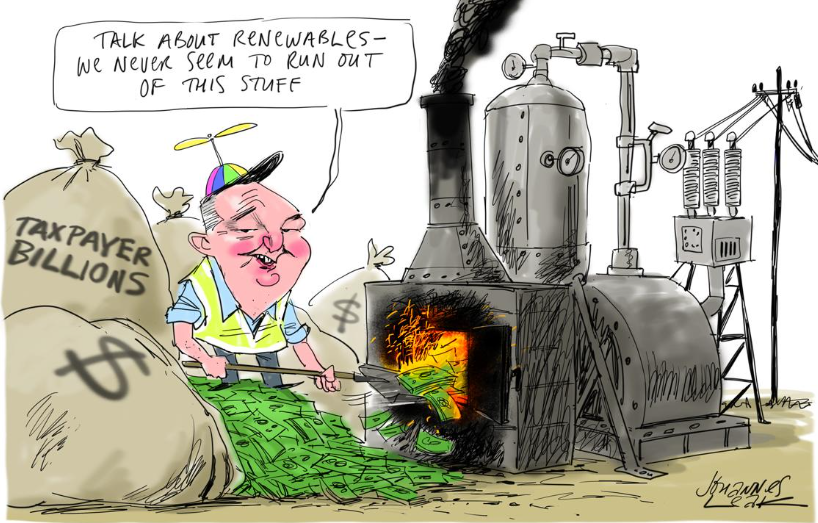
If you’re out to make a small fortune, start with a large one and invest every cent of it in the Ponzi scheme that is industrial scale wind and solar power generation. An even faster way to lose cash is to give it to the hucksters peddling so-called ‘green’ hydrogen, just about anything else that features ‘green’ or ‘clean’ in the title.
Around a decade ago, one such enterprise IFM Investors managed to torch $700 million through its wind power offshoot Pacific Hydro.
As we reported back in 2015, Pac Hydro is the bastard child of IFM Investors – born of the $billions that are collected from workers and thrown into what are called “Union Super Funds” – ie “superannuation”: compulsory retirement savings schemes – owned and controlled by union heavies, like Garry Weaven and/or Labor Party front men; like former Environment Minister, Greg Combet.
Combet, notwithstanding his woeful past performance and handling other people’s money, has just been anointed as the chair of Australia’s Future Fund (a Federal government investment slush fund paid for by taxpayers).
The obvious reason for doing so is that Combet will channel hundreds of millions of dollars into the Labor/Green Alliance’s grand wind and solar transition.
While the Future Fund is treated as a government plaything, there are some with the temerity to believe that superannuation is very much their own. In Australia “superannuation”: refers to compulsory retirement savings schemes, some run by private institutions, but the bulk of them are so-called Industry Funds (meaning “Union Super Funds”) owned and controlled by union heavies and Labor party hacks like Combet and his mate Garry Weaven.
Weaven and Combet were responsible for the IFM Investors/Pac Hydro disaster that unfolded in 2015.
As Eric Worrall outlines below, the super funds have been badgering the government to let them loose and squander mum and dad’s retirement savings in the same way Combet and Weaven did a decade ago.
New Aussie Retirement Fund Rules to Allow Risky Green Tech Investments
Watts Up With That?
Eric Worrall
24 January 2024
Australian Superannuation (retirement) funds have convinced the government to allow them more freedom to “invest” in risky green tech startups.
How Australia’s huge superannuation funds can do much more to fight climate change, with a little help
Published: January 23, 2024 10.25am AEDT
Arjuna Dibley
Head of Sustainable Finance Hub, The University of Melbourne
…
These accumulating automatic payments have turned the Australian super fund industry into one of the world’s largest, and the fastest-growing. Worth $A3.5 trillion, our superfunds sit alongside funds from Canada, Japan, Netherlands, Switzerland, the United Kingdom and United States to make up 92% of total global pension assets.
…
At the same time, many Australian funds continue to invest in carbon-producing companies, such as oil and gas, even when they claim to be making “green” investments.
…
The government has said it will make reforms on one roadblock – the funds’ performance-testing framework.
Why super funds rarely invest in clean energy
Because superannuation funds are required by law to invest retirement savings for the best return for their members, they give preference to investments that offer the best financial returns with the lowest level of risk.
Funds see companies that are developing and deploying new technologies or operating in areas of significant public policy change as higher risk. That’s a big reason why new green technologies struggle to attract institutional capital compared to those based on fossil fuels.
…
The current 8 year simple performance test forces fund managers to stick to high return, low risk investments, or face various levels of censure.
The government has suggested it will increase the performance horizon to 10 years, and suggested it might adjust the performance test to reduce the negative weighting of green technology investments which currently fail the prudent investment test.
It is no mystery when a high risk new technology play fails, or when any kind of startup company fails. But this kind of risk is exactly the opposite of what most savers want in a retirement fund.
This relaxation of standards is a potential disaster for retirement savings. The main opposition party has suggested their focus will be nuclear power rather than renewables. If they stick to this commitment, large scale investment in nuclear could obliterate the value of renewable green tech, even in cases where the tech actually works, leading to a significant loss of retirement capital invested via the relaxed green investment rules.
I have no problem with people who want to gamble their retirement cash on high risk green investments. But people should have to actively choose this option, it shouldn’t be the default option.
Retired people are the most vulnerable investor group, many retirees have failing health, and in many cases do not have the health or energy to pursue fund managers who gamble away their money. Degrading the risk protections on their savings and return on investment, to satisfy the government’s desperation to show progress on their faltering Net Zero fantasy, in my opinion, could turn out to be a horrible betrayal of trust.
The author of the quoted article attempts to justify this loosening of investment oversight by suggesting climate change is “a grave risk to the health, wellbeing and finances of all Australians, including retirees”. But given more than 30 years track record of failed climate doomsday predictions, I suggest the risk to retirement savings capital from speculating on green tech startups far outweighs the alleged risk presented by yet more climate doomsday predictions.
Watts Up With That?
 STOP THESE THINGS
https://www.wind-watch.org/news/2024/02/08/wind-farm-operators-investigated-for-overstating-production/ – fraud in the wind sector allegedly