
The Sun cult reckon solar (with a few $trillion worth of lithium-ion batteries) is already capable of powering the planet. Reality begs to differ.
The performance claims made by solar panel sales reps are always overhyped. Actual output never matches the numbers laid out in glossy brochures or on slick websites. A lot of that has to do with the movement of the Sun and, when it’s shining, everything under it, eg – thick cloud, rain, dust, trees and even pigeon shit.
There are, of course, applications where solar is the best available option. Think remote locations running water pumps in bores and wells, or powering electric stock fences, and other low-voltage applications, where connection to the grid is simply not an option.
Another is the off-road ‘free camper’ – the characters towing camper trailers and off-road caravans behind 4WDs all across Australia’s heartland.
Free campers aim to set up vans and camping trailers away from towns, caravan parks and, therefore, access to electricity.
Getting away from it all means precisely that. However, it does not mean living like stone-age barbarians. To the contrary, the challenge among free campers is to enjoy all of the homely creature comforts, including those requiring reliable electrical energy.
These characters live for freshly made espresso coffee, satellite TV and Internet and high-end smartphones kept fully charged at all times. Indeed, among off-road nomads there’s real kudos given to those who can live in an urbane and civilised fashion, beyond the back of beyond.
Which brings us to Sarah and Keelan, a couple of telegenic young off roaders who have been detailing their travels on YouTube for the last 2 years or so (they’ve attracted more than 80,000 subscribers, for good reason – the locations are idyllic and the scenery is spectacular).
In the video above, Keelan demonstrates a keen and qualified understanding of the limits of solar generation as it applies to off-road camping.
The video is well worth viewing, not least because Keelan, a natural communicator and qualified electrician, has plenty of insights on how free campers can improve their independent power needs, but also because he brings a refreshing honesty to the subject, as Nick Cater details in the article below.
Forget the turkey talk, Chris Bowen could learn a lot about energy from these young nomads
The Australian
Nick Cater
8 January 2024
Keelan has been running an electricity grid, albeit small, for two and a half years. His YouTube videos offering practical advice to the camping and off-road community would be helpful viewing for Energy Minister Chris Bowen.
Keelan is a qualified electrician who has tested the limitations of batteries and solar power during two-and-a-half years on the road with his partner, Sarah. He has a healthy disdain for the wisdom of experts and the nonsense for which they’re responsible.
Keelan is the Mick Dundee of the 12-volt world. Paul Hogan’s character made a name for himself wrestling crocs: Keelan wrestles with the challenges of keeping the lithium-ion batteries charged while his Toyota Prado sits idle.
Dundee busted his way through bullshit: Keelan busts myths about low-voltage DC grids.
“The expert will always turn around and tell you that you need another battery,” says Keelan. “That is because they’re going to make more money out of you from buying a battery than a solar panel.”
Keelan’s first insight is that expert advice is seldom pure and frequently misleading, contaminated by rent-seeking and other sources of bias. The test of an expert’s trustworthiness is not the esteem in which they are held by their peers but whether their advice works.
“They tell you that batteries are the key to your 12-volt system,” says Keelan. “It’s total BS. The batteries mean nothing if you can’t capture the electricity.”
Keelan’s second insight is that it is generation, not storage, that matters. What the Australian Energy Market Operator calls “firming capacity”, utility-scale batteries and hydro storage, doesn’t add a kilowatt of energy to the grid but wastes more than a few of them through inefficiency.
“We’re not making any money off this advice,” says Keelan. “We’re all about keeping it cheap, simple, easy and effective.”
Lesson three is that the most reliable advice comes from people with skin in the game, as Keelan most definitely has. No one at Snowy Hydro loses their job when their flagship project blows out from $2 billion to $12bn and the tunnel machine grinds to a halt. If Keelan shells out a few hundred dollars on a useless bit of kit, on the other hand, it bores a mighty great hole in his budget, and he has to answer to Sarah.
Travelling off-road and off-grid without sacrificing creature comforts has been made possible by solar technology. Keelan and Sarah’s demands are relatively modest: water pumps, a fridge and lights in the caravan plus air fryer, coffee machine and broadband satellite dish.
Yet as Keelan has learned through bitter experience, the benefits of solar are oversold.
“If we’ve got 400 amps of outgoings per day, you’re probably thinking: ‘Okay, we need 400 amps to come in solar’,” he says.
On paper, a 200W solar panel can generate ten to 12 amps an hour. “With 12 hours of daylight, you should expect to see 120 amps per solar panel per day,” says Keelan. “So we’d need around four panels, and we’re in the green.”
Since taking to the road, however, Keelan has learned that solar panels are horribly inefficient, particularly those glued to his roof.
“At 8 o’clock in the morning, yes, it’s light outside. But the sun’s not even in line with the top of the van yet,” he says.
“Once they heat up in the middle of the day, when the sun’s on them, your solar panels are de-rating. As the sun’s moving, going behind trees and stuff, they’re as good as boobs on a bull.”
Panels also suffer from an allergy to dust, fine particles of solid matter that will likely become more common when aridity increases, as the expertocracy tells us it will.
Keelan’s gem of wisdom number four is that grids which rely on renewable energy must be massively overbuilt. The installed capacity must be many times greater than the actual demand to make up for everything from variations in the weather to our feathered friends’ poor sanitation practices.
“A rogue pigeon that’s just had a big night out on the Indian curries and lays a fat s**t across the roof” is no laughing matter, says Keelan. “You’re gonna get like two amps less off every panel.”
Keelan’s back-of-the-envelope calculation is that you need between 2.5 and 3 times more panels than the specs on the box would suggest, which means his system requires 1200 watts of nameplate solar capacity.
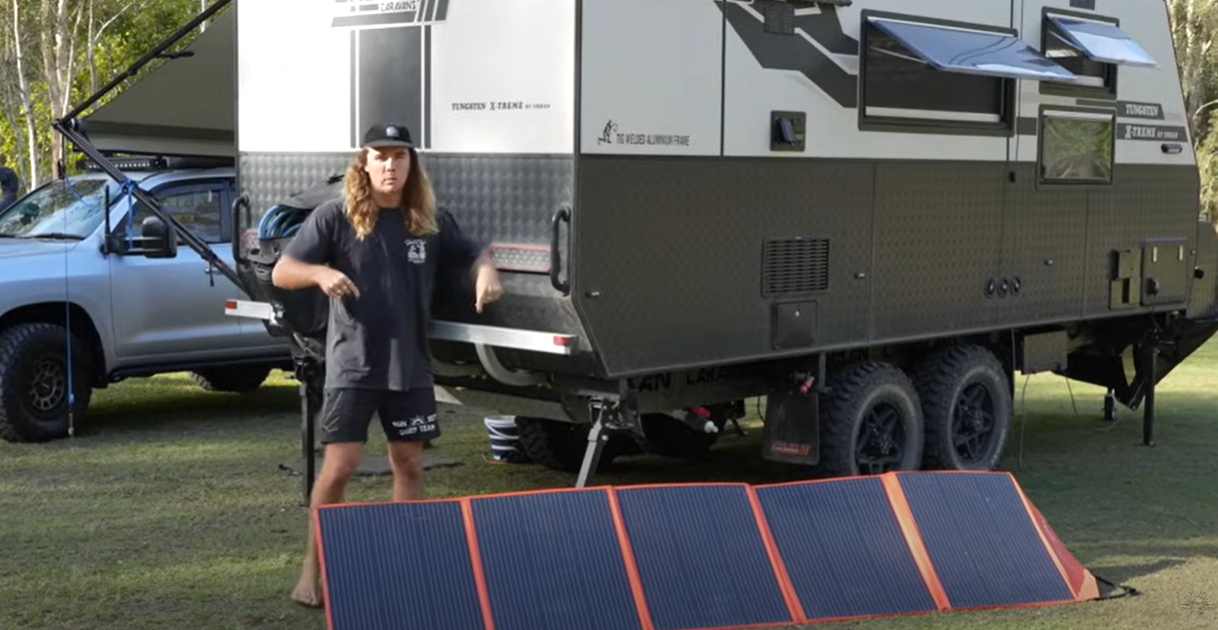
It was here that Keelan encountered the limitations of his roof real estate. His caravan would only accommodate 1050W of solar panels, so he has to supplement rooftop power with a 300-W portable solar blanket.
Lesson five is that the availability of land restricts the capacity of solar generation.
The upper limit is reached quickly by a couple in a caravan. It takes longer if you’re the federal Energy Minster in league with state governments, which draw circles on the map and calls them renewable energy zones. Yet the limitations are no less real and are manifest in the growing community opposition to renewable energy plants and transmission lines.
Lesson five is that renewable energy is restricted by the pile of available capital, which, in Keelan’s case, is smaller than that of the government. Either way, it is money that could be spent on other things and makes nonsense of Bowen’s claim that wind and solar are free.
But what would Keelan know? What can the experts at AEMO learn from a random bloke with a Grade 3 certificate who opens his videos with the friendly greeting “G’day turkeys”?
The mundane information Keelan imparts is valuable to some, but is it knowledge? The expertocracy imagines that knowledge falls in a hierarchical order, with the fruits of their own higher learning somewhere near the top.
Yet as Thomas Sowell unpacks in his recent book, Social Justice Fallacies, the hierarchical theory of knowledge is a self-serving fallacy promoted by the expertocracy to make themselves important.
The critical distinction is between higher knowledge and consequential knowledge, knowledge affecting decisions with meaningful consequences in people’s lives. Good public policy requires both.
When energy policy is set without an engineer in the room, you end up where we are now: at the mercy of experts unable to distinguish between the theoretically possible (green hydrogen, for example) and the technically unfeasible (green hydrogen).
If the Minister can find ten minutes, entering “Sarah and Keelan Travels” and “YouTube” into his search engine, it will give him a taste of the advice he seems not to be receiving.
The Australian
 STOP THESE THINGS
His caravan would only accommodate 1050kW of solar panels,
I doubt his caravan is big enough to accomodate 1050 kW of solar panels …. 1050 W would certainly be more appropriate !
Nick Cater’s error, we’ve fixed it, thanks.
Do you know what is rent-seeking?and DUP?(directly unproductive profit seeking).
It damages public welfare (affordable and reliable electricity)
发送自我的盖乐世