
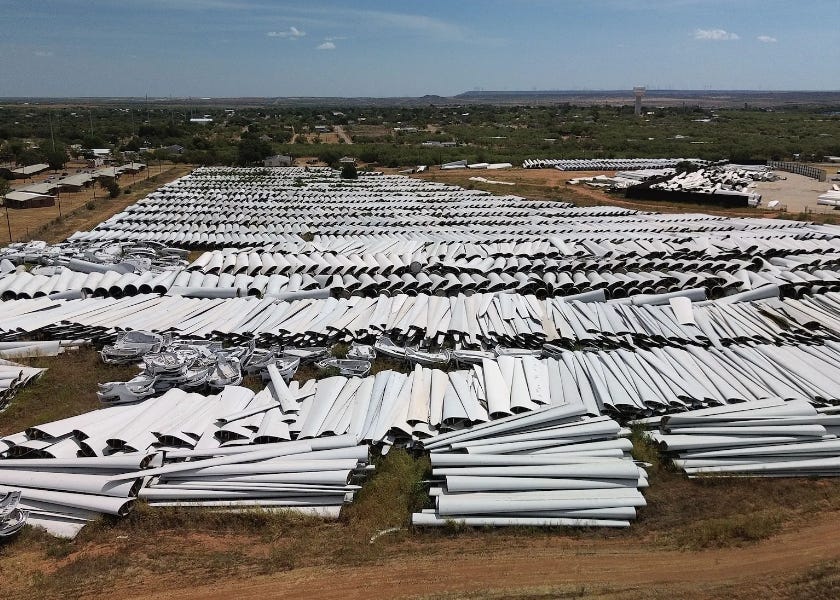
There’s nothing vaguely ‘renewable’ about wind and solar – when panels and turbines give up the ghost after a decade or so, the panels are crushed and dumped in landfills, as are millions of turbine blades. None of which is recycled; none of which is renewable. The panels and turbines are completely replaced and the cycle of decay, destruction and waste begins anew.
Had the wind and sun cult not made wild claims about being clean and green, none of the above would signify. It’s the rank hypocrisy that rankles.
Then there’s the utter pointlessness of energy production ‘systems’ that are impossible to control, in any meaningful way. As impossible to control as the movement of the sun across the sky and the winds across the face of the earth.
In short, if you’re relying on sunshine and breezes for your power needs, don’t expect a have electricity as and when you need it.
What’s true at the macro is evidently true at the micro level. As the team from Jo Nova details below.
$160,000 worth of wind and solar power with batteries can’t power two homes alone
Jo Nova Blog
Jo Nova
27 October 2023
Imagine scaling this up for a country?
The Daily Sceptic has the story of an Australian farmer in Victoria who has gone off-grid to try to be as self-sufficient as he can, not out of ideology, but for pragmatic reasons. He has two 3 bedroom homes, with 30 solar panels and a 1kW wind turbine each. For storage they have about 30 German lead acid batteries which at current prices is about $15,000 worth of batteries each. But even so, each house still has bottled gas stoves, and a 6 kVA petrol generator. The generators are set to come on when the batteries get too low, which often happens in the evenings of autumn, winter and sometimes in spring. (He estimates about 60 – 100 hours each year). Even above all that equipment that needs gas, fuel and maintenance and cost about $160,000 in total to set up, they still have to grow, cut and collect, ouch, 100 kg of wood (220lbs) per week in winter for each house.
He warns that anyone who thinks the nation can run on wind and solar without fossil fuel or nuclear energy is “totally deluded”. And these are farmhouses on the coast in Victoria — so a milder climate — we’re not talking of snow.
The author was a part-time specialist medical practitioner until the government tried to force him into a medical experiment (you know the one) that he didn’t want to take part in. Now he is an anonymous peasant farmer with chicken and sheep. So he’s a bright guy, who had a good income, and the kind of man that can rebuild a 70 year old diesel generator that weighs 1.4 tonnes. How exactly does this kind of system translate into a national energy for people living on high-density blocks with no trees, a heat pump and a Tesla they need to plug in?
Living Off-Grid Has Shown Me That Modern Society Cannot Function on Renewable Energy
Pseudonaja Textilis, Daily Sceptic
Extrapolating from our renewable energy experience, anyone who thinks that a modern society can function with a power grid that runs on just solar and wind power without fossil fuel or nuclear backup that’s able to immediately provide up to 100% of power needs on cloudy, still days and dark, windless nights, is totally deluded!
And getting grid-scale lithium-ion battery storage to provide the sort of supply time that we have on our farm would cost trillions of dollars, deplete the planet’s non-renewable resources to the point of imminent exhaustion and then it would have to be done all over again in 10 years.
Nothing is truly set and forget:
After 20 years the first of our solar panels have started to fail and have been replaced. …
Renewable energy systems should more honestly be called replaceable energy systems. None of the components can be expected to work for more than 25 years and often a much shorter time than that.
Even with nearly 3 tons of lead acid batteries for two homes, they still really only have a one day supply:
In theory we have three to four days of zero input power supply if we were to flatten the batteries, but in practice we don’t let the batteries drop below 70% capacity in order to protect them and make them last as long as possible. So we are limited to about one day of stored capacity.
Both house systems are close to as optimised as we can get them and represent a total investment of around $160,000.
I’m assuming the $160,000 was for both houses together, I hope I’m not reading that wrongly. And of course, here in Australia, the solar panels were almost certainly subsidized, so the true cost is even more.
The Daily Sceptic has all the kVA details... thanks to the anonymous farmer for sharing his story.
Jo Nova Blog

 STOP THESE THINGS
Yes, meanwhile the waste goes straight to landfill