
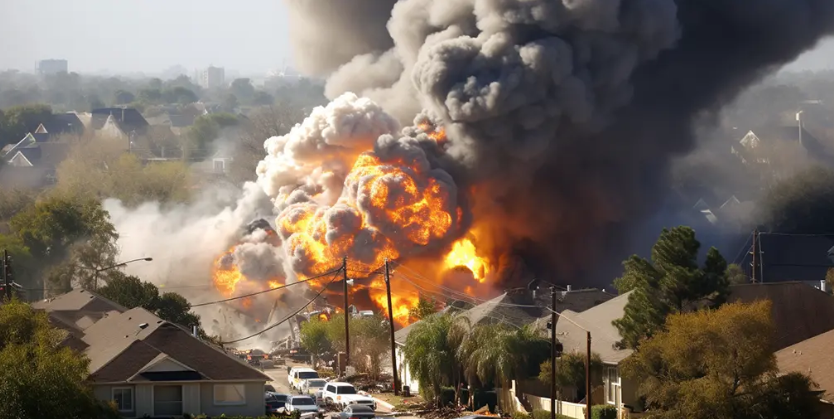
Unable to deal head-on with the hopeless intermittency of wind and solar, acolytes are reduced to waffling about batteries and so-called ‘green’ hydrogen gas as the answer.
Stripped back, the great hydrogen hoax is just another scheme dreamt up by crony capitalists to gouge subsidies from unwitting taxpayers, all the support of their political enablers.
Just like wind and solar, green hydrogen makes absolutely no sense, at any level – as Charles Rotter outlines below.
Ready, Fire, Aim: Explode!
Watts Up With That?
Charles Rotter
15 October 2023
Reader Julius Shanks writes:
Hydrogen Subsidies are Stupid
On Friday, 13 October, the White House triumphantly announced it is awarding $7 billion to seven “hydrogen hubs,” making the following statement:
Collectively, the hubs aim to produce more than three million metric tons of clean hydrogen per year, thereby achieving nearly one third of the 2030 U.S. clean hydrogen production goal. Together, the seven Hydrogen Hubs will eliminate 25 million metric tons of carbon dioxide emissions from end uses each year—an amount roughly equivalent to combined annual emissions of over 5.5 million gasoline-powered cars. The nearly $50 billion investment is one of the largest investments in clean manufacturing and jobs in history.
This is so stupid I have a hard time believing anyone thinks it is a good idea. For these reasons:
- Hydrogen does not exist in free form. It must be manufactured. That requires a LOT of electricity. Where does the electricity come from? Hold onto your seats: fossil fuel plants! No way wind or solar can provide this much juice.
- It is impossible to manufacture as much hydrogen energy as was used to manufacture it. Those pesky laws of thermodynamics. So the hydrogen energy cost will exceed the energy cost that could have otherwise been used directly.
- It is very difficult to store, because the molecules are so small. Hydrogen embrittlement is a problem in materials. And those tiny molecules can find the tiniest flaws in materials containing the. That results in leaks, which leads to reason number 4.
- Safety. “We regret to inform you your wife, children, and car disappeared in a puff of pale blue flame and water vapor.” Alternative: “An entire block was destroyed today as a hydrogen fuel station exploded in a giant pale blue flame and huge water vapor cloud.”
At least electric vehicle charging stations will not explode. Well, I don’t think they will.
Here are excerpts of the announcement.
Investing in American Infrastructure and Manufacturing is a key part of Bidenomics and the President’s Investing in America agenda
Today, President Biden and Energy Secretary Jennifer Granholm are announcing seven regional clean hydrogen hubs that were selected to receive $7 billion in Bipartisan Infrastructure Law funding to accelerate the domestic market for low-cost, clean hydrogen.
Regional Clean Hydrogen Hubs
Today, the President is in Philadelphia to announce seven regional clean hydrogen hubs nationwide.
The hubs selected for negotiation include:
- Mid-Atlantic Hydrogen Hub (Mid-Atlantic Clean Hydrogen Hub (MACH2); Pennsylvania, Delaware, New Jersey) — The Mid-Atlantic Hydrogen Hub will help unlock hydrogen-driven decarbonization in the Mid-Atlantic while repurposing historic oil infrastructure and using existing rights-of-way. It plans to develop renewable hydrogen production facilities from renewable and nuclear electricity using both established and innovative electrolyzer technologies, where it can help reduce costs and drive further technology adoption. As part of its labor and workforce commitments to the community, the Mid-Atlantic Hydrogen Hub plans to negotiate Project Labor Agreements for all projects and provide close to $14 million for regional Workforce Development Boards that will serve as partners for community college training and pre-apprenticeships. This Hydrogen Hub anticipates creating 20,800 direct jobs—14,400 in construction jobs and 6,400 permanent jobs. (Amount: up to $750 million)
- Appalachian Hydrogen Hub (Appalachian Regional Clean Hydrogen Hub (ARCH2); West Virginia, Ohio, Pennsylvania) — The Appalachian Hydrogen Hub will leverage the region’s ample access to low-cost natural gas to produce low-cost clean hydrogen and permanently and safely store the associated carbon emissions. The strategic location of this Hydrogen Hub and the development of hydrogen pipelines, multiple hydrogen fueling stations, and permanent CO2 storage also have the potential to drive down the cost of hydrogen distribution and storage. The Appalachian Hydrogen Hub is anticipated to bring quality job opportunities to workers in coal communities and create more than 21,000 direct jobs—including more than 18,000 in construction and more than 3,000 permanent jobs, helping ensure the Appalachian community benefits from the development and operation of the Hub. (Amount: up to $925 million)
- California Hydrogen Hub (Alliance for Renewable Clean Hydrogen Energy Systems (ARCHES); California) — The California Hydrogen Hub will leverage the Golden State’s leadership in clean energy technology to produce hydrogen exclusively from renewable energy and biomass. It will provide a blueprint for decarbonizing public transportation, heavy duty trucking, and port operations—key emissions drivers in the state and sources of air pollution that are among the hardest to decarbonize. This Hydrogen Hub has committed to requiring Project Labor Agreements for all projects connected to the hub, which will expand opportunities for disadvantaged communities and create an expected 220,000 direct jobs—130,000 in construction jobs and 90,000 permanent jobs. (Amount: up to $1.2 billion)
- Gulf Coast Hydrogen Hub (HyVelocity Hydrogen Hub; Texas) — The Gulf Coast Hydrogen Hub will be centered in the Houston region, the traditional energy capital of the United States. It will help kickstart the clean hydrogen economy with its plans for large-scale hydrogen production through both natural gas with carbon capture and renewables-powered electrolysis, leveraging the Gulf Coast region’s abundant renewable energy and natural gas supply to drive down the cost of hydrogen—a crucial step to achieving market liftoff. This Hydrogen Hub is expected to create approximately 45,000 direct jobs—35,000 in construction jobs and 10,000 permanent jobs. (Amount: up to $1.2 billion)
- Heartland Hydrogen Hub (Minnesota, North Dakota, South Dakota) — The Heartland Hydrogen Hub will leverage the region’s abundant energy resources to help decarbonize the agricultural sector’s production of fertilizer, decrease the regional cost of clean hydrogen, and advance the use of clean hydrogen in electric generation and for cold climate space heating. It also plans to offer unique opportunities of equity ownership to tribal communities through an equity partnership and to local farmers and farmer co-ops through a private sector partnership that will allow local farmers to receive more competitive pricing for clean fertilizer. The Heartland Hydrogen Hub anticipates creating upwards of 3,880 direct jobs–3,067 in construction jobs and 703 permanent jobs. (Amount: up to $925 million)
- Midwest Hydrogen Hub (Midwest Alliance for Clean Hydrogen (MachH2); Illinois, Indiana, Michigan) — Located in a key U.S. industrial and transportation corridor, the Midwest Hydrogen Hub will enable decarbonization through strategic hydrogen uses including steel and glass production, power generation, refining, heavy-duty transportation, and sustainable aviation fuel. This Hydrogen Hub plans to produce hydrogen by leveraging diverse and abundant energy sources, including renewable energy, natural gas, and low-cost nuclear energy. The Midwest Hydrogen Hub anticipates creating 13,600 direct jobs—12,100 in construction jobs and 1,500 permanent jobs. (Amount: up to $1 billion)
- Pacific Northwest Hydrogen Hub (PNW H2; Washington, Oregon, Montana) — The Pacific Northwest Hydrogen Hub plans to leverage the region’s abundant renewable resources to produce clean hydrogen exclusively from renewable sources. It’s anticipated widescale use of electrolyzers will play a key role in driving down electrolyzer costs, making the technology more accessible to other producers, and reducing the cost of hydrogen production. The Pacific Northwest Hydrogen Hub has committed to negotiating Project Labor Agreements for all projects over $1 million and investing in joint labor-management/state-registered apprenticeship programs. This Hydrogen HUb is expected to create more than 10,000 direct jobs—8,050 in construction jobs and 350 permanent jobs. (Amount: up to $1 billion)
Investing in America, Investing in Clean Hydrogen
Up to $1 billion of the remaining funding will be used for demand-side support for the hubs to drive innovative end-uses of clean hydrogen.
The hubs are covered under the Justice40 Initiative, which aims to ensure that 40 percent of the overall benefits of certain federal investments flow to disadvantaged communities that are marginalized by underinvestment and overburdened by pollution. Hubs have also submitted detailed Community Benefits Plans, including how the project performers will transparently communicate, eliminate, mitigate, and minimize risks.
To further support DOE’s Hydrogen Shot to reduce the cost of clean hydrogen by 80% to $1 per one kilogram in one decade, DOE has announced other resources to support clean hydrogen research and development.
I could spend days parsing out the issues with each of these politically selected hubs or the hubris of the DOE simply assuming they can get production costs down by 80%. The idea that they would even consider diverting existing nuclear power, from an increasingly unstable electrical grid, for this science fiction fantasy is borderline criminal.
Even if we assume the problems of embrittlement, storage, and transportation can be resolved, which is extremely unlikely, most of these hubs simply create inefficiencies for the sake of ideology, especially the West Virginia one.
Again, on the unlikely assumption that the problems of embrittlement, transport, and storage can be resolved, there may be a place in an overbuilt grid for energy to be diverted to hydrogen production in a demand response fashion.
This is the fantasy behind this initiative, an overbuilt grid and too much electricity.
California, with its daytime abundance of solar would be the most likely candidate and perhaps Texas or the Midwest with their heavy onshore wind resources.
But these overbuilt grids do not exist and will not exist in a time frame to satisfy the need of this insane command and control pronouncement, so strain on weakening grids will increase.
Blackouts to come, in addition to the massive energy waste of West Virginia energy sources.
Here is the Philadelphia announcement in its entirety.
If someone wishes write a PhD thesis on a proposed command and control economy, I can think of no better example than the U.S. National Clean Hydrogen Strategy and Roadmap
Update (EW): A Californian hydrogen fuelling station exploded July this year. By some miracle nobody was hurt. Hydrogen is far more flammable and explosive than natural gas and gasoline. The small size of hydrogen molecules makes hydrogen the escape artist of dangerous gasses.

 STOP THESE THINGS
Producing hydrogen is highly energy intensive – renewables, without sufficient, unaffordable, unsourceable storage, won’t do it
https://www.facebook.com/story.php?story_fbid=pfbid02oQWZARDEP4VxEtHNRggK5QZfkVDMikpoiyNdXmqw7iWTkHjHiZV9phRBGUvLsSUol&id=100064566738653&sfnsn=wiwspwa&mibextid=6aamW6&dl_redirect=1&paipv=0&eav=AfZp7SR8_gt9lWwP1y-n5wIvczc-oLow6itQ21p0pON_LcIPP7u4fkKXfewQ08Nn_2k&_rdr
<
div>
mk
<
div dir=”ltr”>
<
blockquote type=”cite”>
The nightmare just gets worse.
As somebody recently wrote on this blog or another I frequent…
…”if this renewable energy gets any cheaper I won’t be able to afford to feed myself”