

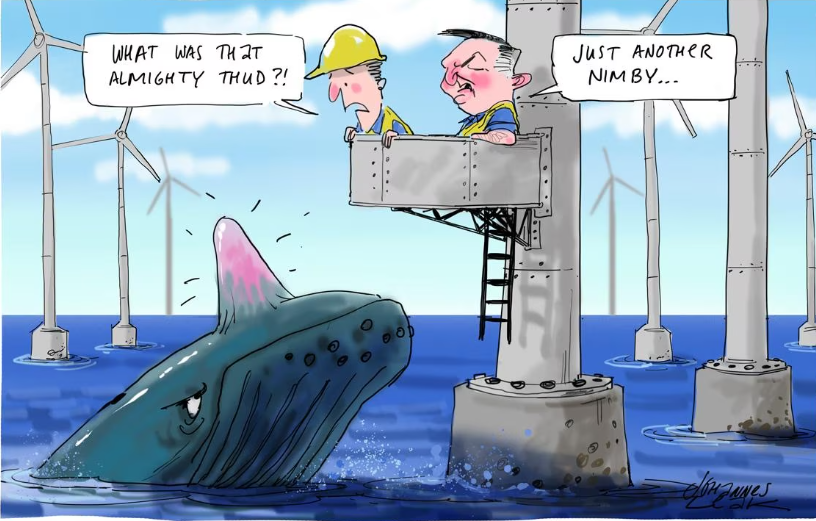
Thanks to the offshore wind industry, it’s never been easier to get up close and personal with rare and endangered whales. Never before has the general public been able to walk along the shoreline and find their favourite beach routinely littered with a steady stream of cetacean carcasses. Call it ‘eco-tourism’, with a twist.
Some might cringe at the carnage, but the wind industry hasn’t a care in the world – long before they began spearing these things into the ocean, they sought and were granted government-backed licenses to (quite lawfully) kill an unlimited number of whales, porpoises and dolphins – aka the ‘Incidental Harassment Authorization’.
Under the witless Chris Bowen, Australia’s wind and solar obsessed Federal government is hell-bent on plugging thousands of these monstrosities off Australia’s coasts, notwithstanding the wholesale whale slaughter playing out along America’s Atlantic coast.
With that in mind, it’s timely to tap into the work of Michael Shellenberger, who has recently produced a half-hour documentary, Thrown To The Wind – that exposes the corrupt relationship between government and the wind industry – desperately designed to cover up the true cause of one the greatest environmental scandals, of all time.
We’ll start first with Shellenberger’s interview on Sky News, and leave you with the video of Thrown To The Wind.
Government offshore renewable projects at risk of killing marine life
Sky News
Outsiders
24 September 2023
Environmental policy expert Michael Shellenberger says offshore renewable projects are “very environmentally degrading technology” that is affecting marine life.
“Windmills are very old, these are hundreds of years old technologies; the wind itself has low energy density meaning you have to spread wind turbines over huge areas, that; ‘s why they keep building them so big,” Mr Shellenberger told Sky News host Rowan Dean.
“The preparation, the mapping of the ocean floor with sonar is so loud it’s actually in violation of the regulations by the US government the separations the mothers from their calf’s, it sent the whales into boat traffic.
“These impacts can be seen around the world; the east coast is very sensitive because it’s actually a very shallow waters on the offshore.
“I think you can expect to see very significant impacts in Australia and everywhere in the world, I think people don’t realise that the oceans are full of life and I think we sometimes miss the fact that it’s a really biodiverse important part of our planetary ecosystem.”
Transcript
Rohan Dean: The Albanese government’s green dream is in strife. Things are not going to plan. Residents near the proposed five gigawatt Hunter offshore wind farm zone are furious. Not only is it outrageously expensive, but it will kill our whales. Our next guest has delved deeply into this sad phenomenon in his documentary, Thrown to the Wind. Take a look.
Thrown to the wind:
“I saw another whale had washed up and it’s becoming a pattern.”
“It sounds like someone pile driving!”
“What the United States is looking at is thousands of wind turbines in an area that our whales, our dolphins, our marine life…”
“So those red dots are whale deaths?”
“Precisely.”
“What a scandal.”
Rohan Dean: Joining us now is the producer of that video, a great friend of Outsiders, Michael Shellenberger, author, journalist, and founder of the group, Environmental Progress. Michael, it’s always great to see you. Thanks for coming on Outsiders. The documentary about killing whales, it has landed at the right point in time here in Australia. We are embarking on a massive offshore wind program across some of our most beautiful Australian ocean sides. What do you make of it?
Michael Shellenberger: Well, it’s good to be with you, Rohan. And yeah, I mean, it’s a very environmentally degrading technology because you have to remember, windmills are very old. These are hundreds of years old technologies. The wind itself has low energy density, meaning you have to spread wind turbines over huge areas. That’s why they keep building them so big, as tall as the Eiffel Tower. What we have documented is just simply the preparation, the mapping of the ocean floor with sonar is so loud. It’s actually in violation of the regulations by the US government that separates the mothers from their calves. It sends the whales into boat traffic and also the wind industry is expanding boat traffic into areas where there wasn’t traffic. That’s what’s behind the deaths of these whales off the East Coast of the United States. Also, dolphins, all cetaceans. And these impacts can be seen around the world.
The East Coast is very sensitive because it’s actually very shallow waters on the offshore and there’s only 340 of these magnificent whales left. It’s the North Atlantic right whales. But I think you can expect to see very significant impacts in Australia and everywhere in the world. I think people don’t realise that the oceans are full of life, and I think we sometimes miss the fact that it’s a really biodiverse important part of our planetary ecosystem, and I think there’s also just a lot of mythology. I think people think that because it’s wind, it’s somehow more natural or better for the environment, but what the science shows is something very different. Massive ecological impacts from industrial wind turbines. And as I pointed out last week, we’re now seeing the impacts of wind turbines on pumas in Brazil, critically endangered, but also on eagles, other raptor species, including raptors in Australia, and bat species. These are huge, loud degrading devices, and so I would just say you really have to make sure because we’ve discovered that the government hasn’t done the research that it claimed it was doing in order to monitor and protect the whales.
Rohan Dean: James.
James Morrow: And Michael, you go further than that, and this is a great concern in Australia because we also have right whales that migrate up and down the East Coast every year. You can watch them from the cliffs at Bondi. You can see them go up the coast. You say that the government knew about these effects and has covered this up. Tell us about that and what does that tell us that we should be watching out for when the government here in Australia says, “This is clean, this is green, this has no impact. This is what we need. If we’re going to march on to net zero, whales be damned.”
Michael Shellenberger: Well, I think the first thing you have to remember is that environmental conservation organisations have been pointing out the impacts of sonar on whales for many decades. This is a very well-studied phenomenon. Two years ago, the big conservation organisations wrote an open letter warning of this particular project on this whale species. Last year, a top government scientists wrote a very unusual letter warning of extinction on the species. We have now sent multiple letters to the government pointing out that the applications for the permits to engage in this industrial activity themselves show that they’re in violation of the law. So it’s big money, huge taxpayer subsidies. Somewhere on the order of one third to two thirds of the cost of wind energy is subsidised by rate payers. The industry then funnels that money to the politicians who then put pressure on the regulators to not enforce these environmental laws.
They have this cover, this story that says that this is good for the environment. It’s bad for the environment. This is greenwashing like I’ve never seen before. I’ve said it before, I’ll say it again. This is the biggest environmental scandal I’ve ever seen or been involved with, and I’ve been involved in environmental causes for over 30 years. This is a critically endangered species that could go extinct because of this project, but I think that people in Australia also need to look closely at the documents. People can be in touch with me, by the way. We’ve now gotten pretty good at the science and also at helping to work with the independent scientists, so many of whom have been sold out and the conservation groups have sold out.
We also documented industry funding for news organisations, aquarium, Woods Hole. I mean, it’s shocking how much money is being spent basically to repress the best available science showing the imminent threat to these magnificent animals, spiritual animals, I should say. There’s a reason we care about whales, the songs, the love of the mothers for their calves, the ways in which they’re a communal species. All of the reasons that we’ve loved and protected whales for decades stand today. It’s more desperate than ever, particularly for the right whales.
Rohan Dean: And Michael, I’ll just point out to viewers, you were of course Time Magazine’s, Young Environmentalist of the Year several years ago, so you know exactly what you’re talking about when you talk about caring for the environment. Liz.
Liz Storer: Well, I was going to ask Michael, how you account for the fact that the government is blindly forging ahead despite all the research done by yourselves and others in this space, and how do you account for that? You’ve kind of already answered that by saying follow the money. Do you ascribe to the idea that that’s really all there is behind the veil of this green dream zero emissions. And what do you make, would you agree with Dr. Jordan Peterson’s assessment that this is an extremely anti-human species agenda that we’re seeing rollout?
Michael Shellenberger: Yeah, absolutely. I think the thing you have to remember is that the reason that wind energy is so expensive is the same reason it’s so bad for the environment, which is that it’s just really inefficient. Wind is very energy dilute. You have to spread the collection of energy over huge amounts of areas. You have to build these machines to be very tall, to have huge environmental impacts. At bottom, it is a kind of mania like a religion, climatism, which says that climate change is the only environmental problem. It is an environmental problem. It’s not the biggest environmental problem and what is more tragic than actually killing an entire species of whale out of, because people are in the grip of this religion. We have shut down more nuclear energy on the East Coast of the United States, closed more nuclear plants that produced more energy than all of the wind turbines will produce if they got them up and running.
So the big hope here is that the finances of these projects are absolutely awful. Even with one to two third subsidy, the wind industry is asking for more money for rate payers. So we’re at just high corruption at this point. I mean, it’s just a money grab by greedy politicians, by frankly greedy journalists, scientists, conservation groups. Many of them have really sold out. It’s been a small group of us that are independent scientists, researchers, advocates, and others that have been fighting this. But I think that Australians also have a really important role to play here. The projects that proposing Australia would be absolutely devastating. We’re here to be in solidarity. If folks in Australia want to reach out, michaelshellenberger@gmail.com, happy to give our assistance because this industry is an absolute nightmare for marine life, marine mammals, and for whales in particular. There’s a reason we care so much about these particular animals.
Rohan Dean: Michael Shellenberger, well said, you will be inundated. I’ll repeat that, michaelshellenberger@gmail.com. We know what a great job Michael has done on so many fronts. We’ll talk to you again soon in a couple of months because the nuclear debate is heating up here. Michael, you were out here in Australia talking to Australians about the need for nuclear to get to net zero. The liberal party is finally… looks like adopting that as their major policy going to the next election. So we’ll be chatting a lot more about that, but that’s yet another example, Michael, of the great work you have done for us here in Australia. Get ready for those emails on the whales. Thanks, Michael.
Sky News
Here’s Michael’s documentary on the offshore wind industry’s utterly pointless and unnecessary marine mammal slaughter.
Thrown to the Wind
YouTube
Public News Video
14 September 2023
 STOP THESE THINGS