
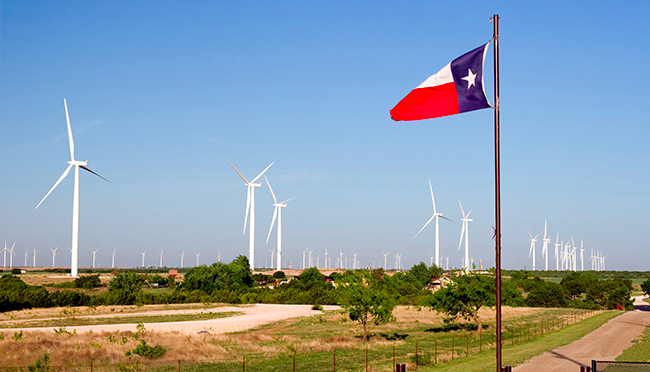
Texas is littered with solar panels and wind turbines, but don’t expect them to deliver power as and when you need it. As happens most years, wind turbines across Texas have been on their annual summer vacation, for weeks now.
In their absence, solar is able to pitch in for a while, but sunset has this remarkable and dramatic effect on output. Which means that, by the time householders turn on their air conditioners and settle down for an ice cold beer in the evening, almost all of their electricity needs are being covered by gas, coal and nuclear, in that order.
Yet again, a calm and balmy Texan summer has shown the part-time power producers to be utterly meaningless, as Ed Ireland explains below.
The Texas Dunkelflaute
Thoughts About Energy and Economics
Ed Ireland
9 September 2023
The hot Texas wind has been dropping off in the summer afternoons of 2023, sending Texas wind turbines on summer vacation. Solar power has faired pretty well on most days, but when the sun sets every evening, solar power goes to zero. The German word for weather conditions that result in no wind or solar generation is “Dunkelflaute.” The Texas version of Dunkelflaute has occurred many evenings this summer, with some pushing the Texas grid to near collapse.
The operator of the Texas electricity grid, ERCOT, declared an Emergency Level 2 on September 6, 2023, because reserve generation capacity had dropped to less than 1,750 megawatts. The emergency notice said: “ERCOT expects tight grid conditions, requests conservation today from 5 PM to 9 PM CT.” It goes on to explain the reasons underlying the emergency:
- Heat. Continued statewide high temperatures.
- Demand. Texas is seeing high demand due to the heat.
- Solar. Solar generation starts to decline earlier in the afternoon hours towards the end of summer before completely going offline at sunset.
- Wind. Wind generation is forecasted to be low this afternoon and into the evening hours during peak demand time.
In a nutshell, ERCOT said it is hot this summer, the wind is falling off, and Texans are using a lot of air conditioning just as the sun sets. Nothing new to native and long-time Texans.
Unfortunately, typical summers in Texas now also mean that the tens of thousands of acres of wind turbines and solar panels are going offline early as the days get shorter in late summer, and the wind stops blowing during the hot summer afternoons. This starts as people are getting home and cranking down the air conditioning, starting at about 4 PM and lasting until about 8 PM, which is half an hour after sunset, and solar generation is zero.
Another factor is that the fleet of natural gas-fired generators that always fill the gaps in electrical power when the wind stops and the sun sets has been running all out for months and foregoing regular maintenance. Eventually, maintenance became necessary, and in the case of this emergency declaration, an estimated 10 MW of natural gas generation was offline for maintenance.
When the wind died down, and the sun was setting on September 6, 2023, natural gas came to the rescue, providing two-thirds of the power on the grid (thanks to David Blackmon for this screenshot taken shortly after ERCOT issued the emergency order):
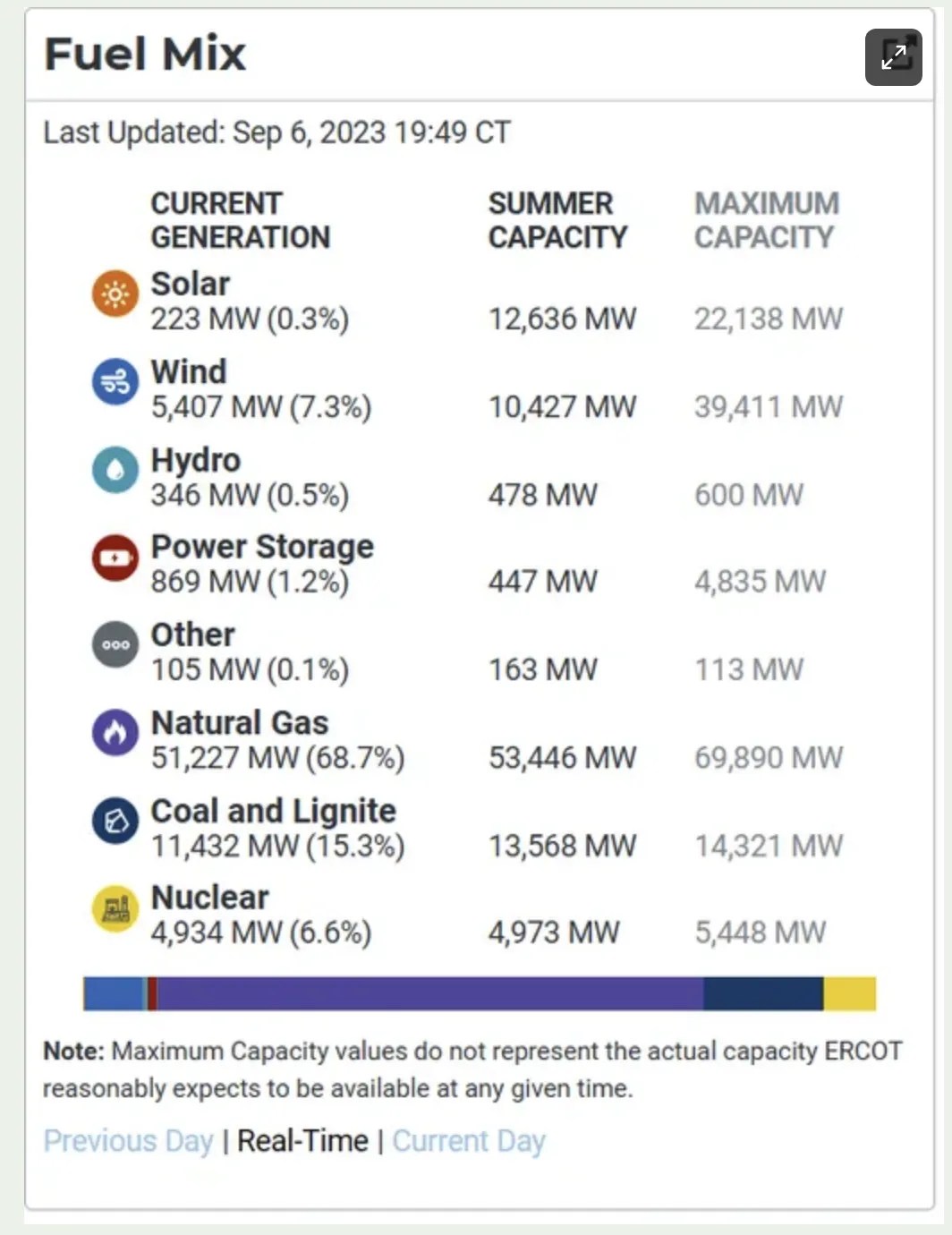
Natural gas generation combined with coal and nuclear provided a whopping 90.6% of total generation on the Texas grid. Without those three dependable workhorses, rolling blackouts would have ensued. Statements that wind power and batteries saved the day are not factual.
The Texas version of a full Dunkelflaute, when the wind isn’t blowing and the sun isn’t shining, is coming next month when a solar eclipse will likely shut down solar power during the day. The 2023 Annual Eclipse on October 14, 2023, will cross North, Central, and South America. Its path will go directly over the prime solar generation country in West Texas, blocking 90% of the sun, according to NASA:
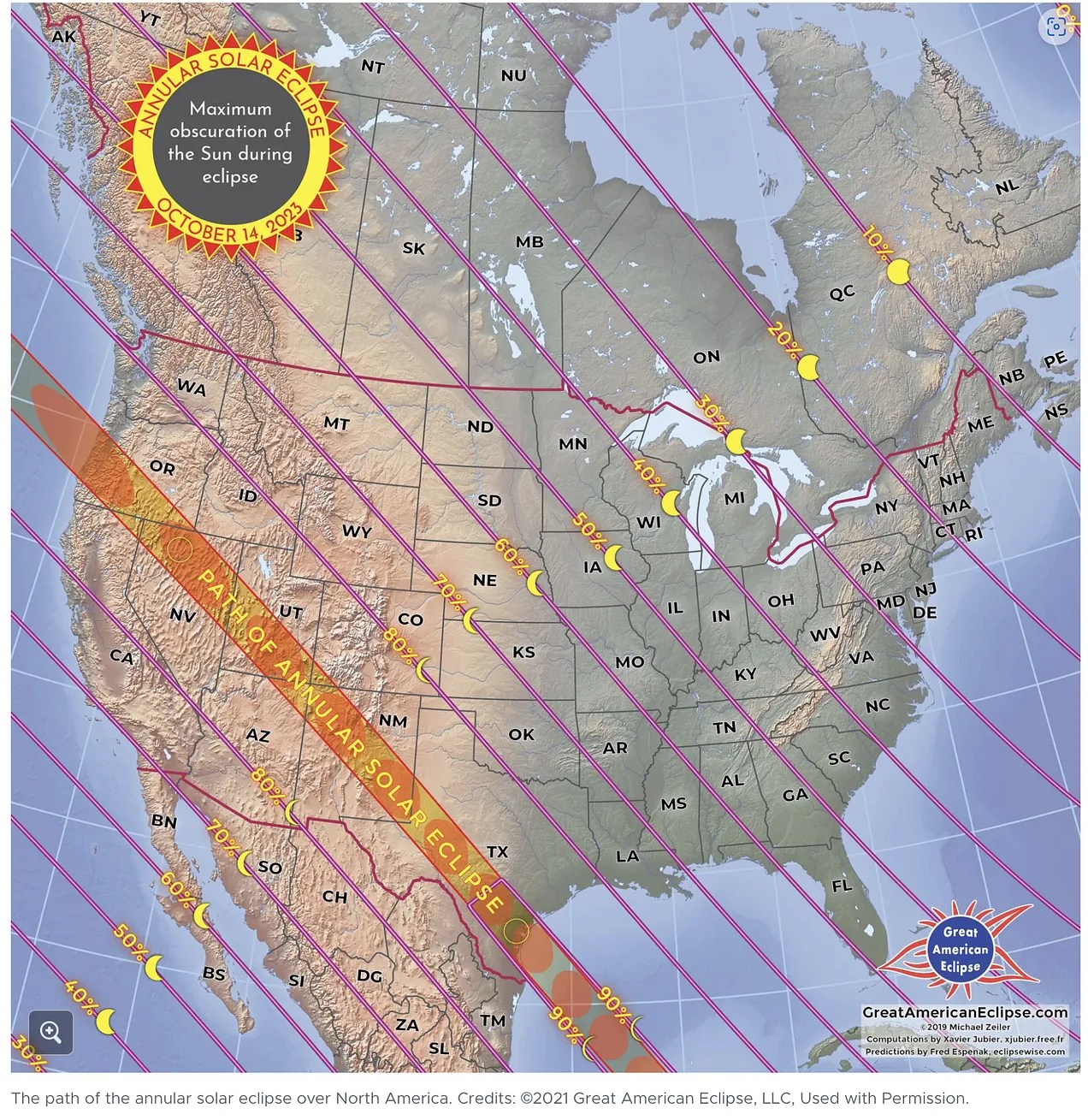
According to NASA, the solar eclipse begins in Oregon at 9:13 AM and ends in Texas at 12:03 CDT so Texas solar power generation will be reduced most of that morning. Of course, a solar eclipse does not occur often, but it will highlight the problems solar power generation faces when cloudy weather reduces solar output.
While rolling blackouts were avoided on September 6, the intermittency of wind and solar highlighted that they depend on the weather. My friend, Robert Bryce, expressed his thoughts to me on this subject:
If we are facing more extreme weather due to climate change, it would be insane to make our most-critical infrastructure dependent on the weather. We need energy and power systems that are weather resilient, not weather dependent.
Truer words were never spoken.
While Texas has the largest installed capacity of intermittent wind and solar power of any state in the U.S., the underlying strength of the Texas power market is that it is deregulated, dating back to 2002 when the Texas legislature fully implemented deregulation, giving consumers the “power to choose” their electricity provider. The basic premise of the ERCOT system was that market-determined prices would encourage power generators to provide the electricity demanded by consumers at the lowest possible price.
That system worked well until heavily subsidized wind and solar generation emerged in the early 2000s. The problem that has now been exposed is that the subsidies for wind and solar result in artificially low prices. As a result, wind and solar operators can sell their electricity at zero or even below zero. That means wind and solar are always first in the queue because they are the low bidders but can drop off at any time due to the weather, as happened on September 6, 2023.
Natural gas generators are expected to provide backup power when wind and solar are unavailable and are occasionally rewarded with peak prices of up to the cap of $5,000 per megawatt, but that occurs only occasionally and briefly. Most of the time, natural gas generators have to take a price below what is needed to maintain existing generation and encourage the development of new power generation. This has resulted in a declining fleet of natural gas-fired electricity generators in Texas.
Add to this the uncertainties of pending federal legislation, such as the EPA “New Source Performance Standards,” which threaten to shut down natural gas generation by 2040. That EPA rule would be devastating to the reliability of U.S. power grids, which was highlighted by pleas from 21 states and all power grids to halt that rule.
The State of Texas wrestled with this problem in the legislative session that ended on May 31, 2023. The state passed legislation to help provide up to 10 gigawatts of new dispatchable thermal generating capacity, most likely powered by natural gas. While that will help avoid rolling blackouts, it will not stop the ongoing problem of near-failures in the Texas power grid caused by intermittent and weather-dependent wind and solar generation.
These situations can be avoided if ERCOT develops new innovative approaches to encourage sufficient natural gas-fired power generation, both base load and peaking. The system that ERCOT proposed in the last legislative session, the “performance credit mechanism,” was rejected by the Texas legislature, but other innovative ideas must be pursued in order to stabilize the Texas grid.
Thoughts About Energy and Economics
 STOP THESE THINGS
The EPA threatens to do more damage to the US than the axis forces achieved in WW2, at least they never looked like taking out the power supply!
The Texas experience in 2021 should have focussed their minds. A pattern is emerging inthe experience of the RE-leaders around the world – Britain, Germany, South Australia, and Texas, because RE can displace coal and gas but not replace them.
https://www.flickerpower.com/index.php/search/categories/renewables/21-7-intermittent-solar-and-wind-power-can-displace-coal-but-cannot-replace-it
The conventional power supplies can run down for years without a lot of drama until there is a tipping point where the downward-sloping supply line starts to hit the more or less horizontal demand line (with well-known daily and seasonal cycles.) That is going to happen eventually in all the states and nations that are committed to net zero.
https://newcatallaxy.blog/2023/07/11/approaching-the-tipping-point/
The signs are not looking good for the green energy transition, it is not really happening worldwide and it remains to be seen how quickly we can pull out of the death spiral and how much more damage will be done to the western economies and the planet before the RE ponzi scheme collapses.