
Germans have worked out that relying on the weather for your power has one major problem: “The Weather”. They’ve even coined a term for gloomy, windless weather – ‘dunkelflaute’ – periods of days or weeks when their more than 30,000 wind turbines and millions of solar panels produce next to nothing or nothing at all.
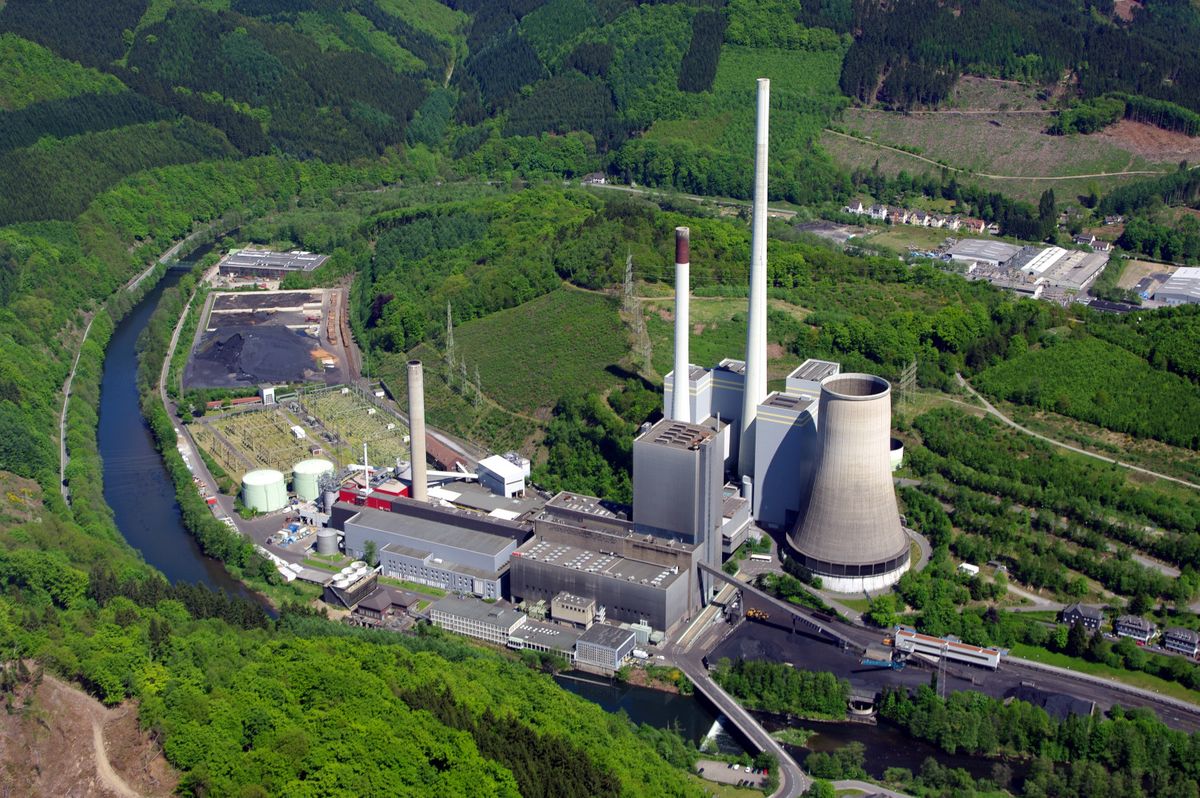
Having foolishly trashed their (once enviable) nuclear power generation capacity, the Germans have been forced to re-embrace coal-fired power, like their lives depend upon it – notwithstanding howls of outrage from their lunatic green fringe.
German power prices are the highest in Europe and large-scale power rationing is now routine.
The result for the German economy is, of course, catastrophic, as Claire Lehmann outline below.
Why Germany’s energy blunders offer us a stark economic warning
The Australian
Claire Lehmann
21 July 2023
Since the 19th century, the phrase “Made in Germany” has denoted quality and reliability in manufacturing. This reputation, and the exports that have flowed from it, has enabled Germany to build the fourth-largest economy in the world – sometimes described as the enginehouse of the eurozone.
But in recent years some of Germany’s most famous brands have moved their manufacturing offshore, and the head of the German Industry Federation, Siegfried Russwurm, has warned that energy prices are so high the country risks losing many of its companies altogether.
Entering a recession in the first quarter of this year, Germany’s recovery has been slower than expected. The Federation of German Business recently found that 16 per cent of businesses surveyed are already in the process of leaving the country, with another 30 per cent planning on following suit. Tesla has halted plans to build factories near Berlin, and the European Commission predicts Germany will be one of the slowest-growing economies this year.
Of course, the factors contributing to this economic decline are complex, but one key policy decision made in the mid-2000s appears to have played a pivotal role. With the benefit of hindsight, we can now see that during her tenure as chancellor, Angela Merkel embarked upon a decision that would prove to be one of the greatest policy mistakes ever made.
A decade ago, Germany had 17 nuclear plants in operation and sourced around one-quarter of its energy from nuclear energy. Although the nation has always had a vocal “dark green” environmentalist movement that advocated for “degrowth”, Merkel originally resisted calls from anti-nuclear advocates, describing their policy preferences as “absolutely wrong”.
But that all changed in 2011, in the wake of Fukushima. The New York Times reported at the time that Merkel “reached the momentous decision to phase out nuclear power by 2022 after discussing it one night over red wine with her husband, Joachim Sauer, a physicist and university professor, at their apartment in central Berlin”. It would prove to be a monumental mistake.
Earlier this year Germany shuttered the last three of its remaining nuclear plants, to the celebration of local Greens and anti-nuclear activists. However, environmentalists outside Germany were aghast. And even Greta Thunberg observed it was a mistake. Data from 2022 indicated that the use of coal had increased by 8.4 per cent on the preceding year, and that coal remained Germany’s dominant power source.
Despite the hundreds of billions spent on renewables (that’s billions not millions), Germany’s carbon emissions persist at double the rate of neighbouring France and nearly triple the rate of Sweden. The country also grapples with electricity prices three times the global average.
As Judith Sloan wrote earlier this week, the disappointing situation in Europe provides a stark warning to Australia.
While in Germany recently, Anthony Albanese signed on to the “Climate Club”, a group of nations with lofty decarbonisation ambitions. But Germany should not be offering lessons on how to achieve decarbonisation – on the contrary, its example should be seen as a cautionary tale.
One economic analysis of Germany’s nuclear phase-out estimates that the nuclear phase-out has cost the country at least $12bn, and has contributed to thousands of preventable deaths from the air pollution generated from the burning of coal. Germany’s spot on the Yale Environmental Performance Index has slid backwards, and analysts note its electricity grid is the third-most carbon-intensive in all of Europe.
Since embarking on the Energiewende, Germany has experienced escalating electricity costs tied to feed-in tariffs and instability during periods of low wind and solar energy generation. Integrating fluctuating renewable energy sources into the power grid has plunged it into uncertainty, creating a volatile mix of surplus and shortfall.
On the other hand, nations boasting the lowest carbon emissions in Europe have not staked their fortunes on wind and solar power alone. Sweden, for instance, charted a course toward nuclear energy in the 1970s, and now emits a mere 3.42 tonnes of carbon per capita compared to Germany’s 8.09 tonnes. Over the past two decades, Sweden’s economy has thrived, boasting a growth rate twice that of Germany’s.
Given the energy intensity of an industry such as manufacturing, it is not entirely surprising that energy policy blunders have precipitated the German economic malaise.
While Australia does not rely on manufacturing like Germany does, we do share a significant parallel – a lack of economic complexity. Our nation’s backbone lies in mines and farms, akin to the centrality of factories to Germany’s economy. And like manufacturing, both mining and agriculture rely on cheap and abundant energy to thrive.
Australia only ranks 25th in the world in the Global Innovation Index, with output in scientific and technical articles identified as one of our core weaknesses. Other weaknesses identified by the index include a lack of hi-tech manufacturing, lack of export complexity and a lack of intellectual property receipts. The industries that provide a buffer against rising energy costs simply do not yet exist.
Rather than transforming the country into a renewable energy superpower, Germany’s Energiewende has created a rust belt. And rather than learn from Germany’s mistakes, Australia appears intent on replicating them.
The Australian
 STOP THESE THINGS
At your entrance: “the Germans have been forced to re-embrace coal-fired power, like their lives depend upon it” – maybe, the live of the politicians. So close to the next elections, the politicians in the current government don’t want to draw attention to themselves with blackouts. The only one real opposition party AfD, is condemned and fought with unlawful means by the “old and united parties” and the left-green media. Despite, the percentage of approval for the alternative’s is constantly growing.
Thank you for your article, I translated it for https://eike-klima-energie.eu/
Australia will always be a follower of those with the most ridiculous ideas until it starts to think for itself and act for its people as a whole.
It’s Politian’s need to grow up and start working/listening to those with alternative ideas which do not depend on starting from scratch – those who come along with silly ‘feel good’ ideas which when considered rationally are nothing more than that a ‘feel good’ idea which will leave the majority of the people worse off and having to live a life full of uncertainty, financial stress and disappointment.
We need politicians and a Government who have a broader vision for the nation and its people – a Government which listens to the science and not just that science promoted by vested interests, but true science.
We need a Government which promotes the people and its needs above the self-righteous puppets of wacko industrialists.
The sooner they come to accept our energy needs are more complex than the occasional power supply we now have, which depends on the weather (rain, wind, sun) all things which we cannot control and encompass the need for security and cheapness of energy supply the sooner we can move forward and achieve our supreme ability to have a cohesive population which enjoys ‘the good life’, much as it was in the past before politicians became more interested in their personal media and camera persona than what is happening to the Nation and its people.
We can stand on our own ‘two feet’, we can be a wealthy cohesive ‘machine’ of a nation we just need Politicians who understand it.
Angela Merkel was the worst thing to happen to Germany since Hitler.
Open borders (ala Sleepy Joe Biden) and the destruction of their energy grid.
Germany is a mess in more ways than one.
Merkel was a clown and many of the world leaders are trying to outdo her.
Madness.
These people are insane, when was the last time North Germany suffered from a tsunami?
Meanwhile, “Coal Ash Is More Radioactive Than Nuclear Waste”
https://www.scientificamerican.com/article/coal-ash-is-more-radioactive-than-nuclear-waste/
Reblogged this on whatyareckon and commented:
The Creator may be trusted when He said in Genesis 8:22 While the earth remaineth, seedtime and harvest, and cold and heat, and summer and winter, and day and night shall not cease.